Optima 70 - 2 17
NOTE:
• Galvanized pipe is desirable above the roof-
line due to its higher corrosion resistance.
Continue to add pipe sections throughout the
flashing until the height of the vent cap meets
the minimum height requirements specified in
Fig. 5. or local codes.
• For steep roof pitches, the vertical height
must be increased. A poor draft, or down
drafting can result in high wind conditions,
trees or neighbor's roof lines. In these cases
increasing the height may solve a drafting
problem. REMEMBER to check that you are
within the maximum vertical height restric-
tions, and are placing the appropriate vent
restrictors as outlined in the venting chart
within this manual.
• Any storage spaces or closets which the vent
must pass through must be enclosed.
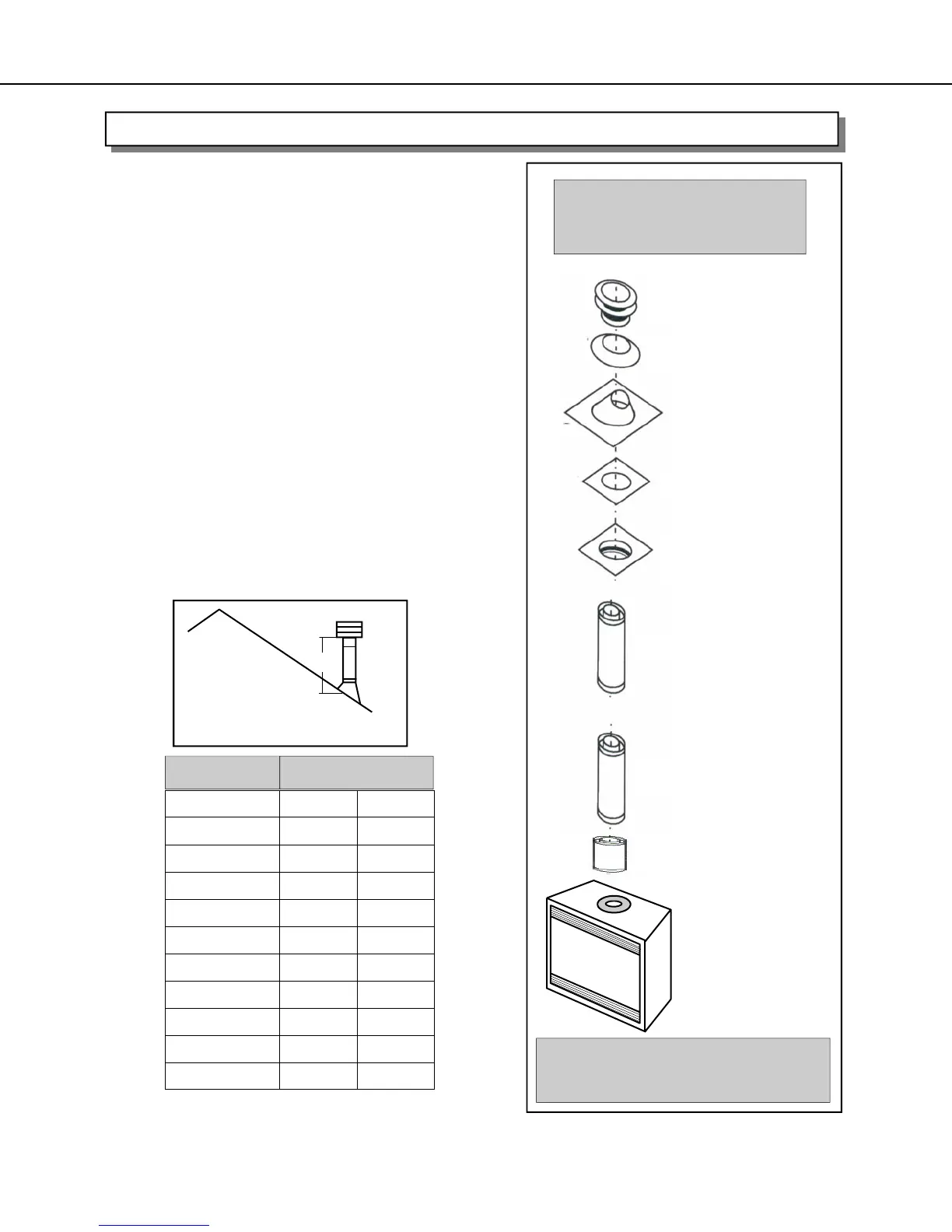
Flat to 7/12 2 Feet 0.61 Meters
Over 7/12-8/12 2 Feet 0.61 Meters
Over 8/12-9/12 2 feet 0.61 Meters
Over 9/12-10/12 2.5 Feet 0.76 Meters
Over 10/12-11/12 3.25 Feet 1.00 Meters
Over 11/12-12/12 4 Feet 1.22 Meters
Over 12/12-14/12 5 Feet 1.52 Meters
Over 14/12-16/12 6 Feet 1.83 Meters
Over 16/12-18/12 7 Feet 2.13 Meters
Over 18/12-20/12 7.5 Feet 2.29 Meters
Over 20/12-21/12 8 Feet 2.44 Meters
Roof Pitch
Minimum Vent Height
Vertical Termination
Cap
Storm Collar
Flashing
Ceiling Firestop
Round Support
Box/wall Thimble
Length of Pipe
Length of Pipe
SDA-3 adaptor
VENTING - VERTICAL TERMINATION USING SIMPSON DURA-VENT PIPE ONLY
Simpson Dura-Vent venting
components are listed on page 22
Typical Vertical venting
configuration using Simpson
Dura-Vent Direct Vent System
Fig. 5
H-represents vent
height
H


 To Next Page