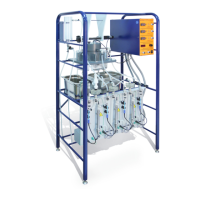
As water is heated, the vapour pressure in the space above the liquid increases and (in
a sealed system) this prevents boiling. This pressure can be observed on the gauge
(15) at the rear of the unit. If the pressure in the system exceeds the maximum
operating pressure of 6.0 bar the power to the heating element is cut off automatically
by pressure switch (16). (The circulating pump will continue to run.) Again, a
warning lamp on the console is illuminated.
If, for any reason, the pressure switch fails and the system pressure continues to rise,
the pressure safety valve (17) provides a mechanical means of relieving the excess
pressure.
The temperature of the water is measured using a Type K thermocouple sensor in the
pipework.
A by-pass (18) has been incorporated in the event that a lower flow rate of water will
be required to heat the product, ie. if full flow is too harsh for the product, the by-pass
can be adjusted. It may also prove necessary to open the by-pass valve if the pressure
drop across the heat exchanger is too great for the circulator pump. This would
normally only happen if a non-standard heat exchanger was fitted, but could be
necessary if, for instance, the plates of the plate heat exchanger were closer together
than normal because of over-tightening.
COOLING WATER SYSTEM
Also within the main compartment of the cabinet is the cooling water flow rate
control and flow meter. Opening the flow valve (20) allows the cooling water to flow
through the cooling section of the heat exchanger, the flow rate being indicated by the
flow meter. Normally the unit should be operated with the cold water control valve
fully open, to allow maximum cooling.
The cold water inlet and outlet are on the side of the cabinet.
When using the optional chilled water circulator (FT61), the cold water inlet is
normally passed through two of the submerged coils in the ice-bank before entering
the flow meter. In this configuration the flow of cold water should be regulated by the
flowmeter valve provide a lower flow rate whilst still providing adequate cooling. In
this way the built up ice bank will last for a longer period of time before melting.
17



 To Next Page