31
cleaners have chemicals in them that will affect the Lexan
body.
The best way to clean your car body is with warm water
and a mild dish soap. Any other products will dry out the
Lexan and make it easier for the body to crack.
Associated has recently released our new #711
Reedy Car Wash, which cleans both your car and Lexan
body. It is biodegradable and Lexan safe but cannot be used
to clean motors or electronics.
TUNING TIPS
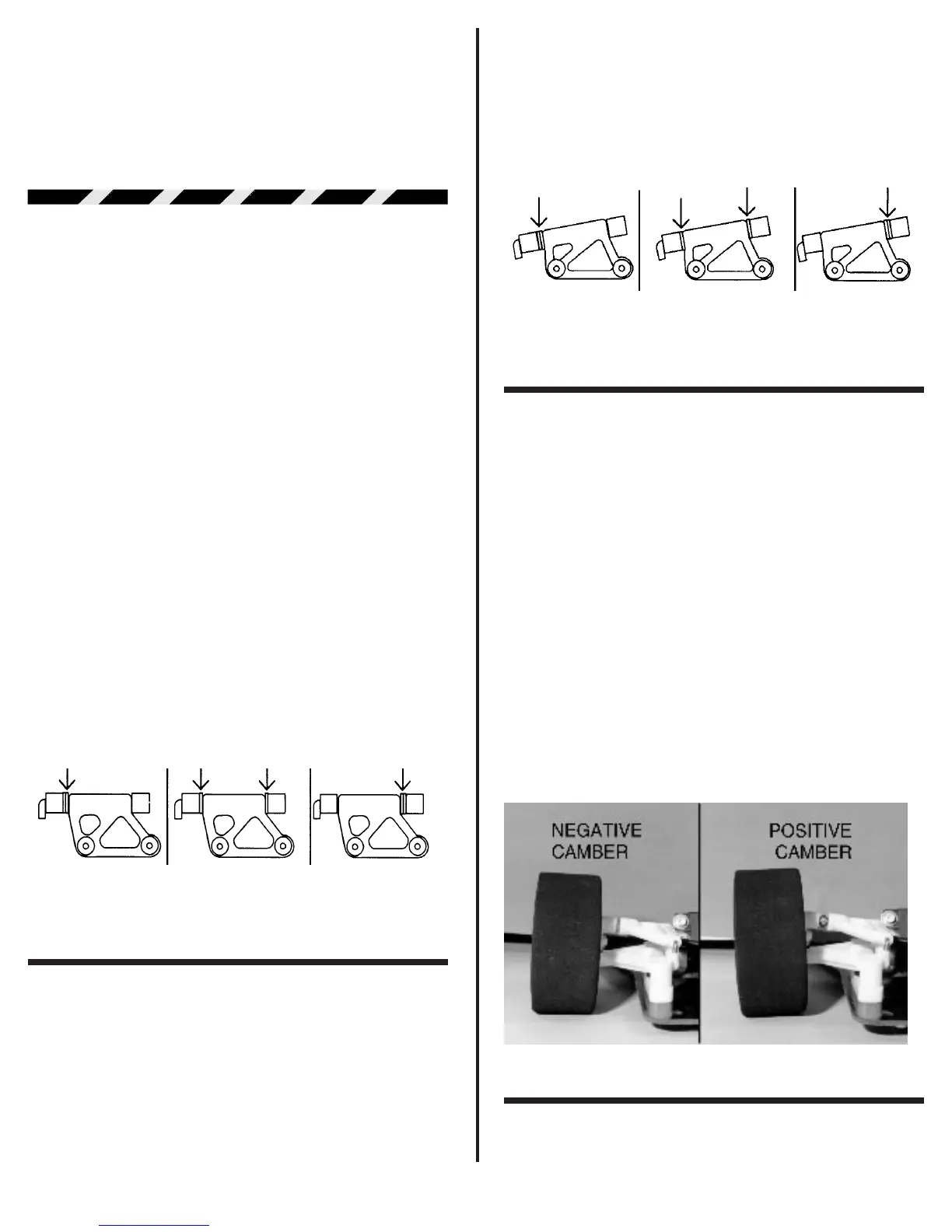
CASTER (fig. 102) describes the angle of the kingpin,
in relation to the vertical plane, when looked at from the side of
the car. As an example, 0° of caster puts the kingpin in a verti-
cal line. Positive caster means the kingpin leans rearward at
the top.
Caster has several effects; however, the easiest way
to see its effects is to compare it to the casters on the bottom of
a shopping cart. When the cart is pushed forward, any mis-
alignment of the casters will cause a side load on the wheels
and thus cause the wheels to realign in the direction of travel.
Increasing the positive caster on your car will slightly increase
the steering turning into a corner and slightly decrease steer-
ing coming out of the corner. Reducing the positive caster will
decrease the amount of steering you have going into a corner
and increase the amount of steering you have in the middle of
the corner and exiting the same corner.
Your RC12LC has adjustable caster in increments of 2°.
With the 0° upper arm mounts you can have settings of 0°, 2°,
and 4° of positive caster as shown. You change the caster by
placement of the PTFE caster shims on either side of the up-
per arm mount. The three drawings below show the locations
of the caster shims and what the resulting caster settings will
be. The 0° mounts are recommended for oval racing or for a
less aggressive steering feel.
REAR
➡
0° mount, 0° mount, 0° mount,
0° caster 2° caster 4° caster
2 shims forward 1 shim each side 2 shims to rear
Fig. 102
CASTER CHANGE (fig. 103) has only been used in
electric R/C racing for a few years. It is however an important
adjustment that is available with our Dynamic Strut front sus-
pension. As was shown in the assembly instructions we have
two different sets of upper arm mounts. The 0° mount is level
with the chassis when mounted (see fig. 90 above). The 10°
mount is angled ten degrees in relation to the chassis or lower
suspension arm. This angle provides a change in caster during
suspension movement. The caster angle will change two de-
grees during full suspension travel. Your car will steer more
aggressively when using this option. The starting or static caster
setting is changed in the same manner using the PTFE caster
shims. Static caster starts at either 2°, 4°, or 6°. A more de-
tailed example would be a starting caster of 2° will have 0°
caster at full suspension travel and a starting caster of 6° will
be only 4° at full suspension travel. This setup is recommended
for road racing applications giving you the most aggressive
steering possible.
REAR
➡
10° mount, 10° mount, 10° mount,
2°-0° caster 4°-2° caster 6°-4° caster
2 shims forward 1 shim each side 2 shims to rear
Fig. 103
CAMBER is a word describing the angle at which the
tire and wheel rides relative to the ground when looked at from
the front or back (fig. 104). This is one of the most important
adjustments on the car. Negative camber means that the tire
leans inward at the top, putting it closer to the centerline of the
car than the bottom of the tire. Positive camber means just the
opposite, the top of the tire is further away from the centerline
of the car than the bottom of the tire.
Excessive negative camber will decrease traction but
increase stability. Positive camber will also decrease traction
and decrease stability. A tire's maximum traction is achieved
when it is perpendicular to the ground (straight up and down).
We suggest a starting setting of 2° of negative camber. If you
want to add a little more steering, reduce front camber to 1°
negative or even 0°. Keep in mind that using little or 0° of cam-
ber can cause the car to be unpredictable. Try to use at least 1
to 2° negative camber at all times. This can be adjusted by
turning the upper arm turnbuckles in the appropriate direction.
Because the rear axle is a solid axle there is no rear camber
adjustment on this car.
Fig. 104
TOE-IN AND TOE-OUT is a beneficial adjustment and
has a fairly significant effect on the car (fig. 105). Toe-in will



 To Next Page
 Loading...