Position it in such a way that free play between nozzle and holder is the same on both - the left and
right side. Shape the sealing cords with a hammer so that their cross-section changes from square to
trapezoid shape. Then spread them along the sides and front of the nozzle and by gently tapping calk
them evenly round its circumference so that they are level with the nozzle. Cover the sealing cord
connections with a small amount of the boiler sealant.
Door sealing cord replacement
Procedure: Use a screwdriver to remove the old sealing cord and to clean the groove in which it was
seated. Lightly shape the cord from a square into a trapeze cross-section using a hammer. Press the
sealing cord along the door circumference (place the narrower base into the groove first) in such a
way to ensure that the cord sticks well in the groove (if necessary use a little hammer). Position the
lock’s handle upwards, and with several gentle, careful taps of the door against the boiler, press the
cord into the groove until the door can be closed smoothly. Fine-tune the position of the wheel that
engages the lock’s cam. This is the only procedure that can ensure good door seal!
Adjusting the door hinges and locks
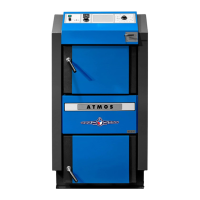
The loading door and ash-pan door are firmly connected to the boiler drum by two sets of hinges.
Each hinge consists of a nut, which is welded to the boiler drum, and a screw to which the door is
connected by means of a pin. If you want to adjust the hinge settings, first take off the upper hood
(control panel) and remove both pins. Then remove the door and slightly turn the screw with a right-
hand thread, as necessary. By following these steps in reverse order, you can replace the door. The
door lock consists of a lever with a handle and a cam which engages a wheel that is screwed into the
boiler and secured by a nut preventing its turning.
36. Environmental protection
The ATMOS gasifying boilers comply with the most demanding environmental requirements
and were awarded the “Environmentally friendly product” mark, in compliance with directive No.
13/2002 of the Ministry of Environment of the Czech Republic. The boilers are certified in compli-
ance with the European standard EN 303-5 and they fall within class 3, 4 and 5.
Disposal of the boiler after expiration of its service life
It is necessary to provide an ENVIRONMENTALLY FRIENDLY DISPOSAL of the boiler‘s individual parts.
Before disposal, clean all the flue cinder and place it in a refuse bin.
Take the boiler drum and hood to a scrap-metal collection site.
Take all the ceramic (fireclay) parts to an approved refuse site
NOTE – In order to comply with the environmentally friendly operation requirements, it
is prohibited to burn any other substances than specified for the boiler. Plastic bags, vari-
ous plastic materials, paints, textiles, laminate are substances which should be particularly
avoided but also avoid burning sawdust, sediment and coal dust.


 To Next Page