CHANNEL STRIP
Console functions.
EQUALISER
Note the dark background indicating
that the equaliser is normally
associated with the LF signal path.
The equaliser is split into two
sections - one for high and low
frequencies (HF/LF) and the other
for middle frequencies (MIDS).
Both sections can be switched in and
out independently and switched into
the SF signal path independently.
The HF section has a boost/cut
range of 15dB. The frequency
can be switched - 10kHz with the
switch up and 18kHz with the switch
depressed.
The LF section has a boost/cut
range of 15dB and a shelving
characteristic. The frequency can
be switched - 50Hz with the switch
up and 100Hz with the switch
depressed.
The high mid section (HMF) has
three controls. The boost/cut range is
15dB and the frequency of operation
can be varied from 450Hz to 20kHz.
A Q control allows for a very sharp
and narrow characteristic or for a
more gentle characteristic covering
a wider range of frequencies.
The low mid section (LMF) has
three controls. The boost/cut range is
15dB. and the frequency of operation
can be varied from 50Hz to 1.5kHz.
A Q control allows for a very sharp
and narrow characteristic or for a
more gentle characteristic covering
a wider range of frequencies.
The actual Q range is between 3.8
(0.4 Octave) and 0.65 (2 octaves).
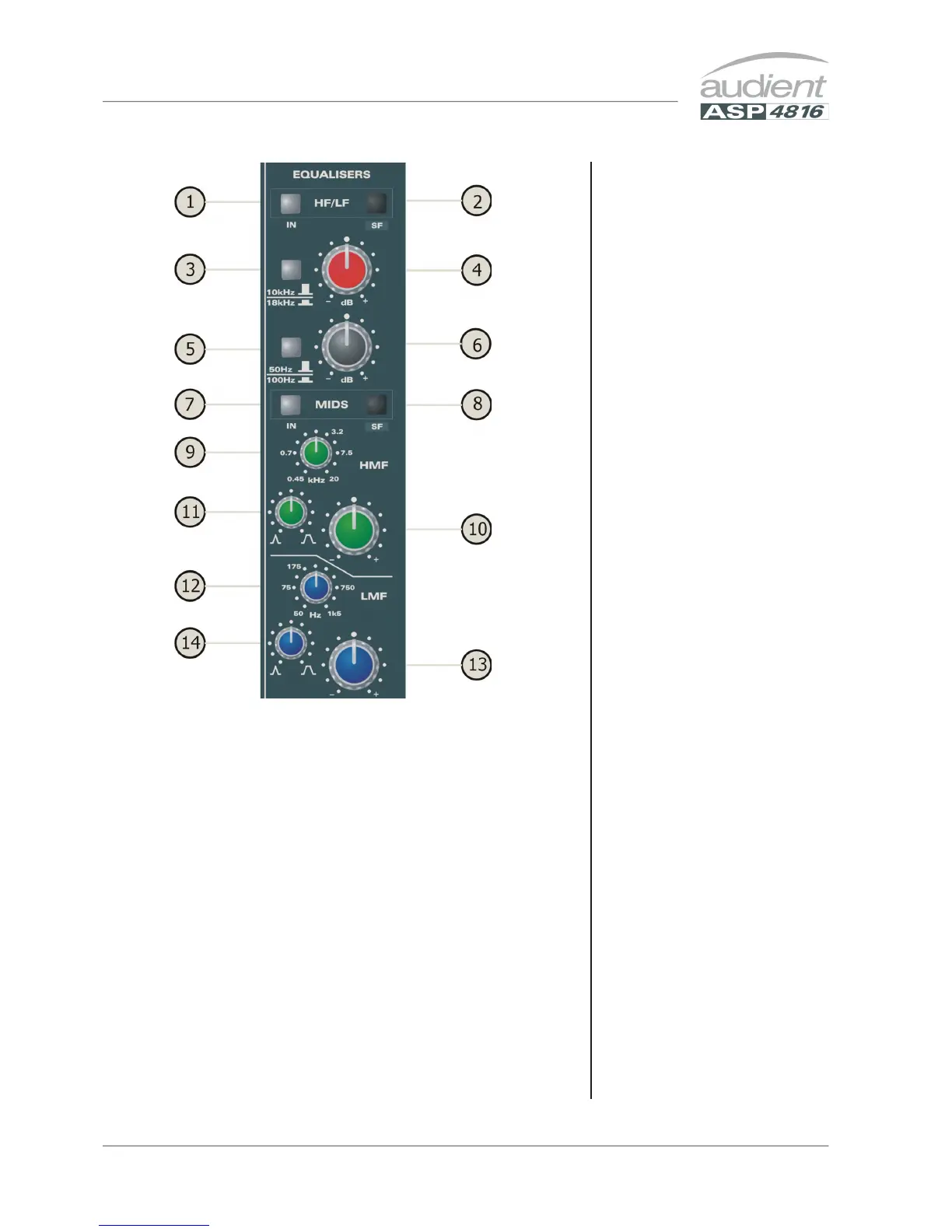
1 HF/LF Section. This places the
HF/LF equaliser in circuit.
2 SF places the HF/LF equaliser
in the SF signal path where it
can be used to treat a signal
before it is recorded.
3 10kHz/18kHz allows the
frequency of the HF equaliser
to be selected.
4 HF boost/cut control.
5 50Hz/100Hz allows the
frequency of the LF equaliser
to be selected.
6 LF boost/cut control.
7 MIDS Section. This places the
MIDS equaliser in circuit.
8 SF places the MIDS equaliser
in the SF signal path where it
can be used to treat a signal
before being recorded.
9 This controls the centre
FREQUENCY of the high
mid equaliser.
10 HIGH MID boost/cut
control.
11 HIGH MID Q control.
12 This controls the centre
FREQUENCY of the low
mid equaliser.
13 LOW MID boost/cut control.
14 LOW MID Q control.


 To Next Page