24
CH 200 / CH 250
Safety
(fig. 11)
(fig. 10) (fig. 9)
(fig. 8)
·
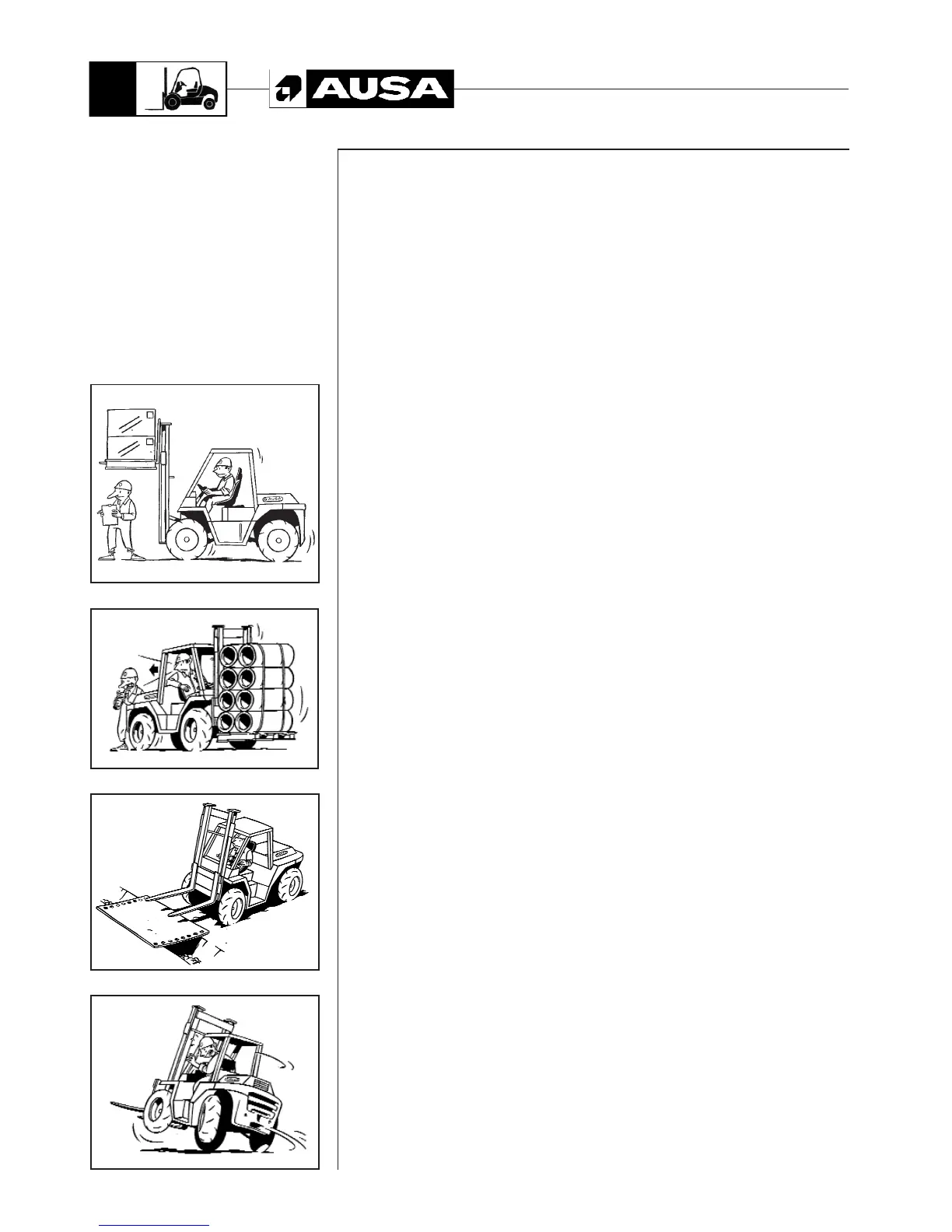
Be certain you have good visibility at all times. It is important that you can see clearly both forward and back-
ward when operating the forklift. If the load does not allow clear forward visibility, then drive with caution in rever-
se. (Fig.9)
·
This forklift is not designed to be used as a tow truck or tow vehicle. However if the forklift is to be towed to
or from work location, see the section “Transporting the forklift” on this Manual.
·
Do not let people stand or walk under raised forks, loaded or unloaded. (fig.8)
Load handling
·
Know the lifting capacity of your forklift and operate within those limits.
See the Load Limits Charts in the manual and on both sides of the mast.
·
Always drive with the forks in the low position and with the mast tilted back (fig.14).
·
Never transport loads with the forks raised -keep them as low as possible to attain maximum stability-. The
risk of overturning increases when the foklift is driven with the load raised. Keep it low when in transit.(fig.15)
·
Only lift the forks to load/unload them.
·
Do not drive on surfaces that could affect the stability of the machine.
·
Only raise the forks when the machine is on a level, flat surface.
·
If necessary to temporarily operate the forklift in rough, unimproved areas, be very careful when operating
near an open trench, a high bank or an overhang that can fall and cause a roll over with the potential of serious
injury or death. You must make a careful judgement whether you and your forklift can be safely operated near
any of these areas.(Fig.10)
·
Stay off steep inclines and slopes. Hillside operation can be very dangerous due to the constant potential
of rollovers (fig.11).


 To Next Page