
 Need help?
Do you have a question about the AUSTRALIAN MONITOR IS SERIES and is the answer not in the manual?
 General
| Brand | AUSTRALIAN MONITOR |
|---|---|
| Model | IS SERIES |
| Category | Amplifier |
| Language | English |
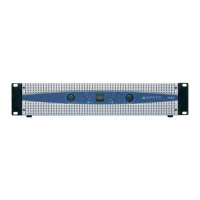
Controls the input level for each channel, with 0dB indicating minimum attenuation.
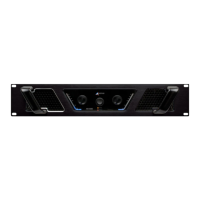
LED indicates output stage status, showing two levels of operation: below clip and clipping/above.
Switches AC power to the amplifier. Press up for power on, down for power off.
Red LED illuminates to indicate thermal shutdown has occurred.
Blue LED illuminates to indicate the amplifier is ON and receiving AC mains power.
LED displays output stage status, varying in intensity with output signal level.
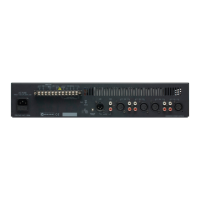
Ensure mains voltage matches the rear panel marker (+/- 10%) for proper operation.
Amplifier is designed for standard 19" rack mounting, occupying 2 EIA rack units.
Axial fans draw cool air from the front and expel heated air from the rear. Unrestricted airflow is crucial.
Instructions for balanced and unbalanced input wiring, emphasizing proper grounding and cable use.
Guidance on using appropriate gauge wire and cable types for speaker connections.
Details using banana plugs or bare wires with binding posts, noting positive and negative terminals.
Describes using the 4-pole connector for speaker outputs, including single, dual, and bi-amp connections.
Emphasizes earthing signal sources, checking mains voltage, power switch status, system grounds, and speaker handling.
Details the amplifier's power-up sequence, including ICS circuit and relay clicks.
Describes attenuator use for gain control and level matching, noting full power output requires attenuator above halfway.
Discusses input sensitivity settings and impedance, relating output voltage swing to mains voltage and load.
Explains electrostatic radiation, electromagnetic radiation, and earth loops as causes of hum and provides solutions.
Explains the switch disconnects input ground to reduce hum, with notes on shielding and balanced sources.
Details cleaning dust from fan grilles and blades to ensure proper cooling and prevent bearing damage.
Instructions for checking and replacing fuses, emphasizing safety and using correct fuse types.


 To Next Page