Standards
37
Range
The range within a WLAN is highly dependent on the following
factors:
• the WLAN adapter used
• the structural conditions
• the amount of radio traffic on the same frequency band.
Other wireless networks may be active, but also micro-
wave ovens, baby monitors, game consoles, garage door
openers, audio-video bridges, or Bluetooth transmitters
(for instance, in mobile telephones).
IEEE 802.11a
This standard communicates with a maximum of 54 Mbit/s
and works exclusively in the seldom used 5-GHz range. This
means it offers the opportunity to transmit data relatively free
of interference from external influences.
IEEE 802.11b
With a maximum throughput rate of 11 Mbit/s, this is the old-
est standard for radio networks in the 2.4-GHz frequency
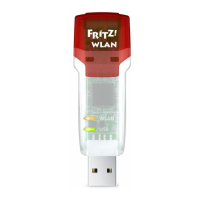
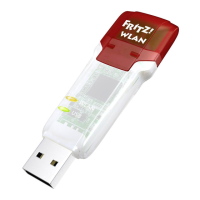
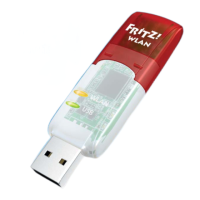
range. First-generation WLAN access points, for example, can
use this standard to communicate with the FRITZ!WLAN USB
Stick.
IEEE 802.11g
This is currently the most common WLAN standard. It commu-
nicates with a maximum of 54 Mbit/s gross in the 2.4-GHz
frequency range (ISM) and guarantees broad compatibility
with many WLAN devices.
However, due to heavy use of the 2.4-GHz range, interference
is more common than in the less-used 5-GHz range.
In order to communicate with each other, the FRITZ!WLAN
USB Stick and the WLAN access point must work in the same
frequency band.
N_man_en.fm Seite 37 Freitag, 27. Mai 2016 2:21 14



 To Next Page