sert and tighten. This
will
help keep lines
on
sheaves.
Remove bolt which holds top of spring
and
rub with
paraffin.
If rudders
do
not kick up easily: pull spring
to
loosen tension
and
replace bolt. Paraffin lock pin.
Sand
all
rough edges on blades lightly. Always remove
blades for trailering.
Salls
Rub paraffin
on
the
luff
of mainsail to
ease
hoisting.
Sail
tape
should be applied to batten pockets where
it
hits shrouds to avoid chafe. Always fold your jib
and
store
it
in
the envelope bag
or
roll
it
- DO NOT
JUST
STUFF
IT
IN
BAG. Roll your main from
the
third
batten (from top) to your boom
and
store
in
long boom
bag. Storing your sails
will
greatly lengthen their
life.
Rinse with fresh water whenever possible.
Note: Howe
& Bainbridge, Inc., the manufacturers of
our sail cloth have sent us the following
memo
which
we felt was important enough to pass
on
to you.
To prevent color transfer
on
your sails, dry
them
as
thoroughly as possible after using. Try not
to
store wet
in
sail bag for any longer periods of time
than
necessary.
When either dyed nylon
or
dacron sail fabrics are
stored wet, the color
will
bleed
or
transfer from
the
colored to the white
or
even from a darker
shade
to
a
lighter shade.
The
wetter
and
more compressed
the
fabric, the greater the bleeding - such as stuffed
in
a
sailbag.
Section
V:
TUNING FOR PERFORMANCE
MAST RAKE
To
measure the
amount
of mast rake,
your
mast
must
be
up
with your
rig
tension snug.
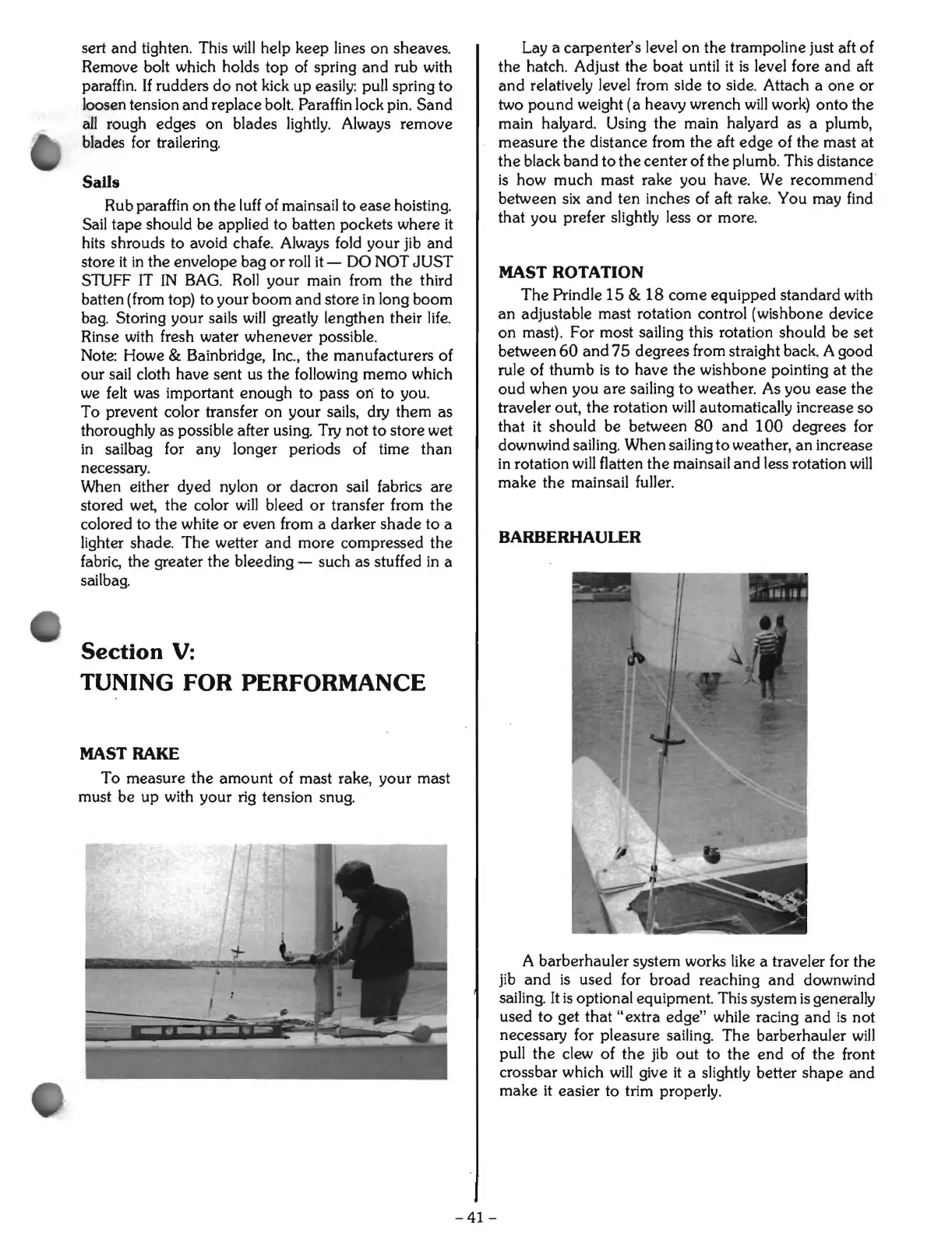
Lay a carpenter's level
on
the trampoline just aft of
the hatch. Adjust the boat until
it
is
level fore
and
aft
and
relatively level from side
to
side. Attach a
one
or
two
pound
weight (a heavy wrench
will
work)
onto
the
main halyard. Using
the
main halyard as a plumb,
measure
the
distance from the aft
edge
of the mast at
the
black
band
to
the
center of the plumb. This distance
is
how much mast rake you have. We recommend'
between
six
and
ten inches of aft rake. You may find
that you prefer slightly less
or
more.
MAST
ROTATION
The
Prindle
15
&
18
come
equipped standard with
an
adjustable mast rotation control (wishbone device
on
mast). For most sailing this rotation should be set
between
60
and
75
degrees from straight back. A good
rule of thumb
is
to have
the
wishbone pointing
at
the
oud
when you
are
sailing
to
weather. As you ease the
traveler out,
the
rotation
will
automatically increase
so
that
it
should be between
80
and
100
degrees for
downwind sailing. When sailing
to
weather,
an
increase
in
rotation
will
flatten
the
mainsail
and
less rotation
will
make the mainsail fuller.
BARBERHAULER
A barberhauler system works like a traveler for the
jib
and
is
used for broad reaching
and
downwind
sailing.
It
is
optional equipment. This system
is
generally
used
to
get
that"
extra edge" while racing
and
is
not
necessary for pleasure sailing.
The
barberhauler
will
pull
the
clew of
the
jib
out
to
the
end
of the front
crossbar which
will
give
it
a slightly better
shape
and
make
it
easier to trim properly.
-
41-



 To Next Page