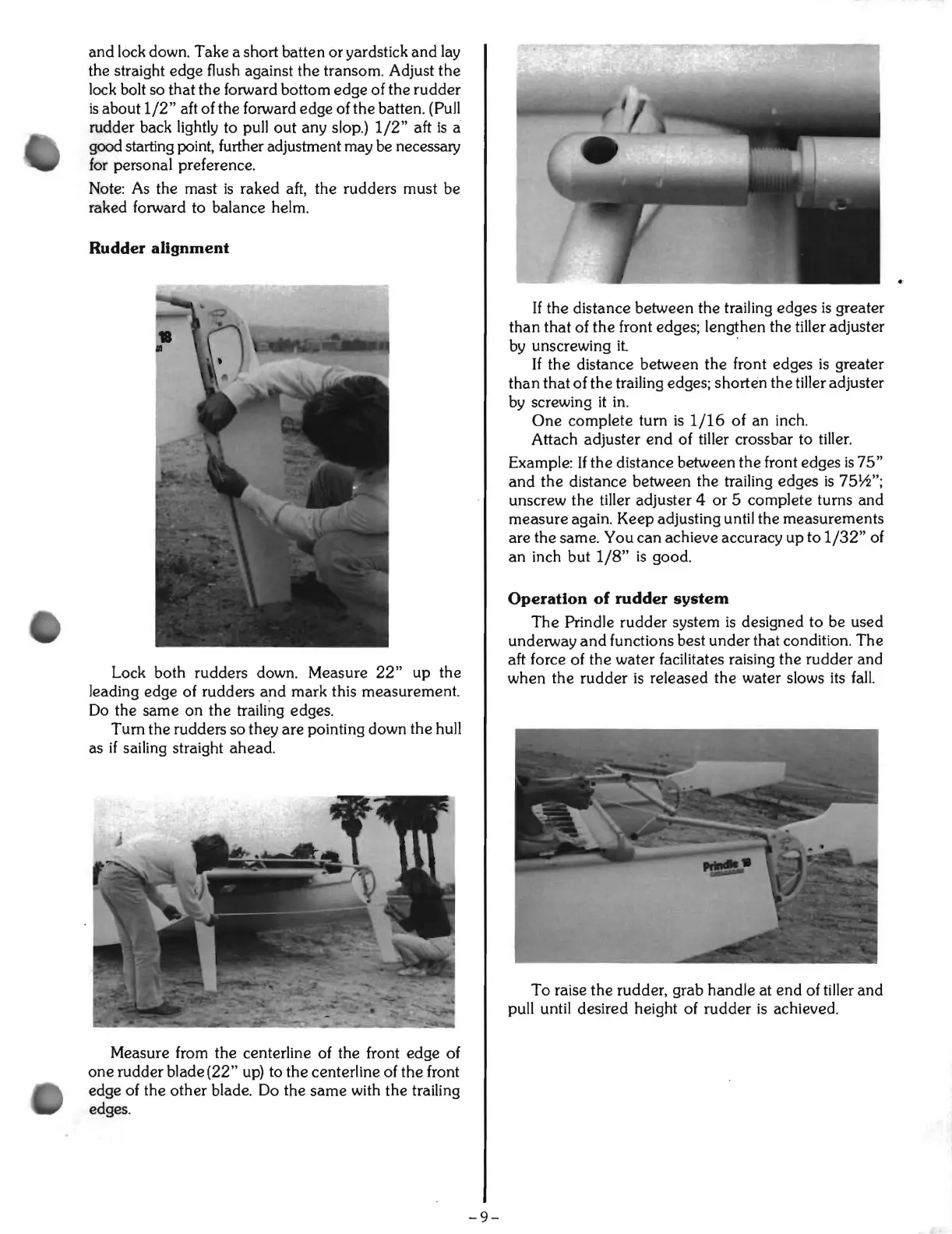
and
lock down. Take a short batten
or
yardstick
and
lay
the straight edge flush against the transom. Adjust
the
lock bolt so that the forward bottom
edge
of
the
rudder
is
about 1/2" aft of the forward edge of the batten. (Pull
rudder back lightly to pull
out
any slop.)
1/2"
aft
is
a
good starting point, further adjustment may be necessary
for personal preference.
Note: As the mast
is
raked aft, the rudders must be
raked forward to balance helm.
Rudder
alignment
Lock both rudders down. Measure 22"
up
the
leading edge of rudders
and
mark this measurement.
Do
the same
on
the trailing edges.
Tum
the rudders so they
are
pointing down the hull
as
if
sailing straight ahead.
Measure from the centerline of the front edge of
one rudder blade
(22" up) to the centerline of the front
edge of the
other
blade. Do the
same
with the trailing
edges.
-9-
If the distance between the trailing edges
is
greater
than
that
of
the
front edges; lengthen the tiller adjuster
by unscrewing
it
.
If
the
distance between
the
front edges
is
greater
than
that
of
the
trailing edges;
shorten
the tiller adjuster
by screwing
it
in.
One
complete
tum
is
1/16
of
an inch.
Attach adjuster
end
of tiller crossbar to tiller.
Example:
If
the
distance between
the
front edges
is
75"
and
the
distance between the trailing edges
is
75W';
unscrew the tiller adjuster 4
or
5 complete turns
and
measure
again. Keep adjusting until the measurements
are the
same
. You
can
achieve accuracy
up
to 1/32" of
an
inch but
1/8"
is
good.
Operation
of
rudder
system
The
Prindle
rudder
system
is
designed to be used
underway
and
functions best
under
that condition.
The
aft force of the water facilitates raising
the
rudder
and
when
the
rudder
is
released the water slows its
fall.
To
raise the
rudder
, grab handle at
end
of tiller
and
pull until desired height of
rudder
is
achieved.



 To Next Page