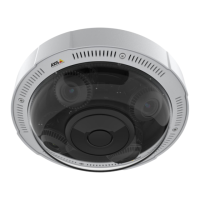
Need help?
Do you have a question about the Axis P3807-PVE and is the answer not in the manual?
Steps to open a browser and log in to the Axis device.
Guide on setting a secure password for the device's root account.
Recommendations for creating and managing secure device passwords.
Instructions about configuring device image settings.
Explanation of different exposure modes to improve image quality.
Configuring the camera to use IR light and shift to night mode in low-light conditions.
Using Wide Dynamic Range (WDR) to manage scenes with extreme light differences.
Instructions on how to view and record video streams from the camera.
Tips for reducing network bandwidth and storage usage.
Creating rules to trigger actions based on specific events like motion detection.
How to configure video streaming and storage options.
Comparison of Motion JPEG and H.264/MPEG-4 compression formats.
Procedure for resetting the device to its original factory configuration.
Important notes and considerations before and during firmware upgrades.
Detailed instructions for downloading and installing firmware updates.
Common reasons and solutions for not being able to access the device via a web browser.
Troubleshooting tips for login issues, including password recovery.
Common issues and solutions related to video streaming.
The AXIS P3807-PVE Network Camera is a versatile surveillance device designed for comprehensive video monitoring. Its primary function is to capture and stream high-quality video, offering various features to optimize image clarity, manage data, and respond to events.
The camera captures video using different capture modes, including 7.5MP camera dewarp and 8.3MP client dewarp. In 7.5MP camera dewarp mode, the camera processes and stitches the image internally, providing a unified view in both its web interface and a video management system (VMS). For 8.3MP client dewarp, the VMS handles the dewarping and stitching, which might result in a misaligned image in the camera's web interface, though this is considered normal behavior. The camera supports Wide Dynamic Range (WDR) to handle scenes with strong backlight, making both dark and bright areas of an image visible. However, WDR can introduce artifacts and may not be available for all capture modes. To achieve a frame rate of up to 25/30 fps, using 8.3MP client dewarp with WDR turned off is recommended.
The camera can operate in both visible light and night mode. During the day, it delivers color images using visible light. As light diminishes, it can automatically shift to night mode, utilizing both visible and near-infrared light to produce brighter, more detailed black-and-white images. The threshold for shifting to night mode can be adjusted, with brighter settings resulting in sharper images with less low-light noise, and darker settings maintaining color longer but potentially introducing more blur.
To manage bandwidth and storage, the camera offers various video compression formats, including Motion JPEG and H.264. Motion JPEG provides excellent image quality and access to every image in the stream but consumes significant bandwidth. H.264, a licensed technology, drastically reduces file size compared to Motion JPEG and MPEG-4 without compromising image quality, thus requiring less network bandwidth and storage. Bitrate control features, such as Variable Bitrate (VBR) and Maximum Bitrate (MBR), allow users to manage bandwidth consumption. VBR adjusts bandwidth based on scene activity, guaranteeing constant image quality but requiring storage margins. MBR allows setting a target bitrate to handle system limitations, with options to prioritize image quality or frame rate. Average Bitrate (ABR) automatically adjusts bitrate over time to meet a specified target, optimizing video quality based on available storage and retention time.
The camera supports AXIS Camera Application Platform (ACAP), an open platform for developing and running analytics and other applications. Multiple applications can run simultaneously, though compatibility and resource demands should be verified to ensure optimal performance.
The camera's image can be adjusted for optimal viewing. Users can level the camera mechanically using a leveling guide in the settings. The camera's position can also be adjusted manually. Exposure modes, including Automatic, Flicker-free, and Flicker-reduced, help improve image quality in various lighting conditions. The "Hold current" option locks the current exposure settings.
To reduce noise in low-light conditions, users can adjust the blur-noise trade-off, set the exposure mode to automatic, slow down the shutter speed, reduce sharpness, lower max gain, or open the aperture. For reducing motion blur, options include moving the blur-noise trade-off slider toward "Low motion blur," setting a shorter max shutter time, and increasing max gain. Increasing the light level in the scene or mounting the camera to capture objects moving toward or away from it can also help.
Privacy masks can be created to hide specific areas of the image, appearing as solid color blocks or mosaic patterns in snapshots, recorded video, and live streams. These masks can be turned off using the VAPIX® API. Overlays, such as timestamps or custom images, can be superimposed over the video stream to provide additional information or aid in installation.
The camera supports setting up rules and alerts to automate actions based on specific events. Conditions can include motion detection (using AXIS Video Motion Detection), shock detection, or tampering (e.g., spray painting the lens). Actions can include recording video, sending email notifications, or displaying text overlays in the video stream. For instance, the camera can be configured to record video to an SD card five seconds before motion is detected and stop one minute after. Similarly, it can send an email if the lens is spray-painted or display "Motion detected" as a text overlay when motion occurs.
Network storage can be configured to store recordings on a host server by specifying the IP address, shared location, and login credentials if required. Video can be recorded directly from the live view and watched from the storage section.
The camera offers several maintenance features to ensure its proper functioning. It can be reset to factory default settings, which reverts all settings, including the IP address, to their original values. This can be done by disconnecting power, pressing and holding the control button while reconnecting power, and releasing it after the status LED indicator flashes amber and then turns green. Alternatively, a factory reset can be performed through the web interface.
Firmware management is available through active or long-term support (LTS) tracks. The active track provides access to the latest features and bug fixes, while LTS tracks offer a stable platform with periodic releases focused on bug fixes and security updates, suitable for third-party integrations. Users can check the current firmware version through the product's webpage and upgrade it by downloading the firmware file from axis.com/support and following the instructions in the Maintenance section of the web interface. Preconfigured and customized settings are generally saved during firmware upgrades, though this is not guaranteed. If a firmware upgrade fails, the device reloads the previous firmware. If problems arise after an upgrade, users can roll back to the previously installed version.
Troubleshooting guidance is provided for common issues, such as IP address conflicts, inability to log in (e.g., due to lost root password or incorrect HTTPS protocol), and problems with streaming (e.g., multicast H.264 accessibility, poor rendering, or lower frame rates). Performance considerations are also outlined, highlighting factors like image resolution, compression levels, GUI rotation, number of clients, simultaneous streams, event settings, HTTPS usage, network utilization, and client computer performance that can affect frame rate and bandwidth.
 General
| Video streaming | Yes |
|---|---|
| Bit rate control | Variable Bit Rate (VBR) |
| Total megapixels | 8.3 MP |
| Maximum resolution | 4320 x 1920 pixels |
| Image quality adjustment | Brightness, Contrast, Saturation, Sharpness |
| Video compression formats | H.264, M-JPEG, MPEG4 |
| Supported graphics resolutions | 480 x 270 |
| Pan range | -180 - 180 ° |
| Tilt angle range | 0 - 55 ° |
| Camera shutter speed | 1/33500 - 1/10 s |
| Minimum illumination | 0.05 lx |
| Type | IP security camera |
| Certification | EN 55032 Class A, EN 50121-4, IEC 62236-4, EN 55024, EN 61000-6-1, EN 61000-6-2, FCC Part 15 Subpart B Class A, ICES-003 Class A, VCCI Class A, RCM AS/NZS CISPR 32 Class A, KC KN32 Class A, KC KN35, IEC/EN/UL 60950-22, IEC/EN/UL 62368-1, IEC 60068-2-1, IEC 60068-2-2, IEC 60068-2-6, IEC 60068-2-14, IEC 60068-2-27, IEC 60068-2-78, IEC/EN 60529 IP66/IP67, IEC/EN 62262 IK10, NEMA 250 Type 4X |
| Languages support | CHI (SIMPL), CHI (TR), DEU, ENG, ESP, FRE, ITA, JPN, KOR, POR, RUS |
| Number of languages | 11 |
| Placement supported | Outdoor |
| Connectivity technology | Wired |
| Sensor type | CMOS |
| Number of sensors | 4 |
| Optical sensor size | 1/2.9 \ |
| Number of lenses | - |
| Fixed focal length | 3.2 mm |
| Maximum aperture number | 2 |
| Wi-Fi | No |
| Streaming method | Multicast |
| Cabling technology | 10/100/1000Base-T(X) |
| Networking standards | IEEE 802.3af, IEEE 802.3at |
| Ethernet interface type | Fast Ethernet, Gigabit Ethernet |
| Supported network protocols | IPv6, HTTP, HTTPS , SSL/TLS , QoS Layer 3 DiffServ, FTP, SFTP, CIFS/SMB, SMTP, Bonjour, UPnP , SNMP v1/v2c/v3 (MIB-II), DNS, DynDNS, NTP, RTSP, RTP, TCP, UDP, IGMP, RTCP, ICMP, DHCP, ARP, SOCKS, SSH, LLDP |
| IK code | IK10 |
| Form factor | Dome |
| Mounting type | Ceiling/Pole |
| Product color | Black, White |
| Housing material | Aluminum |
| Protection features | Shock resistant |
| International Protection (IP) code | IP67 |
| Flash memory | 512 MB |
| Compatible memory cards | MicroSD (TransFlash), MicroSDHC, MicroSDXC |
| Power source type | PoE |
| Power consumption (max) | 12.9 W |
| Power consumption (Power over Ethernet (PoE)) | 7 W |
| Ethernet LAN (RJ-45) ports | 1 |
| Storage temperature (T-T) | -40 - 65 °C |
| Operating temperature (T-T) | -30 - 50 °C |
| Operating relative humidity (H-H) | 10 - 100 % |
| Harmonized System (HS) code | 85258900 |
 Weight and Dimensions
| Depth | 206 mm |
|---|---|
| Width | 198 mm |
| Height | 166 mm |
| Weight | 2000 g |

 To Next Page