Document: 333D012G
5-18-2007
- 19 -
Ultraviolet Germicidal Lamp (Optional)
Ultraviolet lamps lose their effectiveness over time and should be replaced when intensity drops below 40
microwatts per cm
2
at the work surface. Check regularly.
WARNING
• UV light is hazardous, Do not defeat interlock!
• Eyes and skin should not be exposed to direct ultraviolet light.
• Ultraviolet light should not be relied upon as the sole decontaminating agent. Additional surface disinfection
should be performed both before and after every cabinet use.
• A biological safety cabinet acts as a supplement to good aseptic practices, not as a replacement.
Cable Ports (Optional)
A cable port is located in the cabinet’s left and right side walls. It provides a way of introducing power and data
cables, or siphoning tubes into the work area of the cabinet without having to go through the front viewscreen access
opening. A plug is provided for each port, when the port is not being used or the cabinet is being deconed.
It is important not to overload the port with too many cables/tubing. Cables/tubing in the work area need to be
suspended on cable hooks provided. The hooks are located along the interior rear wall. This keeps the cables/tubing
from affecting the airflow in the work area and placing unwanted stress on the cable port gaskets. [Reference Cable
Port Illustration in appendix]
Decontamination
Whenever maintenance, service or repairs are needed in a contaminated area of your cabinet, the cabinet must first
be decontaminated with an appropriate agent. The National Institute of Health, National Cancer Institute and the
Centers for Disease Control have all recommended the use of formaldehyde gas for most microbiological agents. Its
application requires individuals who are experienced in the decontamination of cabinets, since the gas itself is toxic.
A good reference for this procedure is NSF/ANSI Standard 49-2004 ANNEX G “Recommended Microbiological
decontamination Procedure”, NSF International, 789 North Dixboro Road, P.O. Box 130140, Ann Arbor, Michigan
48113-0140.
Have the proper safety equipment (gas masks, protective clothing, etc.) within easy reach for whatever gas you
choose. In addition, you will want to be sure that the gas you are using will be effective against all of the biological
agents within the cabinet. When you have decided which gas to use, post the antidote to it in a visible and nearby
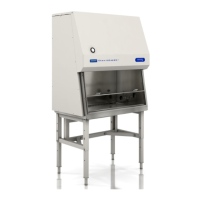
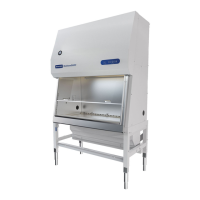
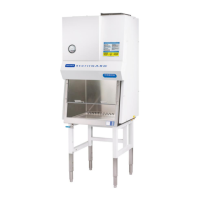
location. The volumes of the SG403A, SG503A & SG603A cabinets are 49, 64 and 78 cubic feet respectively.
Provide the correct amount of decontaminating gas for this volume.
Carcinogens and other toxins present a unique chemical deactivation problem and the standard biological
decontamination will not, of course, be effective against chemicals or other non-biological materials. With materials
of this kind, consult a qualified safety professional.



 To Next Page