EasyManua.ls Logo

Baofeng UV82 - Safety Information; Servicing by Qualified Technicians; Radio Modification Prohibition; Approved Accessories Usage

Baofeng UV82
17 pages
Print Icon
To Next Page IconTo Next Page
To Previous Page IconTo Previous Page
Loading...
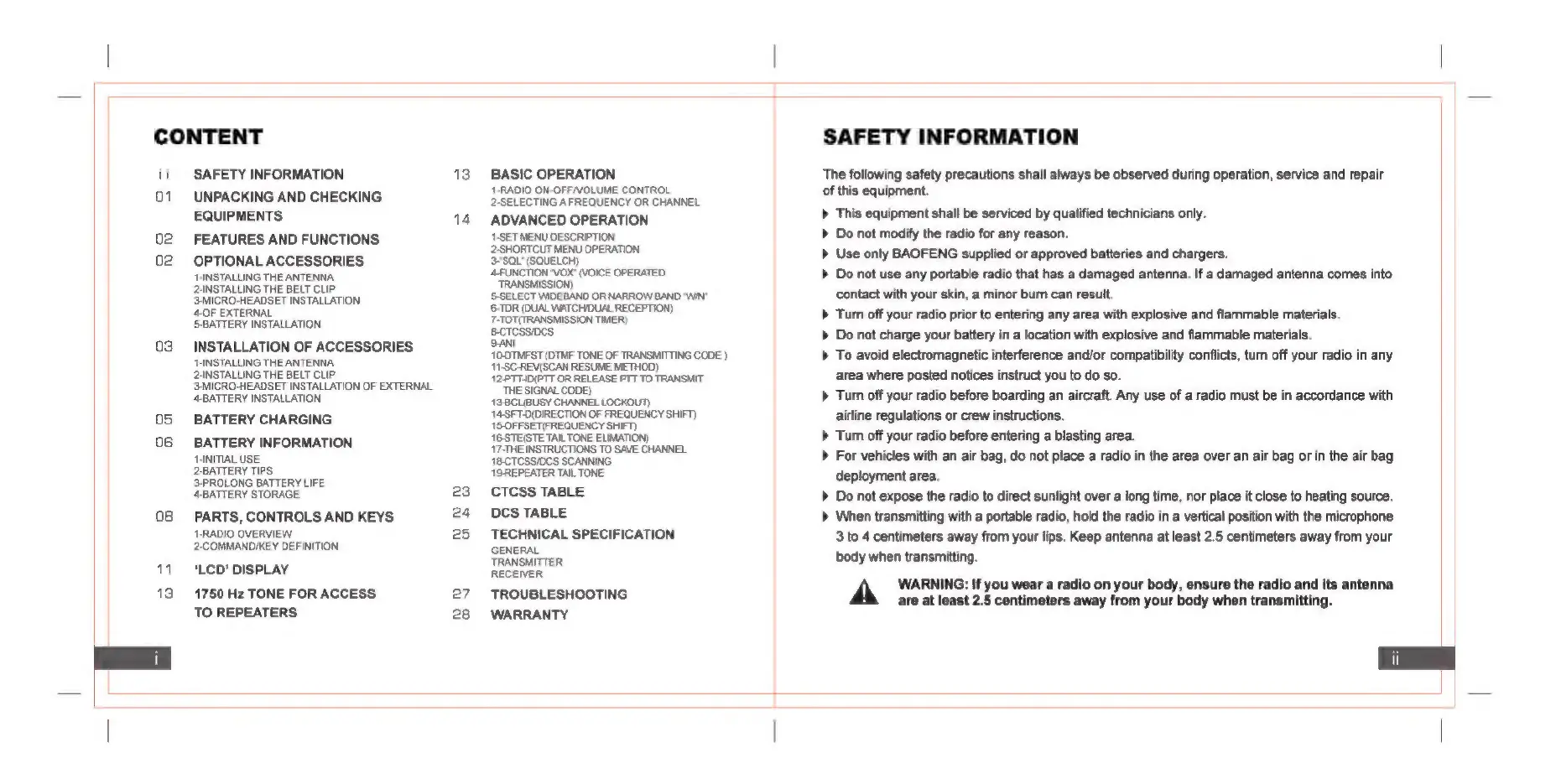
CONTENT
ii
01
02
02
a3
leis}
isle}
08
13
SAFETY
INFORMATION
UNPACKING
AND
CHECKING
EQUIPMENTS,
FEATURES
AND
FUNCTIONS
OPTIONAL
ACCESSORIES
1NSTALLING
THE
ANTENNA
2-INSTALLING
THE
BELT
CLIP
3-MICRO-HEADSET
INSTALLATION
4-OF
EXTERNAL
S-BATTERY
INSTALLATION
INSTALLATION
OF
ACCESSORIES
“INSTALLING
THE
ANTENNA
Z:INSTALLING
THE
BELT
CLIP
3-MICRO-HEADSET
INSTALLATION
OF
EXTERNAL
4-BATTERY
INSTALLATION
BATTERY
CHARGING
BATTERY
INFORMATION
{INITIAL
USE
2-BATTERY
TIPS
3-PROLONG
BATTERY
LIFE
4-BATTERY
STORAGE
PARTS,
CONTROLS
AND
KEYS
1-RADIO
OVERVIEW
2-COMMAND/KEY
DEFINITION
‘LCD’
DISPLAY
1750
Hz
TONE
FOR
ACCESS
TO
REPEATERS
23
24
25
27
28
BASIC
OPERATION
1-RADIO
ON-OFF/VOLUME
CONTROL
‘2-SELECTING
A
FREQUENCY
OR
CHANNEL
ADVANCED
OPERATION
4-SET
MENU
DESCRIPTION
2-SHORTCUT
MENU
OPERATION
3*SQL'
(SQUELCH)
4-FUNCTION
'VOX'
(VOICE
OPERATED
TRANSMISSION)
5-SELECT
WIDEBAND
OR
NARROW
BAND
"WIN
6-TDR
(DUAL
WATCHIDUAL
RECEPTION)
7-TOT(TRANSMISSION
TIMER)
B-CTCSSIDCS
ANI
‘1]0-DTMFST
(DTMF
TONE
OF
TRANSMITTING
CODE
)
11-SC-REV(SCAN
RESUME
METHOD)
12-PTTID(PTT
OR
RELEASE
PTT
TO
TRANSMIT
THE
SIGNAL
CODE)
43-BCL(BUSY
CHANNEL
LOCKOUT),
14-SFT-D(DIRECTION
OF
FREQUENCY
SHIFT)
415-OFFSET(FREQUENCY
SHIFT)
16-STE(STE
TAIL
TONE
ELIMATION)
{17-THE
INSTRUCTIONS
TO
SAVE
CHANNEL
18-CTCSSIDCS
SCANNING
19REPEATER
TAIL
TONE
CTCSS
TABLE
DCS
TABLE
TECHNICAL
SPECIFICATION
GENERAL
TRANSMITTER
RECEIVER
TROUBLESHOOTING
WARRANTY
SAFETY
INFORMATION
The
following
safety
precautions
shall
always
be
observed
during
operation,
service
and
repair
of
this
equipment.
>
This
equipment
shall
be
serviced
by
qualified
technicians
only.
>
Do
not
modify
the
radio
for
any
reason.
>
Use
only
BAOFENG
supplied
or
approved
batteries
and
chargers.
>
Do
not
use
any
portable
radio
that
has
a
damaged
antenna.
If
a
damaged
antenna
comes
into
contact
with
your
skin,
a
minor
burn
can
result.
>
Tum
off
your
radio
prior
to
entering
any
area
with
explosive
and
flammable
materials.
Do
not
charge
your
battery
in
a
location
with
explosive
and
flammable
materials.
>
To
avoid
electromagnetic
interference
and/or
compatibility
conflicts,
tu
off
your
radio
in
any
area
where
posted
notices
instruct
you
to
do
so.
>
Turn
off
your
radio
before
boarding
an
aircraft.
Any
use
of
a
radio
must
be
in
accordance
with
airline
regulations
or
crew
instructions.
>
Turn
off
your
radio
before
entering
a
blasting
area.
For
vehicles
with
an
air
bag,
do
not
place
a
radio
in
the
area over
an
air
bag
or
in
the
air
bag
deployment
area.
Do
not
expose
the
radio
to
direct
sunlight
over
a
long
time,
nor
place
it
close
to
heating
source.
>
When
transmitting
with
a
portable
radio,
hold
the
radio
in
a
vertical
position
with
the
microphone
3
to
4
centimeters
away
from
your
lips.
Keep
antenna
at
least
2.5
centimeters
away
from your
body
when
transmitting.
¥
¥
¥
WARNING:
If
you
wear
a
radio
on
your
body,
ensure
the
radio
and
its
antenna
are
at
least
2.5
centimeters
away
from
your
body
when
transmitting.

Related product manuals