Important: Always read and follow operating instructions. • 25
Pressure Regulator Maintenance
Operating a tire changer with a defective,
improperly adjusted, or by-passed pressure
regulator could cause an operator to acci-
dentally over pressurize a tire, resulting in a
tire explosion with severe injury or death to
the operator or bystanders.
Always be sure that the pressure regulator is
present and is operating properly.
Never inflate tire above manufacturer’s rec-
ommended pressure after bead is seated.
Pressure regulator is set at 60 PSI. Any
required inflation above 60 PSI should be
performed in an inflation chamber/safety
cage or securely mounted on the vehicle if
an inflation chamber is not available. A tire
explosion may cause personal injury or death
to operator or bystanders.
The pressure regulator helps prevent inflation of
standard size or larger tires or tubes beyond 60 PSI to
minimize risk of explosion. This device is for the safety
of the operator and bystanders. Proper operation of
the pressure regulator is essential to safe operation of
the machine.
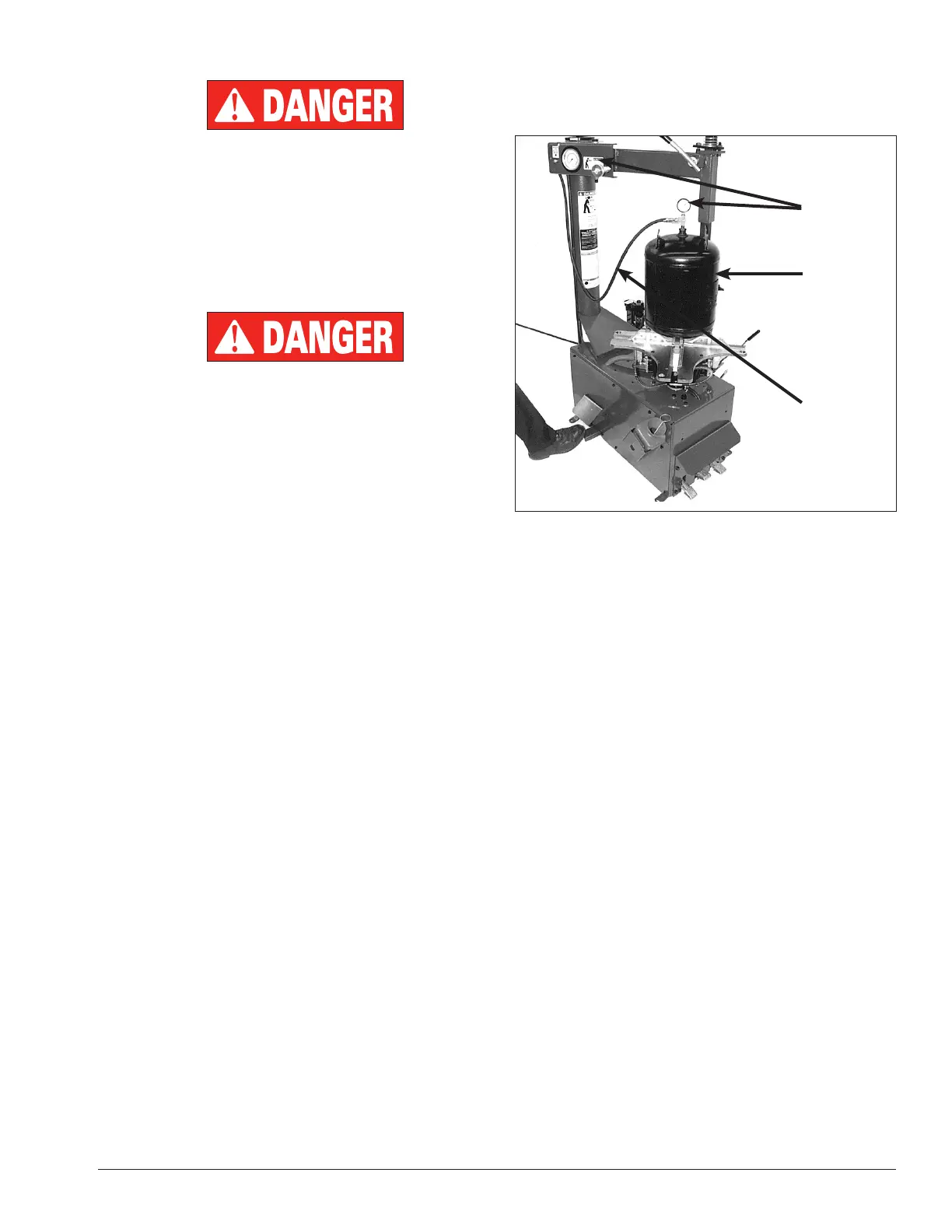
Check operation of the pressure regulator as shown
and described below at least monthly:
1. Remove tires and/or wheels from the machine.
2. Connect the inflation hose to an empty service
tank with a pressure gauge (gauge should read 0).
Use a certified tank with at least 200 PSI pressure
rating.
3. Depress inflation pedal to position 2 to start air-
flow through the hose and into the tank. Maintain a
steady pressure for constant flow.
4. Watch the rising pressure on the tank gauge and
the gauge on the machine. The tank gauge should
rise steadily while inflation pressure is applied. As
tank pressure reaches 60 PSI, the pressure regulator
should stop the airflow automatically. When inflation
pedal is released to position 1, machine gauge and
tank gauge should read 60 PSI ± 5 PSI.
5. Replace pressure regulator if it fails to shut air
supply o at 60 PSI, or if it malfunctions in any other
way. Do not operate machine with a faulty pressure
regulator.
Figure 37 – Pressure Regulator Maintenance
Oil Injector Maintenance
The oil injector typically requires annual service. The
oil level in the oil reservoir tank should be checked
regularly.
Add oil to oil reservoir tank when fluid level is a quar-
ter full or below. Remove cap from the oil reservoir
tank and add Chevron Regal
®
R & O 32 oil to full line
(air tool oil is an acceptable substitute). Replace cap
and clean up any spilled oil.
Important: An air lock will form if the hose between
the reservoir and injector is ever empty of oil. In this
case, after filling the reservoir tank, the line must be
bled of air at the injector connection as follows:
1. Disconnect all power sources, both air and elec-
tricity inputs. Allow any stored air in the reservoir to
escape by depressing the inflate pedal.
2. Remove the side panel and locate the oil injector.
3. Prime the oil injector. Loosen bleeder plug until oil
drips from screw and all air is relieved from the oil line
hose. Retighten the bleeder screw.
4. Reconnect air/electric sources and cycle the
clamp control pedal a few times checking for oil and
air leaks.
5. Test the machine for full function before returning
the machine to operation.
6. Monitor oil consumption to ensure oil is being used
in system.
Watch
Pressure on
Both Gauges
200 PSI Tank
with Gauge
Tire Changer
Inflation
Hose
Connected to
Tank


 To Next Page