This document describes the BCS Action series of two-wheel tractors, including models 710, 720, 730, 710 Gardener, 712 Rental, 718 Harvester, 722 Harvester, and 732 Professional. These machines are designed for various agricultural tasks, primarily tilling with a rotary hoe, but can also be adapted for other implements like ploughs, ridgers, cutter bars, lawnmowers, and snow throwers. The manual emphasizes safety, proper operation, and maintenance to ensure longevity and efficient performance.
Function Description:
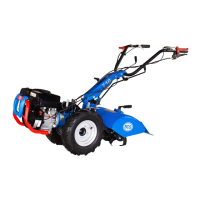
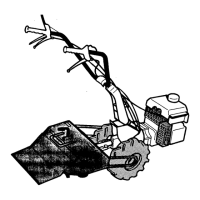
The BCS Action series two-wheel tractors are versatile machines designed for a wide range of agricultural and landscaping tasks. Their primary function is tilling with a rotary hoe (Figure 1), but they can be adapted to operate various front-mounted and rear-mounted implements. The machines are built in accordance with the European Machines Directive and its modifications, ensuring adherence to safety standards.
Important Technical Specifications:
The machines are powered by various engine options, including gasoline and diesel models, with power outputs ranging from 3.6 kW (4.9 HP) to 8.2 kW (11.2 HP) at 3600 rpm. Engine shaft diameters vary, with common sizes being 19.05 mm and 25.4 mm. Fuel consumption ranges from 1.4 kg/h to 2.99 kg/h depending on the engine model.
The clutch is a dry type with manual control. A differential with conical gears and locking mechanism is standard on models 730 and 732. Drum brakes with independent control on both wheels are available for models 710, 720, and 710G, and standard on model 730. The handlebar is adjustable in height and laterally in multiple positions, and can be rotated 180°. The gearbox features gears for various speeds.
Wheel options include pneumatic wheels (3.50-8, 4.00-8, 4.0-10, 5.0-10, 5.00-12) and steel cage wheels (diameter 43 cm). Pneumatic wheels have an inflation pressure of 1.2 / 1.5 bar. Some pneumatic wheels feature adjustable rims for different track widths. Steel cage wheels are particularly suited for very hard ground conditions when using a rotary hoe, providing better grip. "Super-Bite" wheels (anti-drift) are recommended for mowing on sloping ground, enhancing traction and lateral stability.
The machines offer multiple forward and reverse speeds, with specific speeds varying by model. For instance, models 710 and 712 have one forward and one reverse speed, while models 720, 730, 718, 722, and 732 offer up to four forward speeds and three reverse speeds. The PTO (Power Take-Off) is a front-locking 3-teeth implement, rotating to the right, independently of the gear, and operating at 990 rev/1' at 3600 rev/1' of the motor. A unified PTO with a 35 mm splined shaft is available as an accessory, allowing connection of various cardan joints, pulleys, and implements.
Usage Features:
The BCS Action series is designed for operator safety and comfort. Key features include:
- Adjustable Handlebar: The handlebar can be adjusted laterally and in height, and rotated 180°, to optimize the operator's position for different tasks and implements. For front-mounted implements like cutter bars or snow throwers, the handlebar must be rotated 180°.
- Safety Devices: A Motor-Stop lever (red, Figure 9, A) immediately stops the machine when released. A safety device prevents simultaneous engagement of the rotary hoe with reverse speed on two-wheel tractors (Figure 7). The machine cannot be started if the clutch lever is not pulled and locked with the stop lever.
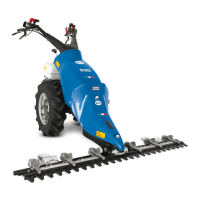
- Implement Versatility: The machines can be fitted with a wide range of implements, including ploughs (one-bottom and 180° swivel types, Figures 31, 32), ridgers (adjustable, Figure 35), cutter bars (Figure 26), lawnmowers (Figure 28), and snow throwers. Implements can be mounted directly to the flange (Figure 12, A) or via a quick hitch (Figure 13, C).
- Working Sulky (Figure 37): For models 730, a working sulky can be used with cutter bars and lawnmowers with grass bags. This requires the machine to be equipped with brakes.
- Moving Sulky (Figure 36): A moving sulky can be attached without removing the rotary hoe, by turning the knife rod (Figure 36, A). For models 720-730, it connects via a curved coupling (Figure 50, A).
- Wheel Spacers (Figure 46): These are used to widen the track and increase stability on sloping ground, especially when mounting 5.00-12" wheels on the 710 for ploughing.
- Ballast for Cutter Bar (Figure 49): A 12 kg (27 lbs) ballast can be added to balance the cutter bar without needing implement extensions.
- Front and Side Protections: Front protection for cutter bars (Figure 54) is mandatory during transfers or when the bar is exposed. Side protections (Figures 55, 56) prevent damage to plants or the blade from obstacles.
- Electric Starter (optional): For models with an electric starter, the battery is 12V 14/16Ah (gasoline engines) or 12V 33/35Ah (diesel engines).
Maintenance Features:
Regular maintenance is crucial for the machine's efficiency and longevity.
- Oil Level Checks: Engine oil levels should be checked every 4 hours of operation and replaced every 50 hours. Gearbox oil levels should be checked every 50 hours, ensuring the level is between the two marks (Figure 23, B and C).
- Air Filter Maintenance: For oil-bath air filters, the filtering element should be washed and oil replenished every 8 hours in dusty conditions. Paper air filters should be cleaned with compressed air or replaced if heavily obstructed.
- Clutch Adjustment: The clutch lever (Figure 24, A) may require adjustment over time due to wear. This involves adjusting the cable using the adjustment device (Figure 24, B) and counter-nut (Figure 24, C).
- Brake Installation (Figures 65-68): Detailed instructions are provided for installing drum brakes, including mounting brake-shoe half disks, brake shoes, and wheel drums.
- Lubrication: Wheel bushes should be periodically greased by disassembling the wheels and filling the space between the bushes with grease. The sliding bushes of the steering column stop rod should also be lubricated.
- Long-Term Storage: For extended periods of inactivity, it is recommended to drain fuel and engine oil, lubricate the cylinder (for gasoline engines) or injector hole (for diesel engines), thoroughly clean the machine, and protect cutter bar teeth.
- Troubleshooting: The manual provides a troubleshooting guide for common issues like engine not starting (checking fuel, carburetor, spark plug) and gears not engaging (clutch adjustment).
Safety Instructions:
The manual stresses several safety precautions:
- Operator Responsibility: Only one operator should use the machine, and observers should be kept away. The operator is responsible for any accidents or damage caused to others.
- Personal Protective Equipment: Wear resistant shoes and long trousers. For machines exceeding 85 dB(A) LAeq, acoustic protection (earmuffs) must be worn.
- Fuel Handling: Fuel is highly flammable. Store it in dedicated containers, refuel outdoors, do not smoke during refueling, and add fuel only when the engine is off and cool.
- Operation Environment: Do not operate the machine barefoot or in open-toe sandals. Do not use the machine on slopes steeper than 25%. Work transversally on slopes, not uphill or downhill.
- Implement Safety: Never approach hands or feet to moving implements. Do not modify engine speed regulator settings. Do not use fast connections or extensions with the rotary hoe, as this brings the hoe too close to the operator's feet.
- Lifting and Transport: If the machine or implements need to be lifted, place them on pallets, secure them, and lift with a forklift.
- Engine Operation: Do not operate the engine in closed environments due to lethal carbon monoxide exhaust. Stop the engine before leaving the machine, making adjustments, or refueling.
- Machine Condition: Never use the machine if guards or safety devices are defective. Keep the machine free from grass and grease to prevent fire hazards.

 Need help?
 General

 To Next Page