Product overview
CU1521-xxxx, CU156116 Version: 2.5
2 Product overview
2.1 Introduction
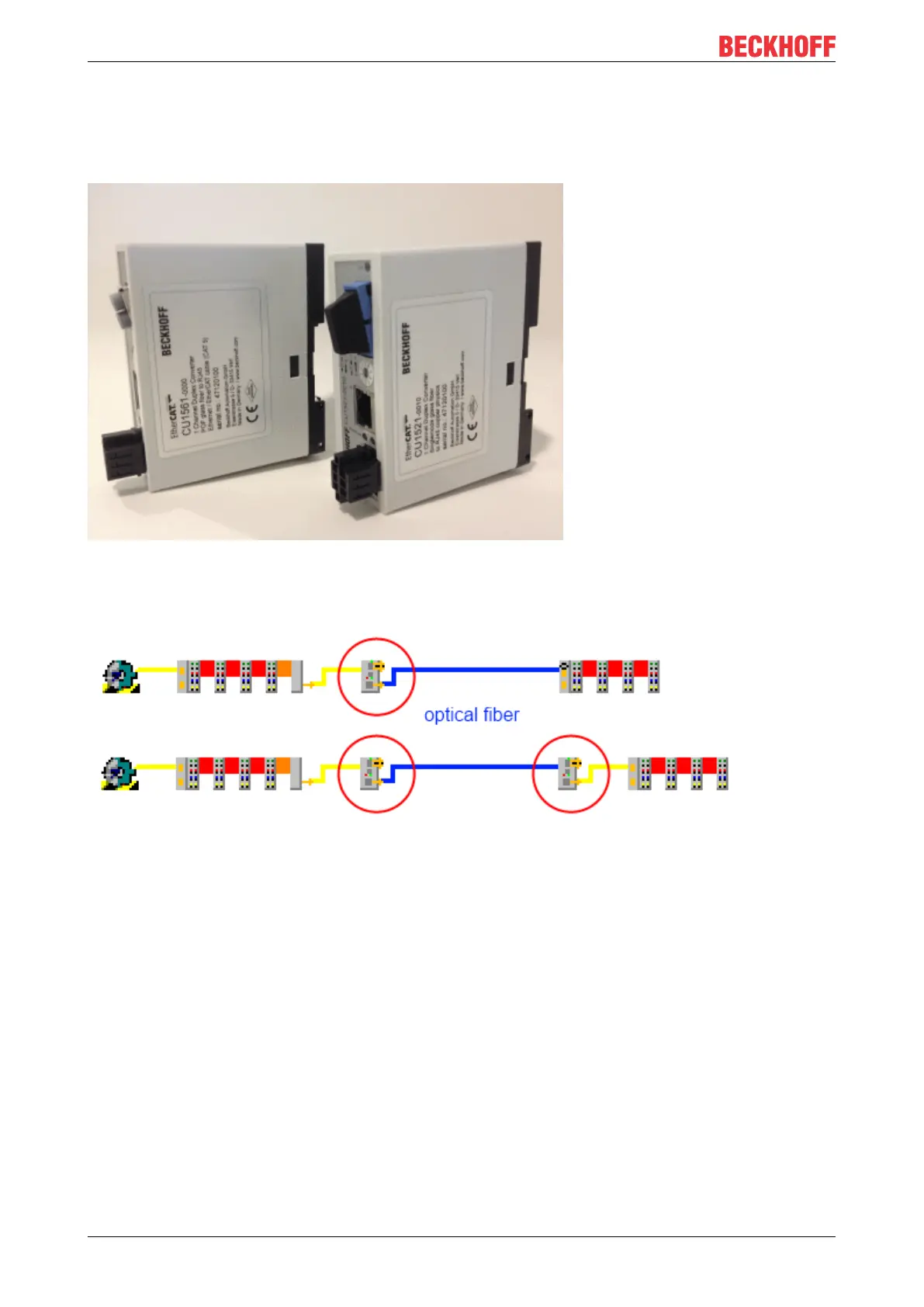
Fig.4: CU1561, CU1521
The EtherCAT-capable CU1521, CU1521-0010 and CU1561 devices should be used as media converter for
industrial fast Ethernet/100 Mbaud from optical fiber to copper and vice versa.
Fig.5: Upper picture: one media converter, copper -> fiber optic,
Lower picture: two media converters, copper -> fiber optic -> copper
From the physical layer perspective the CU1521 is suitable for multimode, while the CU1521-0010 is suitable
for single mode optical fiber and therefore for significantly longer transmission links up to 20 km.
The CU1561 is used for interfacing with POF (plastic optical fiber), which are suitable for small-scale
machine installation thanks to relatively inexpensive cable material and field-configurability.
The media converter operates bidirectionally and collision-free. The CU15x1 devices are therefore also
suitable as media converters for any Ethernet traffic. They support "Link Loss Forwarding", which means
that, if the link fails at the outgoing strand, for example due to a broken wire, the link is also withdrawn from
the incoming line, so that the sending device is notified of the link loss.
The CU15x1 devices are characterized by the fact that they support the requirements of an EtherCAT
network for a converter particularly well. This includes fast link control (establishment and disconnection),
diagnosis of communication errors, constant frame deceleration and readable identity (no transparent
operation). If the CU15x1 is set to EtherCAT mode with the rotary switch, it can be diagnosed as a separate
EtherCAT device. Hence, as opposed to standard media converters, he also ensures fast link control and
thus the secure termination of an EtherCAT strand even in the event of a disruption. Since the transfer
direction (copper Þ optical fiber or optical fibers Þ copper) is relevant for the EtherCAT bus, the operating
direction can be configured via the rotary switch.



 To Next Page