Commissioning/application notes
CU1521-xxxx, CU156126 Version: 2.5
5 Commissioning/application notes
5.1 Application notes
Table of contents
• Standard Ethernet [}26]
• EtherCAT [}27]
• Earthing/Shielding [}28]
• Firmware update [}28]
• General notes [}28]
The media converters CU1521, CU1521-0010, CU1561 (referred to as CU15x1 below) physically convert
100 Mbit telegrams (Fast Ethernet) from copper physics (RJ45 connector) to optical fiber (SC connector or
versatile link) and back.
Special behavior is expected from the converter, depending on whether EtherCAT or standard Ethernet
telegrams are to be transferred.
Used for: Standard Ethernet 10/100Mbit
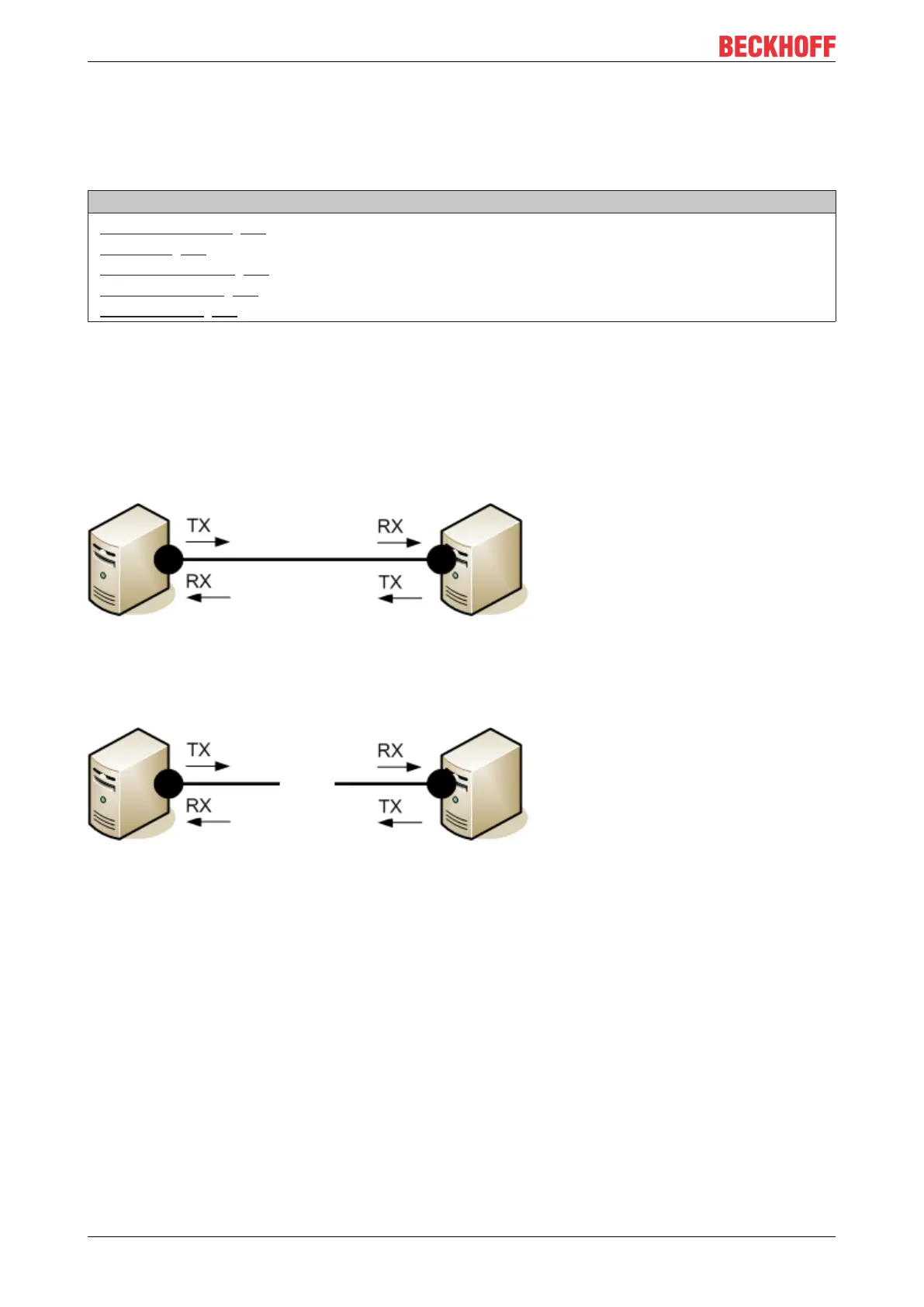
An Ethernet connection is a managed point-to-point connection between two intelligent end devices.
Fig.13: Point-to-point connection between two Ethernet devices
Both devices send a so-called idle sample to their Ethernet connection. The link has been established if a
corresponding sample is received. Both devices then know that they can use this connection. If the
connection is interrupted, the link is lost and both devices are notified.
Fig.14: Interrupted point-to-point connection
If a media converter is placed between the two stations, it too becomes an intelligent transmitter/receiver. If
connection C is interrupted, device A would not necessarily be informed and would continue to send data to
the converter via the existing link B, and the data would "trickle away". The CU15x1 therefore supports Link
Loss Forwarding (LLF) in a selected direction. The notification is indicated by a label on the CU15x1. If the
converter detects an interruption of connection C in switch setting 1 in Fig. Interposed media converter in the
Ethernet connection, it also interrupts link B.



 To Next Page