Need help?
Do you have a question about the Benchmark Scientific BeadBlaster 24 and is the answer not in the manual?
Check instrument and accessories against packing list upon receipt. Report discrepancies.
Read the manual carefully before operating the instrument.
Covers indoor use, skilled personnel operation, no unauthorized repair, and proper power handling.
Details safe installation location, power switch usage, and cord safety.
Covers risks of thermal breakdown for extended runs and unplugging events.
Clean tube holder with alcohol; unit exterior with damp cloth or mild detergent.
High speed, 3D vibration, 24 sample capacity, breakage of biological samples.
Specifies ambient temperature, humidity, and power supply requirements.
Lists parameters like display, speed, cycle duration, noise, power, and dimensions.
Diagram showing key components like cover latch, tube retainer, and display.
Details the buttons (Prog., Set, ▲, ▼, Start, Stop) and their functions.
Explains the information shown on the screen, including program, speed, time, and cycles.
Instructions on removing the tube retainer and placing sample tubes correctly.
How to access and scroll through the 50 onboard programs.
Step-by-step guide to setting speed, cycles, run time, and pause time.
Procedures for starting and stopping the homogenization process.
Explains the motor protection system and how to monitor/manage temperature.
Guidance on selecting appropriate beads based on tissue type and bead material.
Recommendations for sample preparation, including cooling before processing.
Table listing common problems, their possible causes, and recommended actions.
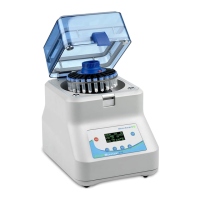
The BeadBlaster™ 24 D2400 Homogenizer is a laboratory instrument designed for the homogenization of biological samples. Its primary function is to break down and crack a wide variety of biological materials, including animal and plant tissues, soils, yeast, spores, and microorganisms. This is achieved through a high-speed, three-dimensional vibration mechanism, which efficiently processes samples to facilitate downstream applications such as DNA, RNA, and protein extraction.
The device is designed for ease of use and efficiency in a laboratory setting. It has a capacity to process up to 24 samples simultaneously, which significantly reduces processing time compared to manual methods or devices with lower throughput. The homogenizer incorporates on-board memory, allowing users to store up to 50 programmed runs. This feature is particularly useful for laboratories that frequently perform repetitive homogenization protocols, as it ensures consistency and saves time by eliminating the need to re-enter parameters for each run.
Safety and operational convenience are key aspects of the BeadBlaster™ 24. The instrument is equipped with a safety mechanism that automatically stops operation if the cover is opened during a run, preventing potential hazards from moving parts. The power switch is conveniently located on the rear of the instrument. For prolonged periods of inactivity, it is recommended to turn off and unplug the instrument, and cover it to protect against dust accumulation.
The operation panel features intuitive controls for program selection and setting. Users can easily select desired programs using the "Prog." key in conjunction with arrow keys. The "Set" key allows for adjustment of crucial parameters such as speed, run time, cycle duration, and pause time for the current program. These parameters can be modified using the arrow keys, and values are automatically saved after a few seconds of inactivity, ensuring that settings are retained for future use. The display provides clear feedback on the current program, speed, cycle count, run time, and interval time, along with the ambient temperature.
Loading samples into the homogenizer is a straightforward process. The tube retainer, which holds the sample tubes, can be easily removed by disengaging a locking latch and turning a knob counter-clockwise. The tube holder can be filled either inside or outside the instrument. When placing sample tubes, it is important to press them down until they are properly seated. If fewer than 24 samples are being processed, they should be distributed evenly within the tube holder to maintain balance during operation. The tube holder itself can be removed by simply lifting it off the shaft, and when replacing it, two bumps on the holder must align with indentations on the shaft to ensure correct positioning. After loading, the tube retainer is placed back on top of the tube holder, tightened clockwise, and the locking latch is pushed inwards until a click is heard, indicating it is securely locked. It is crucial that the locking latch is in the "LOCK" position before operation. The unit should never be operated without the tube retainer in place. Once the cover is closed and the cover latch engaged, operation can commence by pressing the "Start" button.
The instrument also includes a motor over-temperature protection system to prevent damage. An internal sensor monitors the motor's temperature. If the temperature exceeds 65°C, the unit will automatically shut down until the temperature drops below 60°C. Users can choose to display the motor temperature on the screen by simultaneously pressing the "Prog." and "Set" keys and toggling the sensor display to "ON."
Maintenance of the BeadBlaster™ 24 is simple and essential for its longevity. The tube holder should be cleaned with a cloth dampened with a small amount of alcohol. The exterior of the unit can be cleaned with a damp cloth or a mild detergent. It is imperative to disconnect power to the unit before any cleaning procedure. Cleaning solutions should not be applied directly to the tube holder or chamber, and corrosive agents should be avoided. The instrument should never be submerged in liquid.
Proper installation is also important for optimal performance and safety. The homogenizer should be placed in a cool, dry location, away from dust, direct sunlight, strong lights, corrosive gases, strong magnetic fields, and heat sources. Adequate air circulation is necessary, with at least 4 inches of space on all sides of the instrument, and the rear air vent must not be blocked. If multiple instruments are used, they should be placed at least 3 feet apart.
The manual also provides guidance on bead selection, which is critical for effective homogenization. Different types and sizes of beads (e.g., Triple-Pure Zirconium, Stainless Steel) are recommended for various sample types, including different tissues (skin, hair, bone, lung, liver, brain, heart, kidney, pancreas), microbial samples (Gram +/Gram -, yeast, fungi, bacteria, spores, mold), plant samples (soft plant tissue, tough plant tissue, leaves/stems, seeds/corn/nuts, rice, wheat), fecal samples (stool, scat), and soil samples. This detailed guidance helps users choose the most appropriate beads for their specific application to achieve optimal results.
For sample preparation, it is recommended that samples be added to bead-containing tubes and stored at low temperatures (below -60°C) for 12 hours prior to homogenization. This helps to mitigate potential damage to the sample caused by heat generated during the grinding process, ensuring the best possible results.
In case of abnormal operation, such as unusual noise, the "Stop" button should be pressed immediately, or the instrument should be turned off using the On/Off switch. The manual also outlines troubleshooting steps for common issues like no display, "Error: lid" messages, "open" audible alerts, the instrument not running, abnormal running noise, and unresponsive keys, directing users to check power supply, fuses, tube retainer placement, or contact the supplier for more complex problems.
 General
| Model | BeadBlaster 24 |
|---|---|
| Power Requirements | 100-240V, 50/60Hz |
| Bead Mill Homogenizer | Yes |
| Capacity | 24 x 2.0ml tubes |
| Tube Size | 2.0ml |
| Programs | 10 |
| Bead Mill Technology | High-speed bead |

 To Next Page