3
GENERAL SAFETY INSTRUCTIONS
WARNING: Before using this tool or any of its accessories, read this manual
and follow all Safety Rules and Operating Instructions. The important precautions,
safeguards and instructions appearing in this manual are not meant to cover all
possible situations. It must be understood that common sense and caution are
factors which cannot be built into the product.
EYE, EAR & LUNG PROTECTION
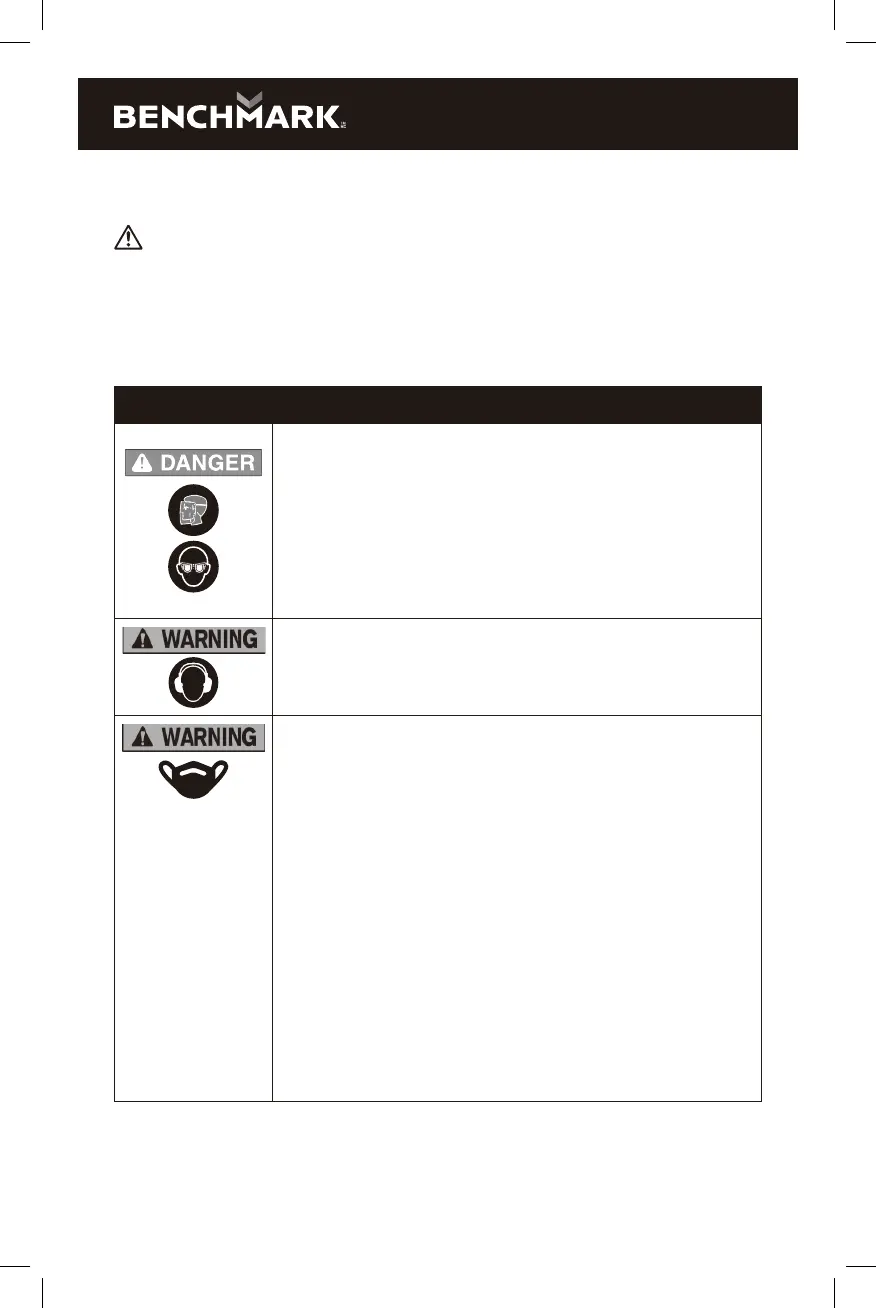
SYMBOL MEANING
ALWAYS WEAR EYE PROTECTION THAT CONFORMS
WITH CSA Z94.3 or ANSI SAFETY STANDARD Z87.1
FLYING DEBRIS can cause permanent eye damage.
Prescription eyeglasses ARE NOT a replacement for proper
eye protection. The usage of a safety standard compliant
face shield placed over proper safety glasses or goggles
can reduce the risk of facial injury.
Non-compliant eyewear can cause serious injury if broken
during the operation of a power tool.
Use hearing protection, particularly during extended periods
of operation of the tool, or if the operation is noisy.
WEAR A DUST MASK THAT IS DESIGNED TO BE
USED WHEN OPERATING A POWER TOOL IN A
DUSTY ENVIRONMENT.
Dust that is created by power sanding, sawing, grinding,
drilling, and other construction activities may contain
chemicals that are known to cause cancer, birth defects,
or other genetic abnormalities. These chemicals include:
• Lead from lead-based paints
• Crystalline silica from bricks, cement, and other
masonry products
• Arsenic and chromium from chemically treated lumber
The level of risk from exposure to these chemicals varies,
according to how often this type of work is performed. In
order to reduce exposure to these chemicals, work in a
well-ventilated area, and use approved safety equipment,
such as a dust mask that is specifically designed to filter
out microscopic particles.


 To Next Page