7
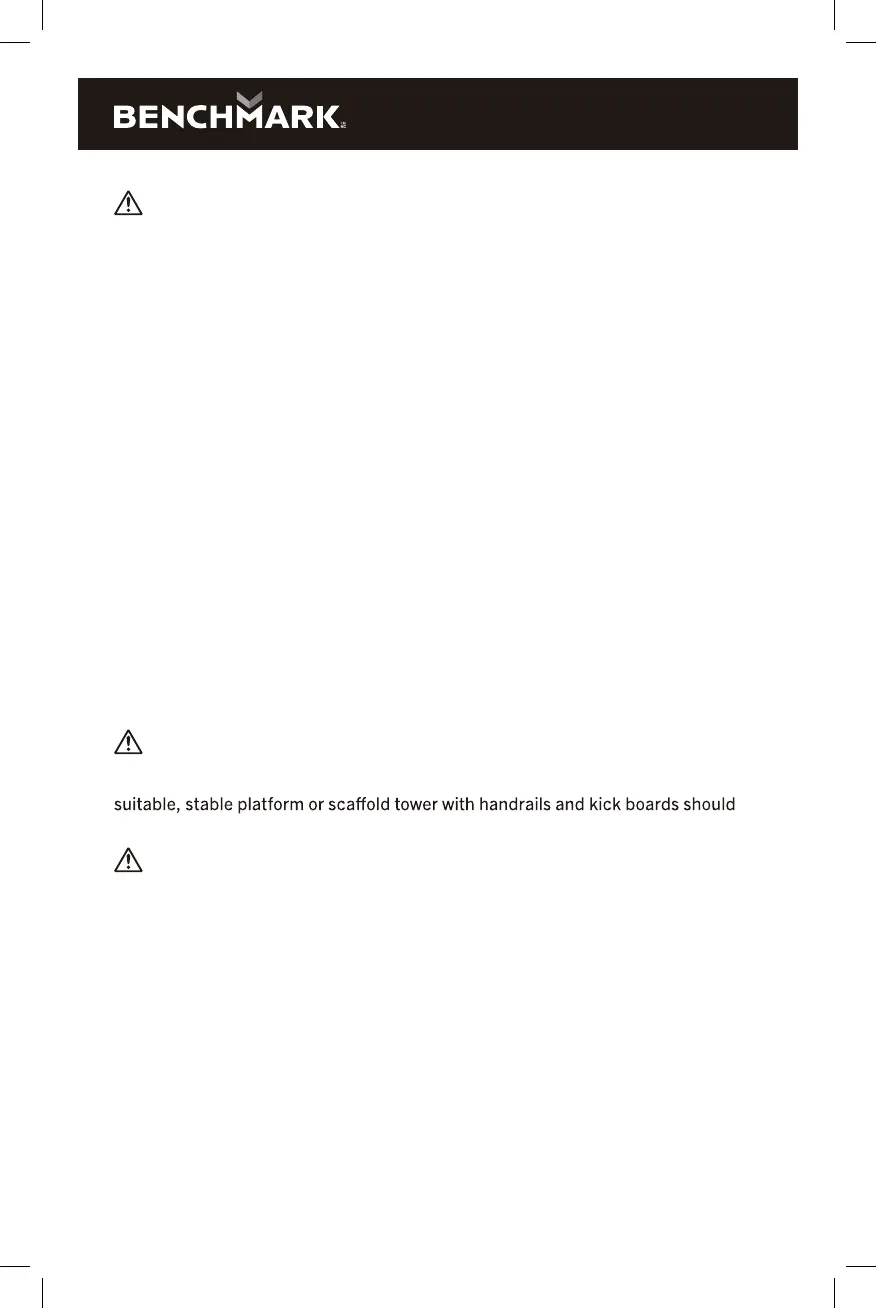
DANGER: Keep hands away from cutting area and blade. Keep your second
hand on auxiliary handle, or motor housing. If both hands are holding the saw,
they cannot be cut by the blade.
• Hold the tool by its insulated gripping surfaces when performing an operation
where the saw blade may contact hidden wiring or its own cord. Contact with a
"live" wire will make exposed metal parts of the tool "live" and shock the operator.
• Always hold the tool with two hands. Attempting to control the tool with only one
hand is dangerous. It could result in loss of control and serious injury.
• Never hold the workpiece in one hand and the tool in the other hand when sawing.
Never place the hands near or below the cutting surface.
• Clamp the workpiece and guide the tool with both hands.
• Always make sure the work surface is free from nails and other foreign objects.
Cutting into a nail can cause the blade and the tool to jump and damage the blade.
• Never lay the workpiece on hard surfaces like concrete, stone, etc. The protruding
blade may cause tool to jump.
• After changing a blade or making adjustments, make sure the blade clamp is
holding the blade securely. Loose blades could be violently thrown from the tool.
• Never use dull or damaged blades. Sharp blades must be handled with care.
Damaged blades can snap during use. Dull blades require more force to cut the
workpiece, possibly causing the blade to break.
• Never touch the blade during or immediately after use. After use the blade is too
hot to be touched.
WARNING: Two handed Operation Required. This machine requires the use
of two hands to ensure safe operation and should not be used when working from
ladders and step ladders. If the machine is to be used when working at height a
be used.
WARNING: Some wood and wood type products, especially MDF (Medium
Density Fiberboard), can produce dust that can be hazardous to your health.
We recommend the use of an approved face mask with replaceable filters when
using this machine in addition to using the dust extraction facility.
• Do not reach underneath the workpiece. The guard cannot protect you from the
blade below the workpiece.
Adjust the cutting depth to the thickness of the workpiece. Less than a full tooth
of the blade teeth should be visible below the workpiece.
• Never hold the piece being cut in your hands or across your leg. Secure the
workpiece to a stable platform. It is important to support the work properly to
minimize body exposure, blade binding, or loss of control.
• Hold the power tool by insulated gripping surfaces when performing an operation
where the cutting tool may contact hidden wiring. Contact with a “live” wire will
also make exposed metal parts of the power tool “live” and shock the operator.
• When ripping, always use a rip fence or straight edge guide. This improves the


 To Next Page