23 - 24
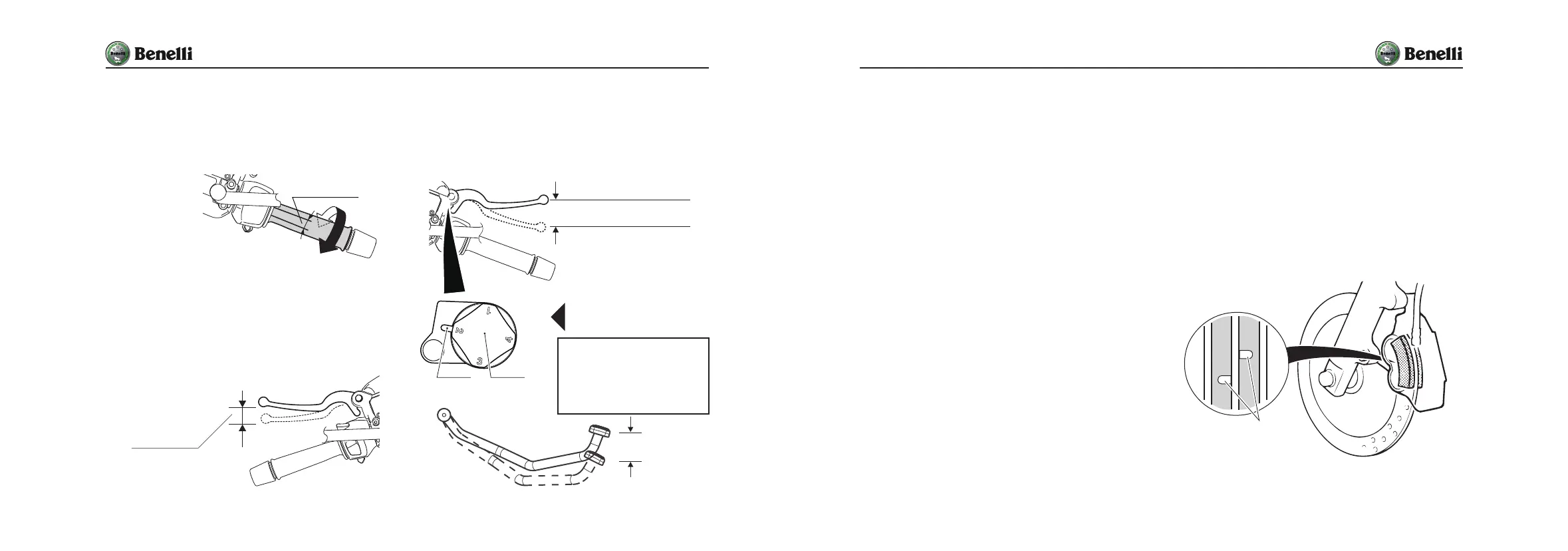
The throttle cable free play should measure 3.0–5.0
mm at the throttle grip. Periodically check the
throttle cable free play and, if necessary, have a
dealer adjust it.
CHECKING THE THROTTLE CABLE
FREE PLAY
3.0–5.0 mm
The free play of clutch is measured from the free
status of the lever,
Adjust in following methods, if anything abnormal.
(1) Loose the locknut.
(2) Screw in or out adjusting bolt and adjusting
screw to make required free stroke.
(3) Tighten locknut.
CHECKING THE CLUTCH FREE PLAY
10 – 20 mm
For the brake lever and brake pedal free play, please
refer to the following parameters as shown. Periodi-
cally check the brake lever free play and, if neces-
sary, have a dealer check the brake system.
CHECKING THE FRONT BRAKE LEVER AND
REAR BRAKE PEDAL FREE PLAY
20-30 mm
The front and rear brake pads(if equipped) must be
checked for wear at the intervals specified in the
periodic maintenance and lubrication chart.
Each brake pad is provided with wear indicator
grooves, which allow you to check the brake pad
wear without having to disassemble the brake. To
check the brake pad wear, check the wear indicator
grooves. If a brake pad has worn to the point that the
wear indicator grooves were mostly disappeared,
have a dealer replace the brake pads as a set.
CHECKING THE BRAKE PADS
Indicator
Disk Brake: No spongy
Drum Brake: 10-20mm
Push and hold the brake
lever foward and turn the dial
"c" to the preferred position
of the clearance setting.
After adjustment, make sure
the number on dial is match-
ing to the arrow mark "b" on
the brake master cylinder.
b c
Rear brake pedal
Front brake lever
a
{
Position #1
Minimum brake lever free play
(for rider with bigger hand)
Position #4
Maximum brake lever free play
(for rider with smaller hand)
(IF EQUIPPED)
COMBINED BRAKE SYSTEM (CBS)
This vehicle is equipped with a three-piston front cal-
iper and a one-piston rear caliper. By pulling only the
front brake lever, the system only activates the two
outer pistons of the front caliper.
By applying the real brake lever or pedal, the system
activates first the piston of the rear caliper. When
brake fluid pressure in rear brake cylinder builds up
to 0.1Mpa, the CBS will enable the auxiliary route to
transfer the pressure to the front caliper center
piston. When reaching certain design value (varies
from model to model), the pressure of center piston
of front brake caliper will reach its safety upper limit
and stop increasing. This design is to ensure when
rider applies the rear brake, the front wheel will also
be involved in contributing appropriate braking force,
but will not lock the front wheel and cause danger to
the riders.
For full braking effectiveness, use both the front and
rear brake lever simultaneously, as all conventional
braking system suggests. Please note that CBS
cannot prevent the hazard of sudden or excessive
the braking behaviors by the riders, which may result
in losing control of the vehicle. Please always con-
sider your speed with the road condition and brake
properly.


 To Next Page