Need help?
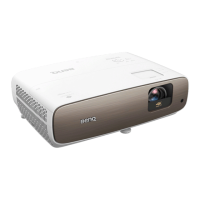
Do you have a question about the BenQ W2710 and is the answer not in the manual?
Details the wire connections for projector control.
Outlines the pin assignments for the RS232 serial port.
Explains how to connect using an RS232 serial port and a crossover cable.
Details COM port identification, selection, and serial port setup parameters.
Explains how to find the projector's IP address and configure network settings for RS232 control.
Details how to set up RS232 communication over an HDBaseT connection.
This document serves as an installation guide for controlling BenQ W2710/W2710i and HT3560/HT3560i projectors via RS232 commands. It outlines the necessary steps for establishing connections and configuring communication settings, followed by a comprehensive table of RS232 commands. The guide is designed to assist users in integrating their BenQ projectors into a controlled environment, allowing for remote operation and management from a computer.
The primary function of this guide is to enable users to control their BenQ projectors remotely using RS232 commands. This capability allows for a wide range of operational controls, from basic power management to intricate picture and audio adjustments, as well as system settings. The RS232 interface provides a robust and reliable method for integrating the projector into a larger control system, such as a home automation setup or a professional AV installation.
The projector can be controlled through various connection methods:
The command set covers a broad spectrum of projector functions, including:
The guide emphasizes a structured approach to setting up RS232 control:
<CR> (carriage return) at the end of each command. Commands are typically in the format <CR>*command#<CR> or <CR>*command=value#<CR>.<CR>*power=?#<CR> to check power status). This is crucial for feedback and verification in automated systems.+#<CR> or -#<CR>), providing granular control without needing to know the exact current value.While the guide primarily focuses on control, some commands can be considered maintenance-related:
rstcurpicsetting#<CR> (reset current picture settings) and rstallpicsetting#<CR> (reset all picture settings) allow users to revert picture adjustments to default values, which can be useful for troubleshooting or preparing the projector for a new setup.Itim=?#<CR> command allows users to read the lamp hours, which is a critical maintenance indicator for projectors. This helps in planning lamp replacements and ensuring optimal performance.qcool=on<CR> and qcool=off<CR> commands, along with qcool=?<CR> for status, relate to the projector's cooling system. Proper cooling is essential for the longevity and stable operation of the projector lamp and internal components.Highaltitude=on#<CR> and Highaltitude=off#<CR> are important for projectors operating in high-altitude environments, where different cooling profiles are required to prevent overheating.prjlogincode=on#<CR> and prjlogincode=off#<CR> commands, along with prjlogincode=?#<CR> for status, suggest the presence of logging features that could be used for diagnostic purposes or tracking projector usage.amxdd=on#<CR> and amxdd=off#<CR>, and amxdd=?#<CR> for status, indicate support for AMX device discovery, which is a feature for integrating the projector into AMX control systems, simplifying setup and management in professional environments.diris=on#<CR>, diris=off#<CR>, and diris=?#<CR> allow control over the dynamic iris, which helps in optimizing contrast and black levels. Proper management of this feature can contribute to better image quality and potentially extend the life of the lamp by adjusting light output as needed.The guide also includes a section for "FAQ Video" with links to YouTube tutorials covering common setup and control scenarios, offering an additional resource for troubleshooting and understanding practical applications of RS232 control. This demonstrates a commitment to supporting users in maintaining and effectively utilizing their BenQ projectors.
 General
| Number of colors | 1.07 billion colors |
|---|---|
| Native aspect ratio | 16:9 |
| Vertical scan range | 23 - 120 Hz |
| Horizontal scan range | 15 - 135 kHz |
| Projection technology | DLP |
| Contrast ratio (typical) | 50000:1 |
| Screen size compatibility | - \ |
| Projector native resolution | 2160p (3840x2160) |
| Keystone correction, horizontal | -30 - 30 ° |
| Light source type | Lamp |
| Service life of light source | 4000 h |
| Service life of light source (economic mode) | 10000 h |
| Offset | 100 % |
| Throw ratio | 1.13~1.47 |
| Focal length range | 12 - 15.6 mm |
| Aperture range (F-F) | 1.9 - 2.47 |
| Vertical lens shift range | 0 - 10 % |
| Noise level | 30 dB |
| Preset modes | 3D, Bright, Cinema, ISF Day |
| Noise level (economic mode) | 28 dB |
| High Dynamic Range (HDR) supported | Yes |
| High Dynamic Range (HDR) technology | Filmmaker Mode, High Dynamic Range 10 (HDR10), Hybrid Log-Gamma (HLG) |
| DVI port | No |
| HDMI ports quantity | 3 |
| Serial interface type | RS-232 |
| USB 2.0 ports quantity | 1 |
| Audio decoders | Dolby Atmos |
| RMS rated power | 10 W |
| Number of built-in speakers | 2 |
| Operating temperature (T-T) | 0 - 40 °C |
| Power source | AC |
| AC input voltage | 100 - 240 V |
| AC input frequency | 50 - 60 Hz |
| Power consumption (standby) | 0.5 W |
| Power consumption (typical) | 330 W |
| Product color | White, Grey |
| Market positioning | Home cinema |
| Video color modes | Bright cinema |
| Supported video modes | 1080p, 2160p |
| Supported graphics resolutions | 640 x 480 (VGA), 3840 x 2160 |
| Security updates end date | 31/12/2026 |
 Weight and Dimensions
| Depth | 263 mm |
|---|---|
| Width | 380 mm |
| Height | 127 mm |
| Weight | 4200 g |


 To Next Page