Need help?
Do you have a question about the Berthold MicroPolar LB 566 and is the answer not in the manual?
Explains symbols and warnings used in the manual for safety and operational guidance.
Details important safety measures, national regulations, engineering rules, and information sources.
Provides essential safety instructions for operating the equipment, including environmental conditions and handling.
Defines the intended purpose of the LB 566 concentration measuring system and highlights inappropriate uses.
Details compliance with FCC rules, Industry Canada standards, and outlines operation conditions and license labels.
Describes how the LB 566 determines water/moisture content and concentration, including sensor types and operational tips.
Provides definitions for key terms used in the manual, such as Attenuation, FlowCell, HF cable, and Microwaves.
Explains how microwaves are used to measure phase shift and attenuation for concentration determination.
Details the formula for calculating measured values based on phase and attenuation, including limitations.
Explains the need for temperature compensation and the formula for calculating it with measured temperature.
Describes how to calculate throughput (mass flow) for pipeline applications and output the result via current output.
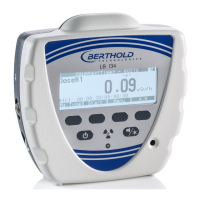
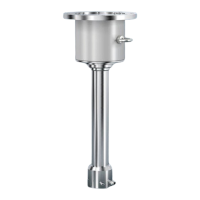
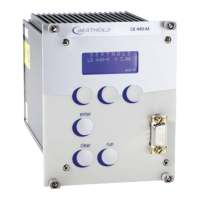
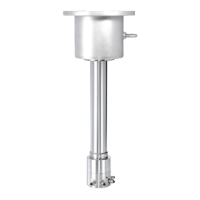
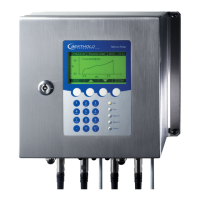
Describes the various mechanical components of the measuring system, including evaluation units, flow cells, probes, and cables.
Details the installation of the evaluation unit and FlowCell for pipeline applications, including preferred orientation and sample points.
Describes the installation of the evaluation unit and container probe for process containers, emphasizing cable length and sampling points.
Provides warnings and recommendations for transporting system components, including packaging, shock protection, and weight considerations.
Guides through the installation and connection steps for commissioning the FlowCell.
Guides through the installation and connection steps for commissioning the container probe.
Details the final connection steps for the evaluation unit, including pin configuration and digital output setup.
Discusses common malfunctions, identifying errors via display messages, and the non-repairable nature of certain modules.
Identifies wear parts like plastic caps and PEEK windows, and provides instructions for replacing plastic caps on container probes.
Provides instructions for cleaning system components using a damp cloth or warm water, respecting temperature limits.
Explains the role of the lithium battery, error messages related to battery voltage, and its service life.
Details the location of mains fuses and the procedure for replacing them, emphasizing disconnection from mains and using correct ratings.
Details housing, weight, ambient conditions, display, and keyboard specifications for the evaluation unit.
Provides technical specifications for FlowCells, including application, material, process coupling, pressure, temperature, and connections.
Details specifications for HF cables, including types, lengths, protection, and temperature ranges.
Defines the headline and data format for serial output, including parameter codes, descriptions, and special characters.
Contains the EC Declaration of Conformity for the Concentration-Measuring System MicroPolar, listing relevant EC regulations and standards.
EHEDG certificate for the microwave sensor FlowCell, confirming compliance with Hygienic Equipment Design criteria.
Presents the CE-marked Expert Opinion certificate and frequency license details, including essential requirements and submitted documents.
Certificate issued by CTC advanced, confirming that the equipment meets the requirements of the above-noted specification.
Grant of Equipment Authorization from the FCC, detailing FCC Identifier, grantee, equipment class, and rule parts.
Provides detailed dimension drawings for the wall housing of the evaluation unit, showing front, side, and top views.
Illustrates the electrical connections for MicroPolar and MicroPolar ++, detailing line input, terminal strips, and internal components.
Provides dimensional drawings for various FlowCell types including Flange (FDA), G-BS/M, and Welding Pipe connections.
Provides dimensional drawings for LB 5650 container probes and shows installation situations in pipelines.
Provides dimensional drawings for LB 5651 container flush probes and shows installation situations in pipelines.
Provides assembly instructions for LB 5650 and LB 5651 container probes, including installation in crystallizers and connection diagrams.
Provides an overview of the LB 566's menu structure, access levels, and notes functions not relevant to the measuring system.
Presents a graphical overview of the LB 566's menu structure, showing navigation paths for Live Display, Diagnostic, Setup, and Language.
Describes functions within the Start Menu: Live Display, Diagnostic, Setup, Access Level, and Language.
Details the Diagnostic menu, including Datalog, Error log, Info, and Print Setup options for data logging and error reporting.
Explains the Setup menu options: Configuration, Calibration, Input/Output, Service, Product selection, and Password change.
Describes the Read only, User mode, and Service access levels, including password protection and password changes.
Allows selection of the dialog language for the user interface.
Covers configuration of General Data, Measurement modes, Plausibility limits, Microwave cable lengths, Mass Flow, and Units.
Details setting the current date, time, and tag for the measuring point within the General Data section.
Details configuration of Measurement Mode (batch/continuous), Start Mode, Averaging, and Current Output at Stop.
Covers setting Process Limits for concentration range, Phase Measurement plausibility analysis, and Offline mode.
Allows configuration of Sigma max, Phi/att ratio, and Auto set for phase measurement plausibility.
Enables and configures the Offline mode, which activates when measured attenuation falls below a set minimum.
Details the prerequisites and configuration for mass flow (throughput) calculation, including cross-sectional area and pipe inside diameter.
Initiates system calibration, conc. calibration for one or two concentrations, and advanced settings.
Starts system adjustment to set phase and attenuation to zero, forming the measurement reference.
Guides through sampling, calibration parameter selection, and tuning for concentration measurement.
Details the process of taking and recording samples for calibration, including header information and sample management.
Displays expanded sample data including current inputs, PT100, phase, and attenuation for detailed analysis.
Allows setting Tare values, Number of Calibration Sweeps, Process Type, and Split Value for advanced calibration.
Explains the calibration formula and how to enter or automatically calculate calibration coefficients (A, B, C, D, E, F, G).
Covers configuration of Current Output, Current Input, PT100, Digital Output, and Digital Input settings.
Details how to adjust and assign signals to current outputs, including 4 mA and 20 mA display values.
Explains assignment options for Current Output 1, 4 mA and 20 mA values, and test/adjust functions.
Details functions for Current Output 2, including assignment options, range (0-20mA or 4-20mA), and test/adjust.
Explains how to configure Current Input 1 and Current Input 2, including activation and calibration menus.
Details settings for Current Input 1: Status, Range (0-20mA/4-20mA), 0/4mA and 20mA display values, Adjust, and Live current.
Details settings for Current Input 2, noting they correspond to Current Input 1.
Explains enabling and adjusting the PT100 input, including requirements for resistance and displaying live temperature.
Describes the two relays (Relay 1 and Relay 2) and the functions that can be assigned to them, including Error, Hold, and Alarm.
Explains the three digital inputs and the functions that can be assigned to them, such as Start/Stop, Hold, Sampling, and Product selection.
Covers factory settings, general reset, memory tool operations for parameter and datalog saving, and data printout options.
Explains how to use the Trend Display by zooming on measurement values and corresponds to datalog content.
Guides users to navigate the menu for configuration setup, starting from the main menu via SETUP.
Details setting the current date, time, and tag for the measuring point within the General Data section.
Instructs to check and adapt measurement settings like Mode, Start Mode, Averaging, and Reset Averaging.
Explains adjusting process limits for concentration range and setting up phase measurement and offline mode.
Covers entering reference and signal cable lengths, correcting factory-set values to match actual geometry.
Allows setting desired units for concentrations, current inputs, and temperature measurements.
Enables setting a marker with up to 5 characters to identify values in the live display.
Guides users to start calibration and access coefficients, explaining the default calculation formula (Measured value = A * Phase + C).
Explains how to configure Plausibility settings including Sigma max, Phi/att ratio, and Auto set, and how to determine the Phi/att ratio.
Guides through the System Adjust process, which sets phase and attenuation to zero, forming the measurement reference.
Explains how to check reference values for Sigma and Attenuation after system adjustment.
Details the process of starting measurement, taking samples, and saving them for calibration, including temperature compensation.
Explains that system adjustment and calibration are similar to standard MicroPolar, but highlights the minimum attenuation requirement for the ++ unit.
Details how to configure Plausibility settings and the Phi/Att ratio, including entering known values or using auto-set.
Provides steps to determine the Phi/att ratio by performing a process recording or entering a start value.
Explains the process recording procedure to determine the phase and attenuation ratio for plausibility analysis.
Explains how to enter a correction factor and offset for subsequent calibration adjustment, including an example offset calculation.
Guides on how to print the start-up protocol via RS232 and RS485, including its contents and further information.
Details various setup options for calibration, including Cal. Base selection (Phase, Attenuation, Both).
Describes calibrating for two concentrations by changing the process type and repeating calibration for concentration 2.
Explains calibration combining two curves in one range, defining the split value and sample assignment based on concentration.
Provides typical calibration coefficients (A and C) for dry matter and moisture determination under specific conditions.
Explains how to reset the user level password if forgotten, by turning the device off and on while pressing a specific key.
Lists error codes related to power failures (24V, 9V, 5V, 3V) and battery failure, with probable causes and corrections.
Lists error codes for attention due to ambient temperature too high or RF temperature out of range, with checks for operating temperature.
Details error codes for hardware failures like program memory corruption, data memory corruption, I2C-bus communication, and LCD issues.
Lists error codes for sensor issues such as phase variance too high, no product, no system adjustment, and insertion loss.
Details error codes for current input 1, current input 2, and PT100 temperature being out of range.
Lists error codes for concentration or loading values being out of range, sync time issues, and waiting for sync values.
Details error codes related to mass flow calculation, including invalid product speed or density.
Lists error codes for current output 1 and 2 being out of range, indicating concentration is outside the current range.
Reports watchdog errors, suggesting contact with Berthold Technologies Service.
Details system errors like 'No time / date setting', prompting the user to enter the date and time.
Lists error codes for density calculation errors, related to radiometric MPUA or height signal out of range.
Details input errors such as value too large/small, table empty, faulty chart data, no chart data, or sampling full.
Explains different device states (Error, Warning, Hold, Offline) and their corresponding LED indications and current output behaviors.
Provides an example start-up protocol table with parameters, codes, and interpretation for service personnel.
Presents a table structure for recording sample data, including columns for Active, Measured value, Lab value, current inputs, PT100, Phi(fm), and Attenuation.
 General
| Light Source | LED |
|---|---|
| Resolution | 0.001° |
| Power Supply | 24 V DC |
| Wavelength | 589 nm |
| Dimensions | 200 x 300 x 150 mm |

 To Next Page