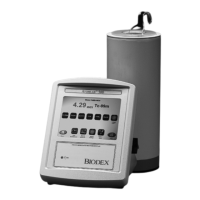
Effective Renal Plasma Flow (ERPF)
(See Figure 9-10 and 9-11.)
The ERPF procedure in the Biodex Medical Spectrometer is based on the Journal of Nuclear Medicine,
Volume 30, Number 12, December 1989, entitled, "Estimation of Technetium-99m-MAG3 Plasma
Clearance in Adults From 1 or 2 Blood Samples" by Charles D. Russell, Andrew Taylor and Dennis
Eshima, Div. of Nuclear Medicine, Univ. of Alabama, Birmingham V.A. Medical Center.
The Biodex program is designed to do the calculations for ERPF using the formula and procedures
discussed in the above mentioned article. The following instructions describe how to count and obtain the
correct results using the Biodex Medical Spectrometer. \
The Technetium-99 Mag 3 Renal Function Study: For the single sample method, a plasma sample must
be obtained between 35 and 55 minutes after injection. It is recommended to use a 44 or 45 minute time
for withdrawing the blood sample.
The following procedures are for counting and getting results for the ERPF study.
1. From the <Patient Definition> window, choose ERPF as the study that will be performed. This can
be done with either a new patient or an existing patient.
2. At the counting page, verify that the patient and patient ID# are correct.
3. Click on <Preferences> to access the ERPF parameters. Verify that the parameters are correct. If you
wish to make any changes, do so before counting. The Mag 3 conversion factor should be set up as a
study default if desired in the procedure window. Once the parameters are set, click on <OK> to
save them.
4. Place the background counting vial into the well counter. Click <Background> to begin counting
background. When done counting, the system displays the counts and the CPM.
5. Click on <Injection> and enter the time that the Mag 3 was injected into the patient. Click <OK> to
return to the counting page.
6. Remove the vial for background from the well counter and insert the standard counting vial into the
well. Click on <Standard>count the standard for the designated period of time. When counting is
complete, the count and CPM will be displayed and entered on the system.
7. Click on <Time / Sample 1> to display the window for entering the blood sample withdrawal time.
Once you have entered the correct blood withdrawal time, click <OK> and proceed with the study.
NOTE: It is recommended to save test results before leaving this patient and screen.
8. Remove the standard from the well and place the sample into the well. Click on <Sample> for the
system to proceed to count the sample. When counting is complete, the system will display the
results on the screen for both counts and CPM.
9. When the system has finished counting and displays the results for the sample, it will also display
the "Verified Test Complete" message. You can now save the study by clicking on <Yes>, or if you
click <No>, you can go back and make changes to the times that the samples were made or recount
any of the items counted. Once you are satisfied with the results, click <Save> to display the
"Verified Test Complete" screen and then click <Yes> to save the results.
10. To print a report, click on the <Printer> icon to display the report window. If desired, enter the
technologist's name, activity used, and add comments to the report in this mode before printing.
11. Once counting had been completed, you can proceed to do any other studies desired.
CONTENTS
9-17 HEMATOLOGY


 To Next Page