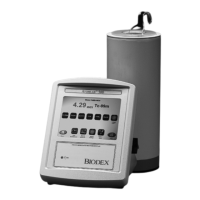
From these two examples, you can see that the well is at least 4 to 5 times more efficient for wipe test
counting than the probe and is less dependent upon wipe positioning errors.
The Atomlab 950 is shipped with the Isotope Efficiency screen set to centimeters (see pages 3-12 and
Figure 3-10). The system can be set to centimeters, inches or any other unit of measure, as long as it is
consistent for the diameter and distance. Please verify that the set-up in the Isotope Efficiency page is set to
match the 2" diameter tube supplied with this unit.
B. Detector Efficiency (D.E.)
D.E. can be calculated theoretically from system parameters or can be empirically determined by
measuring the count rate from a known activity of each isotope. The empirical method results in a
composite value (G.E.
*
D.E.) which can be reduced to D.E. by dividing by the calculated value for G.E.
Only the empirical method will be discussed below. The theoretical (analytic) method is discussed (Item
E) following an example calculation.
C. Efficiency Values for Wipe Testing
All isotopes for which wipes are to be counted shall either be prepared from a known liquid
concentration or if possible, a standard source can be purchased in a wand form from various
manufacturers. Generally, the isotopes Cs-137, Co-57, Co-60, Ba-133, and Am-241 are available in wand
form with a stated activity and uncertainty. The activity should be kept in the range of 0.01 to 0.1 µCi, and
should not exceed 0.2 µCi. This will generally keep the overall counting rate below 10,000 cps and will
eliminate any spectrum distortion or non-linearity from playing a role in the efficiency calculation.
A suggested procedure for source preparation is outlined on the next page. The liquid source will be
deposited on an absorbent material in the bottom of a plastic vial which fits inside the well. It is recom-
mended that no more than 10 ul of liquid be dispensed in order to reduce spilling radioactive material.
NOTE: If a probe is being tested for efficiency, a method for holding the source or vial in proximity of the probe,
approximately one (1) cm, must be arranged and then the following procedure followed with modification as needed.
If a greater distance is used then you must increase activity according to the inverse square law.
Source Preparation:
1. Prepare an activity of 0.1 to 0.01 mCi of the isotope in 10.0 ml of saline. This will result in a
concentration of approximately 0.01 to 0.001 mCi/ml. The volume should be either controlled as close
as possible to 10.0 ml or precisely measured.
2. Assay the activity in the vial in a dose calibrator which has a resolution of 0.01 µCi. Compensate for
background before making the measurement. Record the time of measurement.
3. Calculate concentration by dividing the measured activity by the source volume and record with the
time of measurement.
4. Prepare the vial with absorbent material (such as a portion of a wipe pad or the end of a Q-tip) at the
bottom of the vial.
5. Draw off 10 ul of source material and carefully place the end of the syringe tip at the bottom of the
vial. Deposit all of the source material onto the absorbent material.
6. Withdraw the syringe and immediately rinse it in saline at least ten (10) times. This will reduce the
chance of contamination of the next source which will be a different isotope.
7. Record the activity in the test vial as A
Xx-123
at the time T is recorded in step 2. (The Xx-123
subscript is meant to designate the isotope symbol which should be recorded, i.e., Am-241.)
1. INTRODUCTION
APPENDIX A A-2


 To Next Page