1. Introduction
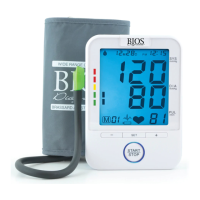
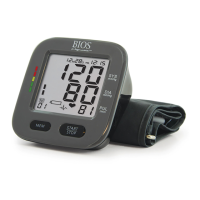
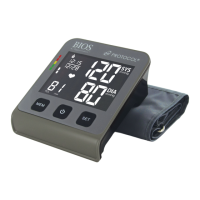
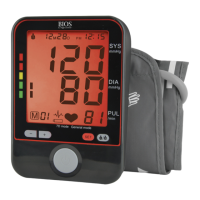
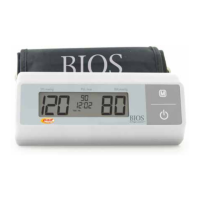
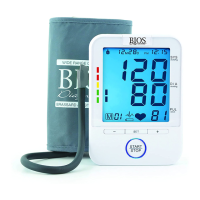
Thank you for purchasing the BIOS Diagnostics™ Easy Read Blood Pressure Monitor. Designed for convenient and
easy operation, this device provides a simple, yet accurate method to measure your blood pressure.
Your blood pressure is an important parameter that can be used to monitor your health. This device enables you to
monitor your blood pressure regularly, and maintain a record of your blood pressure measurements. You can then use
this record to assist your physician in diagnosing and maintaining a healthy blood pressure level.
1.1 Features
The BD201 uses oscillometric technology to measure the arterial blood pressure and pulse rate. The cuff is wrapped
around the arm and automatically inflated by the air pump. The sensor in the device senses weak fluctuation of the
pressure in the cuff produced by extension and contraction of the artery of the arm in response to each heartbeat. The
amplitude of the pressure waves is measured, converted in millimeters of the mercury column, and is shown on the
display.
• Memory Features 2 users, 90 blood pressure readings each with time and date.
• BP Assessment Indicator displays the range between which your blood pressure values lie, according to
Hypertension Canada.
• Detects Irregular Heartbeat
• BIOS Averaging - averages last 3 readings
• Time and Date
This device is easy to use and has been proven in clinical studies to provide excellent accuracy. Before using the
BD201, read this instruction manual carefully and keep it in a safe place.
The blood pressure monitor meets the accuracy requirements of Hypertension Canada and has been tested for clinical
accuracy.
1.2 Important Information
Refer to the following sections to learn about important safety instructions and how to take care of the BIOS
Diagnostics™ Easy Read Blood Pressure Monitor.
1.2A Safety Information
• Self-measurement means control, not diagnosis or treatment. Your values must always be discussed with your
doctor or a physician who is familiar with your family history.
• If you are undergoing medical treatment and receiving medication, consult your doctor to determine the most
appropriate time to measure your blood pressure. Never alter the dosages of any medication without direction
from your doctor.
• Your blood pressure depends on several factors, such as age, gender, weight and physical condition. It also
depends on the environment and your state of mind at the time of measurement. In general, your blood pressure is
lower when you are asleep and higher when you are active. Your blood pressure may be higher when recorded at a
hospital or a clinic and may be lower when measured in the relaxing comfort of your home. Due to these variations,
we recommend that you record your blood pressure regularly at home as well as at your doctor’s clinic.
• Try to record your blood pressure regularly at the same time of the day and under the same conditions. This will
help your physician detect any extreme variations in your blood pressure and thus treat you accordingly.
• Morning Hypertension (>135 / 85 mmHg): Recently, several studies have identified elevated cardiovascular risks
(heart failure, stroke, angina) associated with “morning hypertension”. There is a typical rise in blood pressure
during the physiological changes from sleep to arising for the day.
• The ideal time to measure your blood pressure is in the morning just after you wake up, before breakfast and any
physical activity, and in the absence of the urge to urinate. If this is not possible, try to take the measurements


 To Next Page