45
4.1 General
The helm controls consist of three systems: the
engine throttle and shift controls, the steering
system, and the trim tab control switches. These
systems provide the operator with the ability to
control the direction and attitude of the boat from
the helm station.
Each manufacturer of the control components
provides an owner’s manual with its product. It is
important that you read the manuals and become
familiar with the proper care and operation of the
control systems.
4.2 Engine Throttle & Shift Controls
The shift and throttle controls on your boat may
vary depending on the engine and options se-
lected. The following description is typical of most
cable and electronic control systems. Refer to the
engine or control manual for specic information
on the controls installed on your Boat.
Cable Engine Controls
Cable engine throttle and shift control systems
consists of three major components: the control
handle, the throttle cable and the shift cable. The
cables are all the push-pull type. Two cables are
required for each engine and control. One con-
nects the remote throttle control to the engine
and the other connects the remote shift control
to the shift linkage.
The helm is designed for a binnacle mount control
with a single lever for each engine that operates
as a gear shift and a throttle. General operation
will include a position for neutral (straight up and
down), a forward position (the 1st detent forward
of neutral), and a reverse position (the 1st detent
aft of neutral). Advancing the control lever beyond
the shift range advances the throttle in forward or
reverse. Each control is equipped with a means of
permitting the engine to be operated at a higher
than idle RPM while in neutral for cold starting and
warm-up purposes.
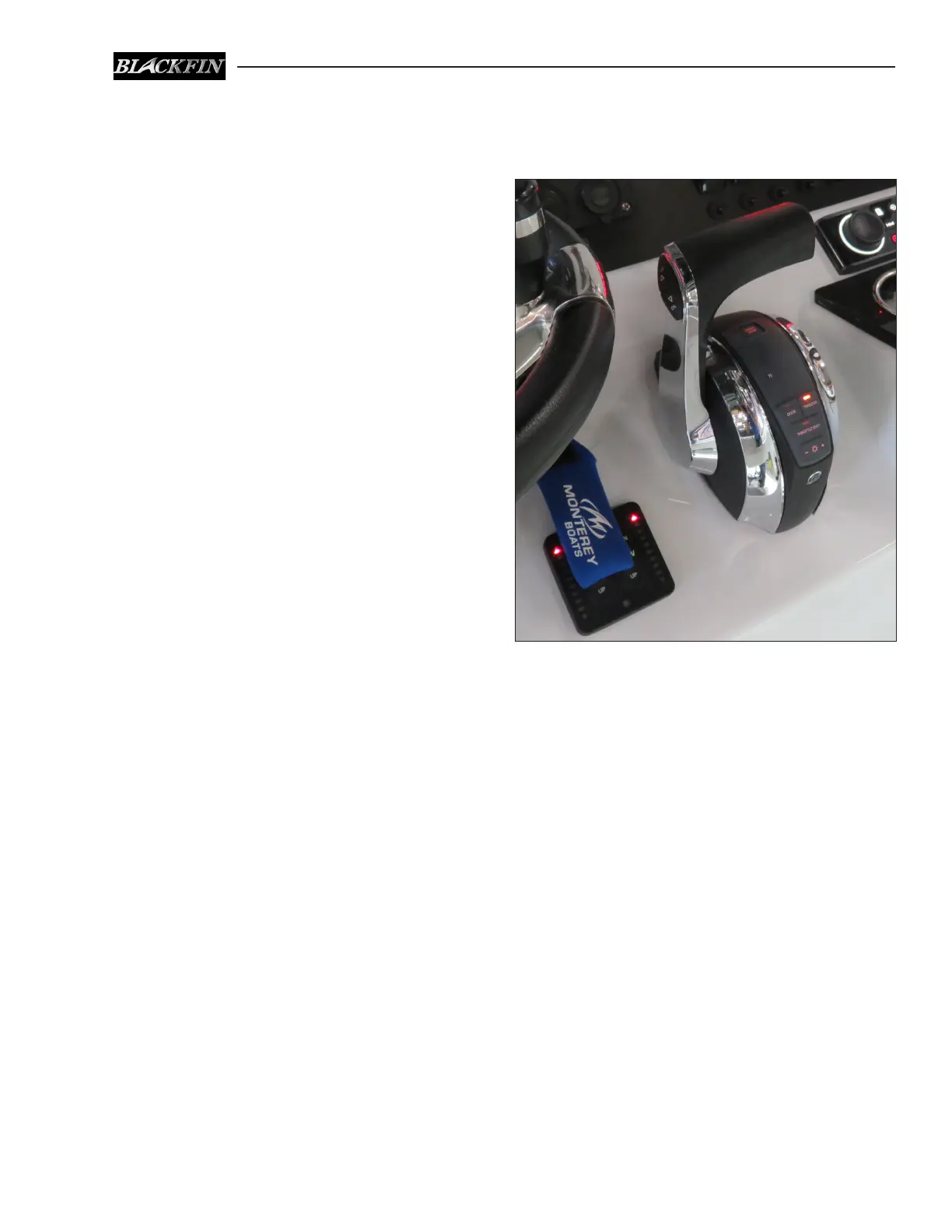
Electronic Engine Controls - Single Engine
The helm is designed for a binnacle style control
with a single lever. The electronic control system
consists of three major components: the electronic
Chapter 4:
control head, instruments and keypad, the control
processors and applicable harnesses. The control
is completely electronic and there are no cables.
The control has a single lever for the engine that
operates as a gearshift and a throttle. General
operation will include a position for neutral (straight
up and down or slightly aft of vertical), a forward
position (the 1st detent forward of neutral) and
a reverse position (the 1st detent aft of neutral).
Advancing the control lever beyond the shift range
advances the throttle in forward or reverse. Each
control is equipped with a means of permitting the
engine to be operated at a higher than idle RPM
while in neutral for cold starting and warm-up
purposes. The control lever is equipped with an
adjustable control head detent and friction settings.
The engine control and key pad typically have in-
tegrated switches and indicator lights which allow
the operator to control all aspects of the boat’s
propulsion system. LED lights on the control in-
HELM CONTROL SYSTEMS
Typical Mercury Single Engine Electronic Control



 To Next Page