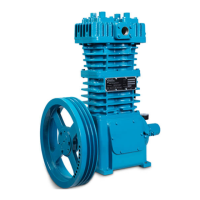
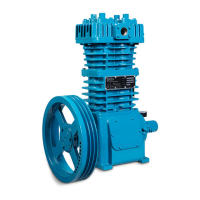
COMPRESSOR DISASSEMBLY
588/A page 13/24
Hazardous
machinery can
cause serious
r
n
l in
r
.
FAILURE TO DISCONNNECT AND
LOCKOUT ELECTRICAL POWER OR
ENGINE DRIVE BEFORE ATTEMPTING
MAINTENANCE CAN CAUSE SEVERE
PERSONAL INJURY OR DEATH
Hazardous pressure
can cause serious
personal injury or
property damage
FAILURE TO RELIEVE SYSTEM
PRESSURE PRIOR TO PERFORMING
COMPRESSOR SERVICE OR
MAINTENANCE CAN CAUSE SERIOUS
PERSONAL INJURY OR PROPERTY
DAMAGE.
Hazardous gases
can cause property
damage, personal
in
r
r
th
VENTING PRESSURE FROM THE
COMPRESSOR PIPING COULD
RELEASE EXPLOSIVE GAS TO THE
ATMOSPHERE CREATING AN
EXPLOSION HAZARD, POSSIBLY
CAUSING SEVERE PERSONAL INJURY
OR DEATH.
NOTICE:
Before starting work on the compressor, make sure
all pressure is bled off on both the suction and
discharge.
1. Remove the center head capscrews from the
cylinder head. Remove the outer cylinder head
capscrews.
2. Remove the cylinder head assembly and cylinder
head O-rings from the cylinder. The suction and
discharge valve assemblies will come off with the
cylinder head. For valve replacement instructions,
refer to the "Valve Replacement" section of this
manual.
3. Removal of the piston requires a 3" adjustable
spanner wrench with 1/4" pins, such as Blackmer
PN 790316.
a. Rotate the flywheel by hand to bring a piston to
top dead center of the cylinder.
b. Remove the piston nut by turning the nut
counterclockwise. (The nylon locking insert in
the piston nut must be replaced during
reassembly.)
c. To remove the piston from the cylinder, turn it
counterclockwise with the use of the adjustable
spanner wrench. For removal and replacement
of the piston rings, refer to the "Compressor
Assembly" section.
d. Remove the thrust washer and any shims.
Keep the shims and piston together.
e. Repeat these steps for the other piston.
4. Remove the cylinder capscrews.
5. Lift the cylinder and cylinder O-rings from the
crosshead guide (or distance piece).
6. Packing Box Removal
a. Using an adjustable spanner wrench, remove
the packing box hold-down rings. (Replace the
nylon locking inserts in the hold-down rings
during reassembly.)
b. Remove the packing box and packing box O-
ring from each piston rod. Double-Seal models
will have a spacer ring and a second packing
box O-ring to remove from each piston rod.
c. For disassembly of the packing boxes, refer to
the "Seal (Packing) Replacement" section of
this manual.
7. Remove the crosshead guide capscrews, and lift
the crosshead guide and gasket off.
8. To remove the connecting rod assemblies, with the
crossheads attached, it may be necessary to drain
the oil from the crankcase. The piston rod is
permanently attached to the crosshead to form a
single assembly. Do not attempt disassembly.
a. Remove the inspection plate from the
crankcase.
b. Remove the locknuts from the connecting rod
bolts. This will release the connecting rod cap
(the lower half of the connecting rod) and the
two halves of the bearing insert. The
connecting rod and the connecting rod cap are
marked with a dot on one side so that they can
be properly aligned when reassembling.
c. Lift the crosshead assembly and connecting
rod off the top of the crankcase.
NOTICE:
The connecting rod parts are not interchangeable
and must be reassembled with the same upper and
lower halves. To avoid confusion, work on one
connecting rod at a time, or mark the individual
halves with corresponding numbers.
9. Remove the opposite connecting rod and
crosshead assembly in the same manner as
outlined in step 8.
10. Rest the crosshead assembly on a bench.
Carefully drive the wrist pin and wrist pin plugs out
of the crosshead and connecting rod using a
suitable pin driver or an arbor press. Removal of
the pin releases the crosshead assembly from the
connecting rod.
11. If necessary, the wrist pin bushings can be replaced
after the crossheads are removed. New bushings
must be honed to the proper size after installation.



 To Next Page