
 Need help?
Do you have a question about the Bosch CS3400iAWS 6 OR-S and is the answer not in the manual?
Provides crucial safety guidelines for installation and operation.
Covers safety, connection, and preparation for refrigerant piping.
Essential safety precautions for working with R32 refrigerant.
Procedures for evacuating, charging, and testing the refrigerant circuit for leaks.
Covers safety precautions and steps for connecting the unit to the power supply.
Detailed instructions for wiring the outdoor unit's communication and power supply.
Safety and procedural guidelines for servicing the refrigerant system.
Procedure for safely removing refrigerant from the system before servicing.
Detailed performance data, electrical ratings, and refrigerant information.
Electrical schematics for connecting the outdoor unit components.
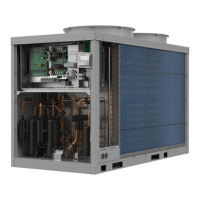
This document is an installation manual for the Bosch Compress 3400i AWS outdoor unit of an air-to-water heat pump. It covers models CS3400iAWS 4 OR-S, CS3400iAWS 6 OR-S, CS3400iAWS 8 OR-S, and CS3400iAWS 10 OR-S.
The Compress 3400i AWS outdoor unit is designed to connect to AWS E, AWS B, or AWS M indoor units to form an air-to-water heat pump system for sealed heating systems in residential buildings. The system's control is based on the building's heat demand, adjusting the compressor output or activating an integrated/external auxiliary heater via the indoor unit. The outdoor unit operates according to a set heating curve. If the outdoor unit cannot meet the heat demand, the indoor unit's auxiliary heater activates to provide the required temperature for heating and domestic hot water (DHW).
The defrosting method employed is hot gas defrosting. During defrost, the refrigerant flow is reversed by an electrically-controlled four-way valve, feeding compressed gas into the top of the evaporator to melt ice. This process slightly cools the water in the heating system. A minimum volume and flow in the heating system are crucial for effective defrosting, which can be provided by open circuits or a buffer tank. If the minimum flow is not met, additional measures like a differential bypass valve or parallel buffer may be required. An auxiliary heater can also assist in complete defrosting if system energy storage is insufficient. The outdoor unit automatically turns off if the outdoor temperature falls below -20 °C or exceeds 45 °C, in which case the indoor unit's auxiliary heater handles heating and DHW.
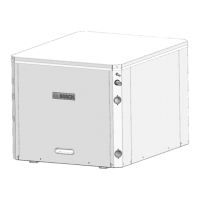
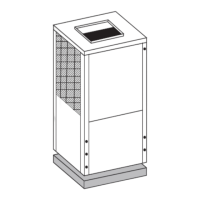
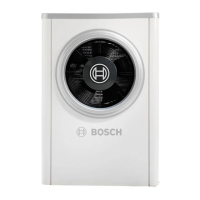
The outdoor units are available in different capacities:
All models use R32 refrigerant, which is a fluorinated greenhouse gas with a GWP100 of 675. The maximum heating water flow temperature for the outdoor unit only is 60 °C. The protection class is IPX4, and the maximum installation altitude is 2000 m above sea level. Electrical power supply is 230V~1N, with recommended automatic circuit breakers ranging from 16A to 20A depending on the model. Connection type for refrigerant pipes is flare connection, with sizes 1/4" & 1/2" or 1/4" & 5/8".
The system requires a minimum volume and flow in the heating system to ensure optimal and efficient defrost operation, preventing multiple start/stop cycles and incomplete defrosting. The minimum flow must be maintained within the available minimum volume. If the pipe length between the indoor and outdoor units exceeds 10m, additional refrigerant charge is required, calculated based on the excess length.
The outdoor unit is designed for outdoor installation on a flat, stable surface, preferably in a dry and well-ventilated area, protected from direct sunlight and strong winds. Consideration for sound propagation is advised to avoid noise nuisance to neighbors. Adequate access for maintenance work must be ensured. For installations near the sea, a minimum distance of 500m (1000m in France and Ireland) is recommended, with the evaporator not facing the sea wind. In areas with strong wind, heavy rain, or snow, installing the unit at a 90° angle to the wind direction, building a protective barrier, or adding a shelter is recommended, ensuring air flow is not obstructed.
A heating cable for the condensate tray and drain outlet is recommended for systematic condensate removal, powered by the indoor unit during defrost.
Maintenance and service guidelines must always be followed. Any electrical work must be carried out by qualified electrical installation contractors, ensuring all poles of the mains voltage are isolated and secured against reconnection. Before any electrical work, the master switch must be turned off, and a waiting period of at least five minutes is required to ensure full electrical discharge of capacitors.
Repairs to the refrigerant circuit must only be performed by a refrigerant expert, strictly following safety instructions due to the flammable nature of R32. Protective gloves are required during transport, installation, and maintenance. The evaporator should be cleaned if dirt or dust accumulates on the fins, using a liquid dish soap solution and rinsing with water. Hard objects, acid, chlorine-based, or corrosive alkaline cleaning products should not be used. In regions where draining dish soap into the ground is prohibited, the condensate pipe should be removed, and the soap drained into a container.
In snowy conditions, accumulated snow on the back and roof of the outdoor unit should be carefully brushed off the fins to prevent icing. When handling printed circuit boards, an ESD wrist strap must be worn to prevent damage from electrostatic discharge. When replacing circuit boards, observe color coding as different colors are not interchangeable. Only genuine spare parts should be used, and seals and O-rings must always be renewed during servicing or repair work. Regular checks include alarm logs, function checks, and inspection of electrical cabling for damage.


 To Next Page
 General