ENGLISH
7
Before performing any maintenance or repair,
disconnect power source from the compressor
and bleed off all airpressure.
Customer Responsibilities
Before each
use
Daily or after
each use
See tank
warning
label
Check Safety Valve
X
Drain Tank X
Remove tank from
service
X
1
1- For more information, call our Customer Care Center at
1–800–556–6696.
NOTE: See Operation section for the location ofcontrols.
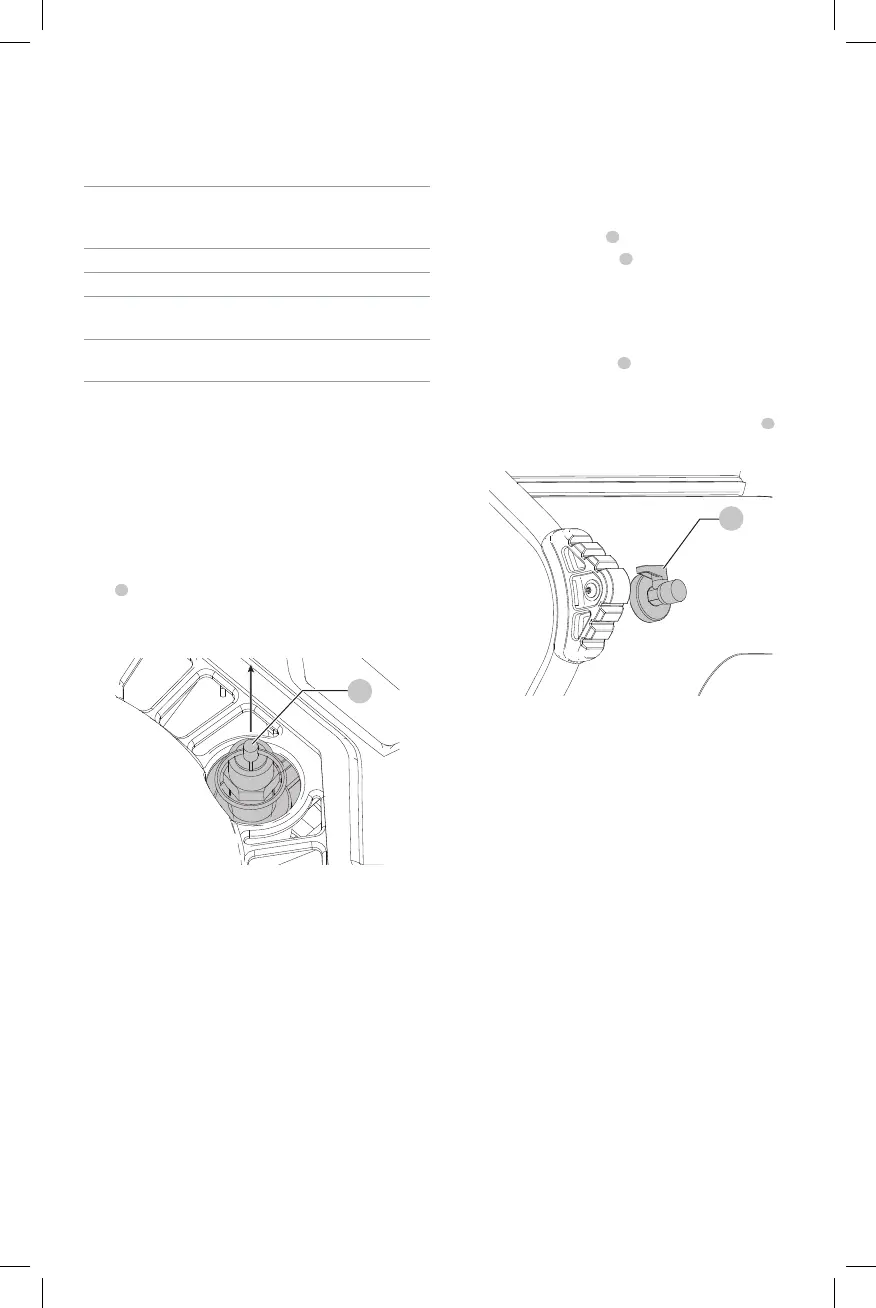
To Check Safety Valve (Fig. C)
WARNING: Risk of Bursting. If the safety valve
does not work properly, over-pressurization may
occur, causing air tank rupture or an explosion.
WARNING: Risk from Flying Objects. Always
wear certified safety equipment: ANSI Z87.1 eye
protection (CAN/CSA Z94.3) with sideshields.
Before starting compressor, pull the ring on the safety
valve
6
to make sure that the safety valve operates freely. If
the valve is stuck or does not operate smoothly, it must be
replaced with the same type ofvalve.
Fig. C
6
To Drain Tank (Fig. A, D)
WARNING: Risk of Unsafe Operation. Air tanks
contain high pressure air. Keep face and other
body parts away from outlet of drain. Use
ANSIZ87.1 eye protection (CAN/CSA Z94.3) when
draining as debris can be kicked up into face.
WARNING: Risk from noise. Always wear proper
hearing protection during use. Under some
conditions and duration of use, noise from this
product may contribute to hearingloss.
NOTE: All compressed air systems generate condensate
that accumulates in any drain point (e.g., tanks, filter,
aftercoolers, dryers). This condensate contains lubricating
oil and/or substances which may be regulated and must be
disposed of in accordance with local, state, and federal laws
andregulations.
WARNING: Risk of Bursting. Water will condense
in the air tank. If not drained, water will corrode
and weaken the air tank causing a risk of air
tankrupture.
NOTICE: Risk of Property Damage. Drain water
from air tank may contain oil and rust which can
causestains.
1. Set the On/Off switch
1
to “Off”.
2. Turn the regulator knob
4
counterclockwise to set the
outlet pressure tozero.
3. Remove the air tool oraccessory.
4. Place a suitable container under the drain valve to
catchdischarge.
5. Pull ring on safety valve
6
allowing air to bleed from
the tank until tank pressure is approximately 20psig.
Release safety valvering.
6. Drain water from air tank by opening drain valve
7
on
bottom oftank.
7
Fig. D
7. After the water has been drained, close the drain valve.
The air compressor can now bestored.
NOTE: If drain valve is plugged, release all air pressure. The
valve can then be removed, cleaned, thereinstalled.
Cleaning
WARNING: Blow dirt and dust out of all air vents with
clean, dry air at least once a week. To minimize the risk
of eye injury, always wear ANSI Z87.1 approved eye
protection when performingthis procedure.
WARNING: Never use solvents or other harsh
chemicals for cleaning the non-metallic parts of
the tool. These chemicals may weaken the plastic
materials used in these parts. Use a cloth dampened
only with water and mild soap. Never let any liquid
get inside the tool; never immerse any part of the tool
into aliquid.
Storage
Before you store the air compressor, make sure you do
thefollowing:
1. Review the Maintenance section on the preceding
pages and perform scheduled maintenance
asnecessary.
2. Drain water from air tank. See To Drain Tank
underMaintenance.




 To Next Page