TERMINOLOGY
The following terms are used throughout the manual, and are standard
terminology among detectorists.
RELIC
A relic is an object of interest by reason of its age or its association with
the past. Many relics are made of iron, but can also be made of bronze
or precious metals.
IRON
Iron is a common, low-grade metal that is an undesirable target in certain
metal detecting applications. Examples of undesirable iron objects are old
cans, pipes, bolts and nails.
Sometimes, the desired target is made of iron. Property markers, for
instance, contain iron. Valuable relics can also be composed of iron;
cannon balls, old armaments and parts of old structures and vehicles can
also be composed of iron.
FERROUS
Metals which are made of, or contain, iron.
ELIMINATION
Reference to a metal being "eliminated" means that the detector will not
emit a tone, nor display a Target-ID, when a metal object passes through
the searchcoil's detection field.
DISCRIMINATION
When the detector emits different tones for different types of metals, and
when the detector "eliminates" certain metals, we refer to this as the
detector "discriminating" among different types of metals.
Discrimination is an important feature of professional metal detectors.
Discrimination allows the user to ignore trash and otherwise undesirable
objects.
PINPOINTING
Pinpointing is the process of finding the exact location of a buried object.
Long-buried metals can appear exactly like the surrounding soil, and can
therefore be very hard to isolate from the soil.
GROUND CANCELATION
Ground Cancelation is the ability of the detector to ignore, or "see through,"
the earth's naturally occurring minerals, and only sound a tone when a
metal object is detected. This detector incorporates proprietary circuitry to
eliminate false signals from many mineralized soils.
318
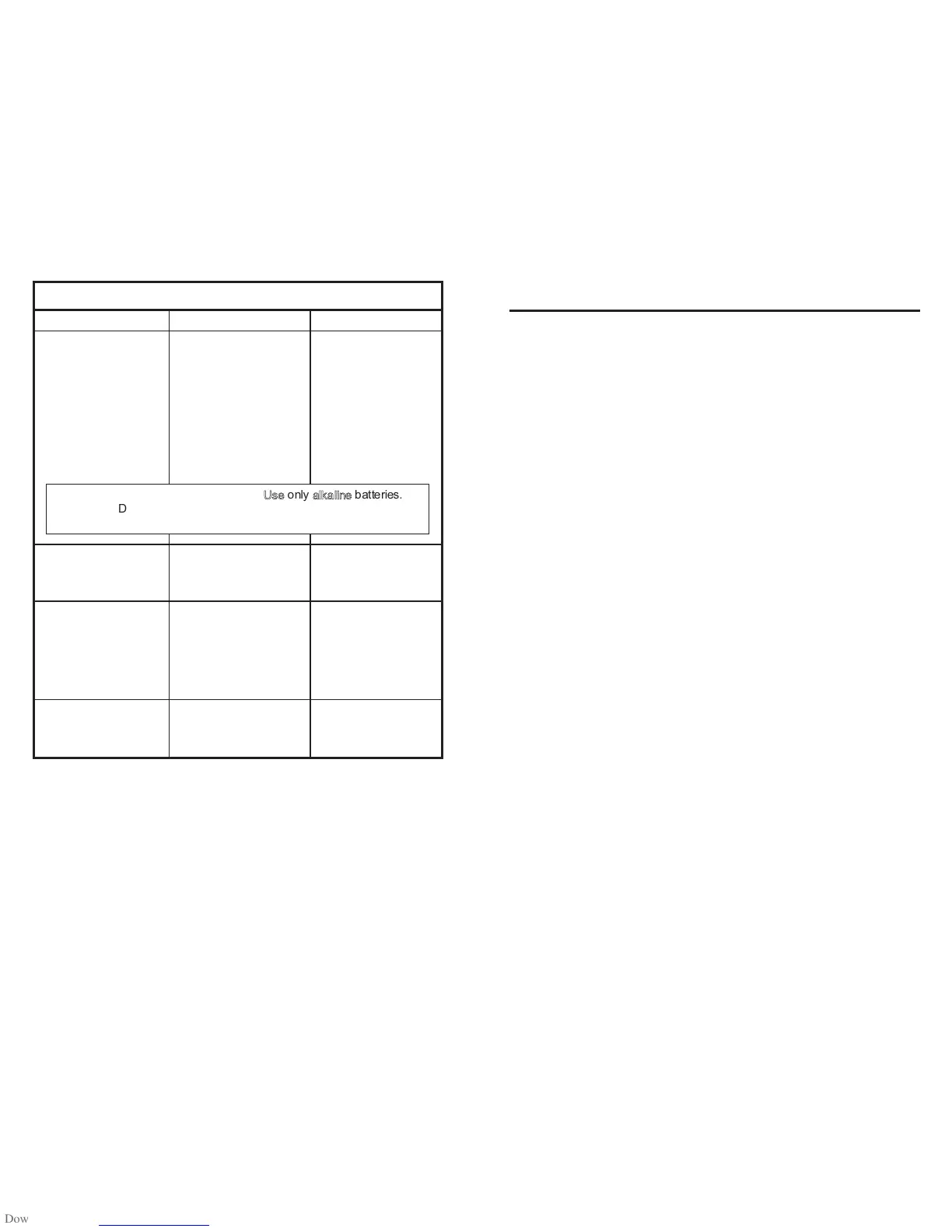
TROUBLESHOOTING GUIDE
SYMPTOM CAUSE SOLUTION
Detector chatters, • Using detector • Use detector
beeps erratically indoors outdoors only
or has low • Using detector near • Move away
sensitivity power lines
from power lines
• Using 2 detectors in • Keep 2 detectors
close proximity at least 6 meters
(20’) apart
• Environmental • Reduce sensitivity
electromagnetic until erratic
interference signals cease
Low speaker •
Discharged battery
• Replace battery
volume
• Wrong type of • Use only
battery alkaline batteries
Display does not lock
• Multiple targets •
Sweep coil at
on to one Target-ID present different angles
or detector emits • Highly mineralized • Move to a
multiple tones soil different area
• Sensitivity set
too high • Reduce sensitivity
No power, no sounds
• Dead battery • Replace batteries
• Cable not connected •
Check connections
securely
Do not mix old and new batteries.
U
U
s
s
e
e
o
o
n
n
l
l
y
y
a
a
l
l
k
k
a
a
l
l
i
i
n
n
e
e
b
b
a
a
t
t
t
t
e
e
r
r
i
i
e
e
s
s
.
.
Do not mix alkaline, standard (zinc-carbon), or
rechargeable (NiCad, NiMH, etc.) batteries.
Note: This equipment has been tested and found to comply with the limits for a Class B digital device,
pursuant to part 15 of the FCC Rules. These limits are designed to provide reasonable protection
against harmful interference in a residential installation. This equipment generates, uses and can
radiate radio frequency energy and, if not installed and used in accordance with the instructions, may
cause harmful interference to radio communications. However, there is no guarantee that interference
will not occur in a particular installation. If this equipment does cause harmful interference to radio or
television reception, which can be determined by turning the equipment off and on, the user is
encouraged to try to correct the interference by one or more of the following measures:
- Reorient or relocate the receiving antenna.
- Increase the separation between the equipment and receiver.
- Consult the dealer or an experienced radio/TV technician for help.
CE
The manufacturer declares that the minimum ESD performance criteria is 1) the unit shall not
be permanently damaged and 2) operator intervention is allowed.
This product is RoHS compliant.
This product meets the requirements of Industry Canada: CAN ICES-3 B/NMB-3 B.



 To Next Page