Shoulder Exercises
SCAPULAR DEPRESSION
Muscles worked: This exercise involves your
lower trapezius muscles, and latissimus dorsi
muscles. Both act as stabilizers and movers of
your shoulder blades. This motion of scapula
depression is very impo_*ant in posture as well
as when using the arms to raise from a chair. It
is also involved in overhead pulling exercises.
Pulley position: Wide or narro;_
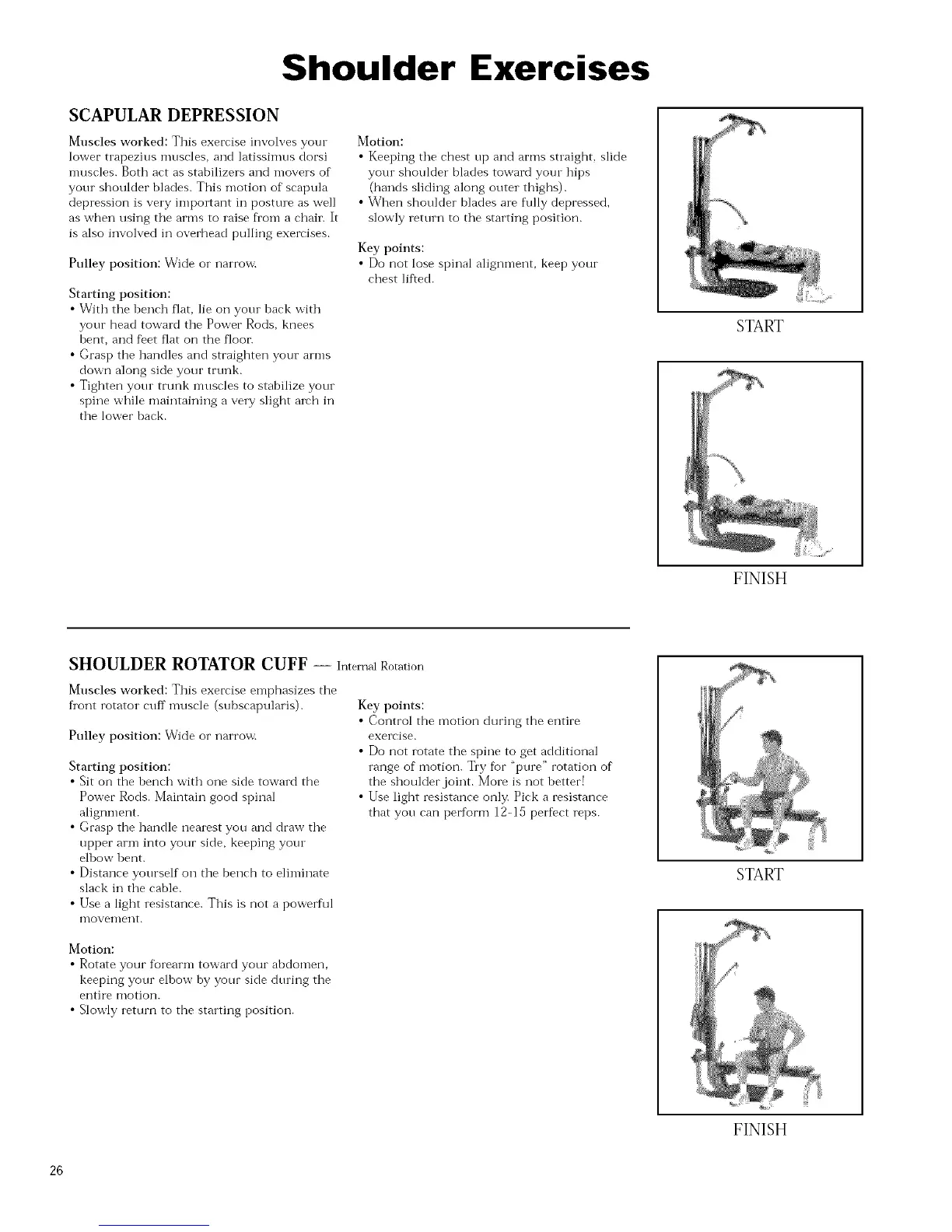
Starting position:
• With the bench fiat, lie on your hack with
your head toward the Power Rods, knees
bent, and feet flat on the floor.
• Grasp the handles and straighten your arms
down along side your trunk.
• Tighten your trunk muscles to stabilize your
spine while maintaining a vein slight aich in
the lower hack.
Motion:
• Keeping the chest up and arms straight, slide
yore shoulder blades toward yore hips
(hands sliding along outer thighs).
• "When shoulder blades are flflly depressed,
slowly return to the starting position.
Key points:
• Do not lose spinal alignment, keeI) your
chest lifted.
START
FINISH
SHOULDER ROTATOR CUFF -- Internal Rotation
Muscles worked: This exercise emphasizes the
fiont rotator cuff muscle (subscapularis).
Pulley position: Wide or narrow.
Starting position:
• Sit on the hench with one side toward the
Power Rods. Maintain good spinal
alignment.
• Grasp the handle nearest you and draw the
upper arm into your side, keeping yore
elhow bent.
• Distance yourself on the bench to eliminate
slack in the cable.
• Use a light resistance. This is not a powerful
inovenlent.
Key points:
• Control the motion during the entire
exercise.
• Do not rotate the spine to get additional
range of motion. T_y for "pore" rotation of
the shoulder joint. More is not better!
• Use light resistance only. Pick a resistance
that you can i)erform 12-15 perfect reps.
Motion:
• Rotate your fbrearm toward your ahdomen,
keeping your elhow by your side dtuing the
entire motion.
• Slowly return to the starting position.
START
FINISH
26


 To Next Page