ENGLISH 37 / 73 CAP. 8 - COMMISSIONING
8.3 FIRST TANK FILLING
Execute the following actions in sequence by following the display guided procedure and the
illustrations on the summary sheet provided with the equipment:
• Gas weight check
• Oil weight check
• Pressure check
• First tank filling
It is possible to interrupt the initial check and print a report with the equipment printer in which
the checking status is reported.
The equipment cannot operate in automatic mode until all the steps of the initial check have been
completed.
CAREFULLY ABIDE BY THE FOLLOWING
INSTRUCTIONS TO AVOID DANGER TO
PERSONS, THE DISCHARGE OF
REFRIGERANT IN THE ATMOSPHERE
Let us consider as first filling the one carried out during the initial check with internal tank of the
equipment free of refrigerant gas and containing air.
Set the quantity of gas to fill (at least 3 kg) and follow the guided procedure shown on the
display.
Check that the equipment hoses are not connected and positioned in the hose winder. Start the
procedure that initially implies the creation of vacuum in the internal tank. This phase will take
from 22 to 45 minutes and will act on the whole equipment.
Only when the message appears asking to connect the recharge tank, connect the supplied HP
quick coupler (red) in case of R134a of the unit to an external refrigerant gas tank using the
supplied adaptor.
Open the coupler by turning the knob clockwise. Open the valve on the external tank.
Just right before reaching the planned quantity of refrigerant, the unit will stop and ask the user
to close the external refrigerant tank. Then, the device will continue the recovery from the hoses
and ends when these are empty. Hence, it is necessary to open the LP quick-coupler and
disconnect it from the external tank. Thanks to the ECO-LOCK function, the refrigerant - usually
kept between the cylinder fitting and the hose quick-coupler until the end of the process - will not
be released in the environment.
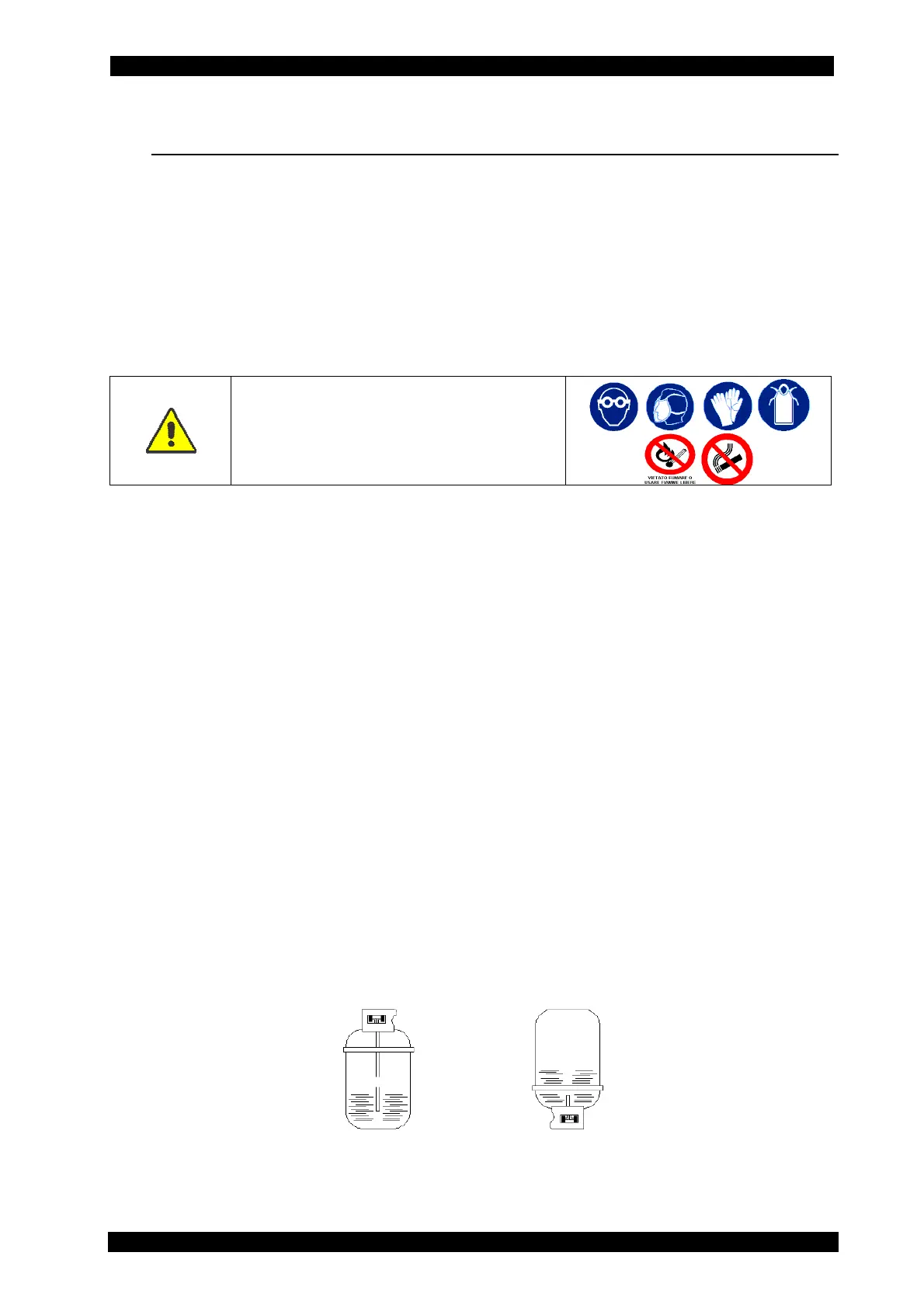
There may be two types of source tanks: with plunger and without plunger.
Tanks with plunger shall remain upright to be able to transfer liquid refrigerant; for this type of
tanks connect to the L (liquid) coupler.
Tanks without plunger have only one valve, so they must be turned upside down to transfer the
liquid refrigerant.
The LP gauge indicates the pressure inside the external tank.
After some minutes the unit will automatically end the function.
At the end the weight of the charged refrigerant will be displayed.


 To Next Page