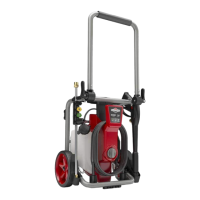
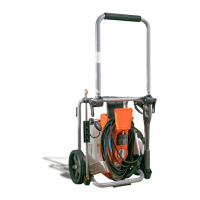
This document is an operator's manual for a reconditioned electric pressure washer, providing essential information for its safe and effective use, assembly, operation, and maintenance. The pressure washer is designed for cleaning tasks, utilizing a high-pressure stream of water to remove dirt and grime from various surfaces.
Function Description
The electric pressure washer functions by generating a high-pressure stream of water, which is then directed through a spray gun and nozzle to clean surfaces. It operates at a maximum pressure of 2,000 PSI (138 BAR) and a flow rate of up to 1.2 GPM (4.5 liters/min). A key safety feature is the automatic shut-off system, which detects when water flow has stopped (e.g., when the spray gun trigger is released) and shuts off the motor. This not only conserves energy but also prevents unnecessary wear on the pump. If the motor continues to run when the trigger is released, the user is advised to stop using the machine and contact customer support, as this indicates a potential malfunction.
The unit is also equipped with a motor overload protection device (thermostat). This device automatically shuts off the motor if it overheats or draws excessive current, protecting the motor from damage. In such an event, the user must disconnect the power supply, allow the unit to cool for 30 minutes, and then restart operation.
For electrical safety, the pressure washer includes a Ground Fault Circuit Interrupter (GFCI) built into the power supply cord's plug. This provides additional protection against electric shock. Users are warned against using extension cords with this electric pressure washer, as they may not provide adequate ground-fault circuit-interruption protection, increasing the risk of electrocution.
Usage Features
The pressure washer is designed for ease of use and versatility. Assembly involves raising and securing the foldable handle and lubricating O-rings on connections for the garden hose, high-pressure hose, spray gun, and spray wand. It's crucial to ensure all connections are tight and free of leaks. The unit requires a cold water supply (less than 100°F/38°C) at a flow rate greater than 3.0 gallons (11.4 L) per minute and no less than 20 PSI (1.3 BAR). The inlet screen must be inspected and cleaned regularly to prevent debris from damaging the pump.
Starting the pressure washer involves connecting the garden hose, turning on the water supply, purging air from the pump system by squeezing the spray gun trigger, and then plugging the electrical power cord into a dedicated 120 Volts AC, 15 Amps circuit. The GFCI indicator light must be ON for operation, and a test/reset procedure is outlined to ensure the GFCI is functioning correctly.
The unit features a 7-in-1 nozzle, allowing users to switch between seven different spray patterns (0°, 15°, 25°, 40° for high pressure, and three low-pressure patterns) to suit various cleaning tasks. A turbo nozzle, if equipped, provides a powerful pin-point jet for intense cleaning. Users are advised to engage the trigger lock before changing nozzles and to avoid twisting nozzles while spraying. For optimal cleaning, the nozzle should be held 8 to 24 inches from the cleaning surface, with caution exercised to avoid surface damage, especially with high-pressure spray patterns.
Detergent application is integrated into the system. The pressure washer has a detergent tank (40 fl. oz. / 1.2 L capacity) that can be filled with pressure washer-safe detergents/soaps. Detergent is applied using specific soap spray pattern nozzles on the 7-in-1 nozzle. After applying detergent, the unit is used for high-pressure rinsing, starting from the top of the area and working downwards with overlapping strokes.
Maintenance Features
Regular maintenance is crucial for improving performance and extending the life of the pressure washer. Before each use, users should clean debris, check the water inlet screen for damage, inspect the high-pressure hose for leaks, and verify spray gun operation. The cooling air slots and openings on the unit must be kept clean and unobstructed to prevent overheating.
The manual emphasizes that the pump and motor assemblies are pre-lubricated and sealed, requiring no additional lubrication. However, proper care after each use is vital. To prevent mineral deposits and "freezing" pump action, users should flush the detergent tank with clean water until empty, then flush the pump system with clean water for one to two minutes. After turning off the unit and disconnecting power and water, the system should be depressurized by squeezing the spray gun trigger. Water should be drained from the hose, spray gun, and pump (by tipping the unit) to prevent damage.
For winter or long-term storage (more than 30 days), it is critical to protect the pump from freezing temperatures and mineral deposits. The manual recommends using a product like Pump Saver™ (Model 6039) to treat the pump, which prevents freeze damage and lubricates internal components. The unit should be stored in a clean, dry area protected from freezing temperatures, and covered with a suitable protective cover that does not retain moisture. The foldable handle allows for compact storage.
Troubleshooting guidance is provided for common issues such as pump problems (failure to produce pressure, erratic pressure, etc.), unit failure to start, detergent not mixing with spray, and hose connections leaking, offering specific corrections for each problem. Users are strongly advised to contact customer support or an authorized service center for any issues not covered in the troubleshooting section.


 To Next Page
 General