EN | 4544 | EN
SAFETY INSTRUCTIONS
Operator
The operator is the owner or les-
see of the water dispenser who
makes it available to the user.
• The operator has been instruct-
ed in the operation of the water
dispenser by the manufacturer
or by a qualied person.
• The operator has been in-
formed about his/her obligation
to maintain a log book provided
by the manufacturer or by a
qualied person.
• The operator is aware of the
dangers in handling CO
2
bot-
tles and is capable of safely
replacing the CO
2
bottles.
• The operator is familiar with the
hygiene regulations applicable
to the operation of a beverage
dispenser.
• The operator has completely
read and understood the in-
structions.
User
The user uses and operates the
water dispenser for the intended
purpose without any other previ-
ous experience.
A user is designated as any per-
son who uses the appliance for
dispensing water.
Danger to life for unau thorised
persons from improper han-
dling!
Unauthorised persons who do not
full the requirements described
here do not know the dangers in
handling the appliance. For this
reason, there is a danger for un-
authorised persons of serious or
even fatal injuries.
Damage could also be caused to
the environment.
• Unauthorised persons may not
open the appliance.
• Unauthorised persons may not
carry out any maintenance or
repair work.
• The operator must ensure that
the user only dispenses water.
• The dened qualications for
all tasks in these instructions
must be fullled.
Operator’s duties
The water dispenser is used on
commercial premises. For this
reason, the operator of the water
dispenser is subject to the stat-
utory obligations for work safety,
hygiene and accident prevention.
The operator is responsible for
the following:
• The installation and initial
commissioning of the appliance
may only be carried out by
qualied persons.
• The requirements in terms of
the installation location dened
in these instructions (see ‘Loca-
tion’ on page 49) must be
fullled at all times.
• Prior to operation of the water
dispenser, the instructions must
be read in their entirety and
understood.
• The cleaning, maintenance
and repair intervals described
in these instructions must be
observed.
• Maintenance work may only be
carried out by qualied person-
nel.
• The initial commissioning as
well as all cleaning, disinfection
and repair work must be re-
corded in the log book.
• The operating instructions for
the replacement of CO
2
bot-
tles must be afxed near the
CO
2
bottle and must be clearly
legible.
• In addition to the safety notes
in these instructions, the ap-
plicable regulations for safety,
hygiene, health and safety as
well as environmental protec-
tion at the place of use must be
observed.
• The operator should contact
the local authorities to check
the local and regional require-
ments for the installation of
devices connected to the mains
water supply.
Safety equipment
Danger through malfunction-
ing safety equipment!
If safety equipment is not func-
tioning or is inoperative, there is
a danger of very severe injury or
death.
• Before starting up, check that
all safety equipment is in good
working order and correctly
installed.
• Never make safety equipment
inoperative or bypass it.
• Ensure that all safety equip-
ment is accessible at all times.
The safety equipment installed in
the device is listed below.
Aquastop
The aquastop is located between
the water shut-off valve and the
water supply of the water dis-
penser.
A sensor inside detects
the quantity of water passing
through. When the registered
amount exceeds 10 litres of con-
tinuous ow, the aquastop valve
automatically shuts off the water
supply.
1
2
3
CO
2
pressure regulator and
pressure relief valve
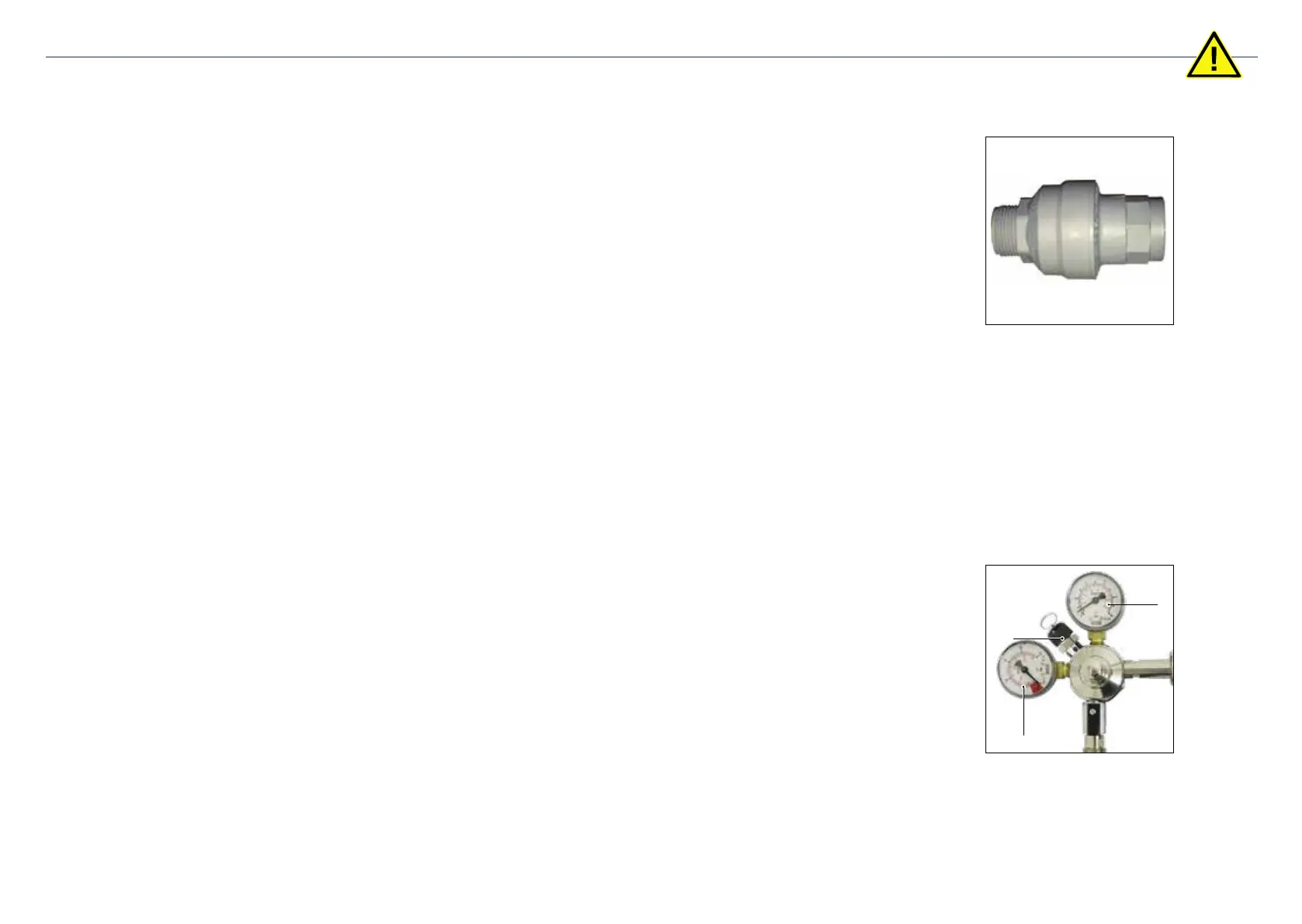
The CO
2
pressure regulator is
mounted on the CO
2
bottle. The
mounted manometer indicates the
applied CO
2
pressure in bars.


 To Next Page
 Loading...