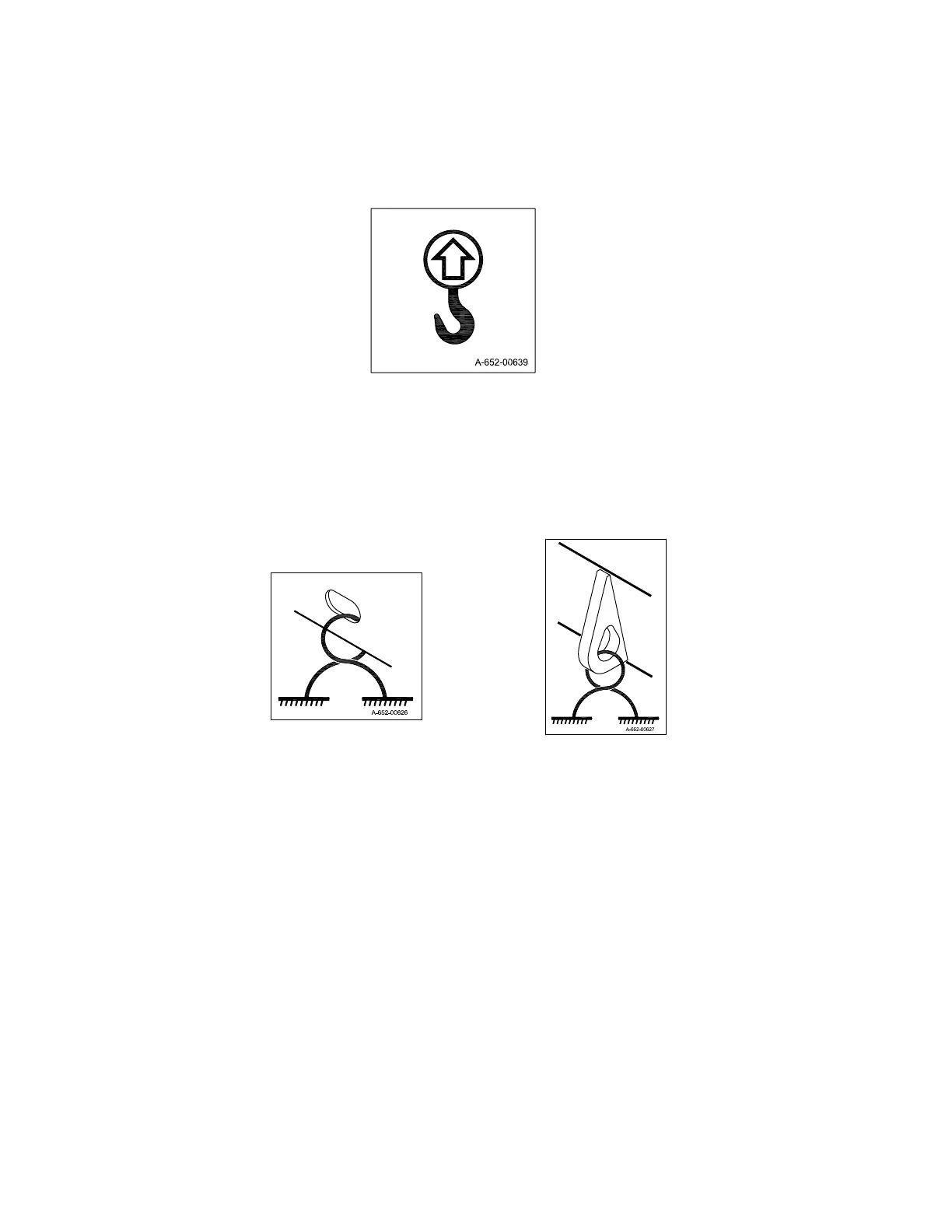
2-6
22. Crane has four lifting rings, one at each corner of load deck, for lifting the crane. Use
proper slings and rigging methods to keep the load balanced during the lift. Do not lift by
the boom. Proper lifting and securing practices are the responsibility of the rigger in
charge.
23. When transporting the crane, be sure it is properly secured to the vehicle. Utilize the tie-
down anchors as indicated on the crane to stabilize the load and prevent shifting during
transport. Use caution to not over-tighten the chains and binders when securing the
crane to the transport vehicle. Proper securement and prudent shipping practices are the
responsibility of the carrier.
TRAVEL:
1. For Pick and Carry operation: Traveling with suspended loads involves so many
variables, such as ground conditions, boom length and vehicle acceleration, that it is
impossible to devise a single standard rating procedure with any assurance of safety. For
such operations, the user must evaluate prevailing conditions and determine safe
practices using precautions, such as the following:
A. The boom shall be centered over front axle.
B. Use shortest boom practical.
C. Carry load as close to ground as practical.
D. Reduce travel speed to suit conditions (2 MPH (3 km/h) maximum).
E. Maintain specified tire pressures and lug nut torques.
F. Avoid sudden starts and stops.
G. Provide tag or restraint lines to snub swinging of the load.
H. Hand-held tag lines should be nonconductive.
I. Do not carry heavy boom loads and deck loads at the same time.
J. Do not pick and carry with boom extension installed.
K. Do not exceed the OVER FRONT, ON RUBBER capacity.



 To Next Page