3.5.2. Record
26
While in "Display" mode, measurements
of
physical parameters can be displayed by
pressing the appropriate parameter pushkey.
If a parameter pushkey is selected and the
requisite Transducer is not connected, the message
COtH-IECT TRANSDUCER will
ap-
pear on the Display.
Note: For measurement
of
Relative Humidity
it
is necessary
to
connect both the
Air
Temperature Transducer MM 0034 and the Humidity Transducer MM 0037.
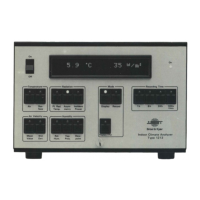
The "Display" mode can be used
to
obtain displays
of
measurements
of
the various
physical parameters as soon as they are obtained by the Analyzer.
In
most
cases the
measurement appears on the
Display as soon as the relevant pushkey is depressed.
However, a short
delay will occur
if
either the AIR VELOCITY
or
HUMIDITY pushkeys are
activated
immediately after the initial self-test routine. During this delay the message
MEASURING
appears. This message changes as soon as the
first
measurement has
been
completed (see Chapter 4
for
further details). Subsequent selection
of
either the
AIR VELOCITY
or
HUMIDITY pushkeys provides an instantaneous display
of
the last
measured value. If the Analyzer is unable to accurately determine a dew point measure-
ment, the measured
value will be displayed alternating with the message
DEWPO
I NT
UNSTABLE.
If another parameter pushkey is not activated, this type
of
Display will
persist
for
up to 3 minutes until a new measurement
of
the dewpoint is obtained.
It is also possible to obtain instantaneous air velocity measurements in the "Display"
mode, via the
X-output
on the Rear Panel
of
the Analyzer (see Chapter
5).
The Indoor Climate Analyzer can store
60
measurements
of
each preselected parameter
in its
internal memory. These data can be stored for up to five years, and will not be lost
when the Analyzer is switched
off
or
the power supply disconnected. Data can thus be
conveniently collected during on-site measurements and analyzed when the instrument is
returned
to
the laboratory. The memory is powered by
an
internal lithium battery.
Details
of
the pushkey sequences and operation
of
the Analyzer in the "Record" mode
are shown in Fig. 3.8.
In
order to commence recording and storing data in the Analyzer
memory the "Record" pushkey must be activated. This produces the message
SELECT
TRANSDUCERS on the Display. The user then selects the parameters
to
be recorded by
pressing the appropriate PARAMETER pushkeys. Provided that
all five Transducers are
connected
to
the Analyzer, simultaneous recording
of
all measurements is possible.
Should
a parameter pushkey be activated when the appropriate Transducer is not con-
nected, the message
CONNECT TRANSDUCER will appear on the Display. Pressing the
parameter pushkey once more
will cancel the requested recording.
Once the measurement parameters have been selected, the
operator
must select a mea-
surement period over which recording
of
data will take place. Four different recording
times are
available
(1,
6,
24
and 120 hours) and measurements are recorded at equal
intervals
throughout the measurement period. Thus,
for
a
six-hour
measurement period,
data are recorded every 6 minutes. These measurements may be made in the one
loca-
tion
or
the transducers may be moved
to
different locations in the interval between
measurements.
The recording period begins when the
"Record" pushkey is activated
for
the second
time. This
also transfers the Analyzer to a
low-power
mode, which is characterised by a
blank Display and all LED's except the "Record" LED being extinguished. This
low-power
mode reduces the power consumption
of
the Analyzer and enables a
24
hour
recording
to
be made using one set
of
fully charged alkaline batteries.


 To Next Page
 Loading...