The
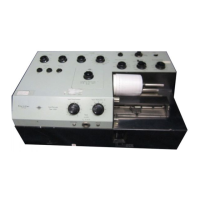
Averaging Time
of
the
Level
Recorder
is
controlled
by
the
setting
of
the
"WRITING. SPEED
CONTROL".
The
setting
of
the
"Potentiometer
range
dB"
also influences
the
effective averaging
time.
The
RMS
fluctua-
tions
in
measurements using
the
Level Recorder
and
the
Filter
Set
depends
on
the
averaging
time
of
the·
Recorder
and
the
bandwidth
of
the
filter
employed.
A simple relationship exists:
where
e
is
a measure
of
the
statistical
RMS
fluctuations,
6.
f
is
the
frequen-
cy
bandwidth
(or measurement
bandwidth)
whichever
is
the
smallest'
and
T
is
the
averaging time.
To
minimise
the
error
involved
in
trying
to
average
these
fluctuations
for
any
particular
1/3
octave
band
and also
cut
down
time
consuming calculations it
is
to
be
suggested
that
the
level should
be
.
taken
where
the
fluctuations are
most
dense. When using
the
most
common-
ly
employed
potentiometer
(50 dB)
the
inherent
error
will be
~
1-2
dB
(the
width
of
the
trace~
1 dB).
The
slowest writing speed, however, should
always
be
employed
except
when
time
considerations
enter
into
the
mea-
surements,
the
question
of
a suitable filter scanning speed
is
brought
up.
This scanning speed
is
a direct
function
of
the
Level Recorder Paper Speed.
If a Level Recording
is
made
the
recorder
stylus
at
each
1/3
octave
band
has
to
move
to
a new level. The
maximum
scanning speed can
therefore
be
ascertained from this.
If we assume
that
the
stylus has
to
traverse
at
the
most
the
paper
width
( 100 mm)
before
the
next
filter
is
switched
in
then
the
paper
speed
~
0.05 x writing speed. (The
width
of
1/3
octave band
is
5mm).
35


 To Next Page
 Loading...