1.
INTRODUCTION
1.1. GENERAL
When measuring vibration by means
of
an accelerometer, it
is
necessary
to
incorporate a preamplifier between it and
the
measuring amplifier.
The
preamplifier
is
introduced
in
the
measuring circuit for
two
reasons:
1.
to
transform
th~
high
output
impedance
of
the
accelerometer
to
a
lower value and
2.
to
amplify
the
relatively weak
output
signal from
the
accelerometer.
The
signal from
the
piezoelectric accelerometer appears
as
a voltage
across a capacitive impedance. As
the
capacitive
output
impedance
of
the
accelerometer
is
very high,
the
associated amplifier
must
be
of
a special
design having a high
input
impedance. This
is
necessary
in
order
to
avoid
loading
of
the
accelerometer and
thereby
obtaining decreased sensitivity and
limitation
at
the
low end
of
the
frequency range.
The
combination
of
a charge amplifier and a piezoelectric accelerometer
gives a sensitivity which
is
independent
of
cable length within very wide
limits. This feature makes a charge amplifier especially attractive
in
vibration systems where
different
cables are used.
The
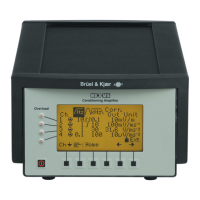
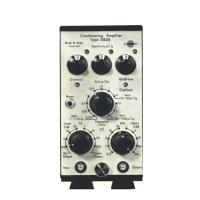
Conditioning Ampli-
fier
Type
2626
may be used with cable lengths
up
to
several
thousand
meters.
Another
advantage
the
2626
Amplifier offers
is
the
wide conditioning
possibilities
to
different
transducers and measuring requirements. It features
a 3 digit sensitivity
adjustment
network
which enables
the
amplifier sensitiv-
ity
to
be adjusted
to
the
particular
transducer
used.
The
network
is
calibrated
in
pC/g.
Output
of
the
amplifier can be adjusted stepwise
between 1
rnV/g and
10
V/g, depending
on
the
transducer sensitivity. A
maximum sensitivity
of
1 V
/pC
is
available.
The
output
signal
is
available
either
directly coupled
or
through a
transformer
(switchable) for floating
output.
Stepwise adjustable
HP
and
LP
filters are incorporated,
by
which
the
frequency limits can be adjusted
independent
of
sensitivity.
The
filter scales
5


 To Next Page
 Loading...