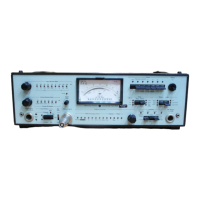
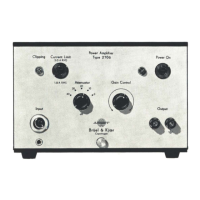
give
the
5%
as well as 3
dB
frequency limits.
The
lowest frequency limit
for
the
amplifier
is
0.3
Hz
which makes it
quite
suitable for measurement
of
impulses.
Two
neon indicators are connected
to
the
output,
one
for overload and
the
other
for
underload which lights when
the
signal level
is
at
least 1 V
peak. On
account
of
quick recovery time after overload,
the
amplifier
is
also
suitable
for use
in
a servo-loop
in
exciter systems.
1.2. CHARGE AMPLIFIER
The
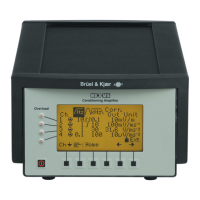
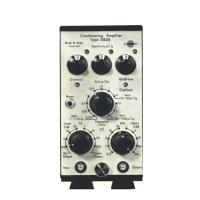
Conditioning Amplifier
Type
2626
has been designed
for
use with
accelerometers, where it
is
required
that
the
measuring system be
independent
of
the
cable length connecting
the
accelerometer
to
the
preamplifier.
The
active elements of a piezoelectric accelerometer are small discs
of
polarized ceramic which when deformed mechanically, develop a charge
across opposite faces
of
the
discs.
The
equivalent circuit
of
this system can
be represented
either
as a capacitance Ct across which a charge
Sq
a:
appears
(Fig.1.1a),
or
as a capacitance Ct
in
series with a voltage generator
Sv
a:
(Fig.1.1
b)
where
Sq
charge sensitivity (pC/g)
Sv
voltage sensitivity (mV /g)
a:
acceleration
(g)
a.
b.
Q=S•O<
Fig.
1.
1.
a)
Charge equivalent circuit
b)
Voltage equivalent circuit
From
the
voltage equivalent circuit it can be seen
that
the
cable
capacitance
Cc
and Ct
act
as
a voltage divider, reducing
the
signal appearing
at
the
other
end
of
the
cable.
The
cable capacitance
is
proportional
to
its
length, which means
that
for very long cables,
the
voltage signal appearing
at
6


 To Next Page
 Loading...