31 Operation and Adjustment Manual
thescaleimageatsomerandompoint,butyoucan
readthatitissomewherebetween7.8”and8.0”.
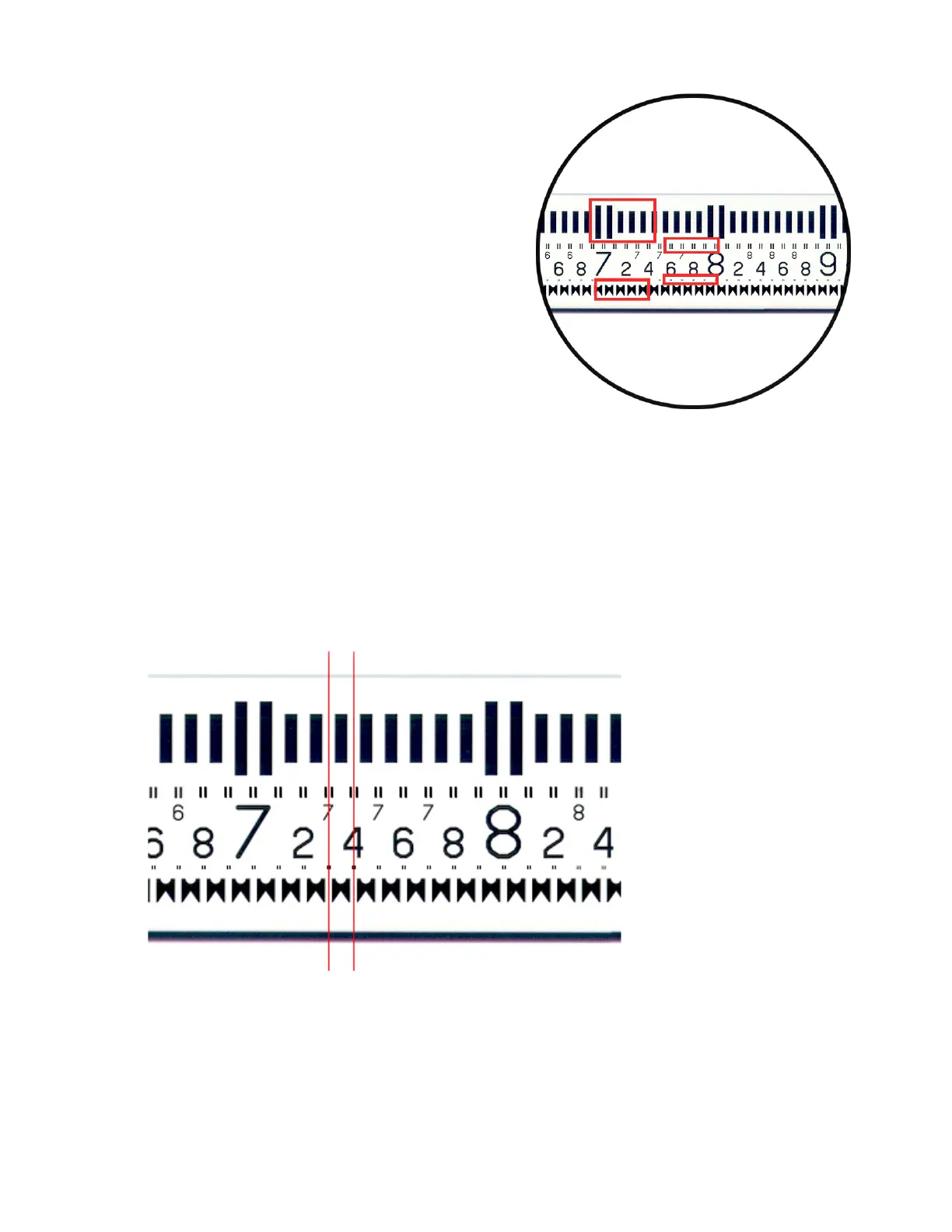
Beforeweproceed,let’stakeacloserlookatthe
opticaltoolingscales.Theyhavearepeatingpat‐
ternoflinesandgaps.Thegapsareactuallythe
targetsthatareof
importance.Thescaleismadeto
bereadbyplacingthevertical(orhorizontal)reti‐
clewirepreciselyinthetargetgapbetweentwo
adjacentlines.InFigure3.16,thefourredboxes
pointoutfourrowsofrepeatinglines.Thelines
areofdifferentheightsbutthetargetinggaps—the
gapsbetweenanypairofadjacenttargetlines—areal‐
ways0.1”(or2mm)apart.Thatis,anytwoadjacent
are0.1”(or2mm)apart,center‐to‐center.Thefour
differentlysizedpatternssimplyallowthescaleto
beusedatdifferentdistances.Thelargerowatthe
topisusedforfurtherdistancesfromthetransit,andthesmallest
rowisusedwhenthescaleisclosetothetransit.
WeareusinganEnglishscaleinourexample,sothedistancefrom
onetargetgaptothenext,betweenanytwoadjacentlines,isex‐
actly0.1”.InFigure3.17,bothoftheredlinespassthroughfour
targetgapsinthefourtargetrows,andthetworedlinesareexactly
0.1”apart.Theredlineontheleftpassesthroughallofthe7.3”tar‐
getgaps,andtheoneontherightpassesthroughthe7.4”target
gaps.
ThetargetgapsarefurtheroutlinedforclarityinFigure3.18.
Infigure3.19,thebluesquarehighlightsarowofsevens.Thesefig‐
uresindicatewhichinchincrementyouareviewingandareonly
necessarywhenthetransitissoclosethatyoucan’tseethelarger
inchincrementnumbers.
Figure3.16
Figure3.17


 To Next Page