Model 771, 75, and 76-RH190 Transits 4
youcandesigninyourmind.
Asweindicatedearlier,the76‐RH190istheonlycurrentlypro‐
ducedOpticalToolingtransit.Althoughthismanualwaswritten
specificallyforthe76‐RH190,muchoftheinformationitcontainsis
applicabletotheothertransitsaswell.
Thedifferencesbetweenthe771‐x,75‐x,and76‐xtransitsrelate
solelytothewayinwhichthecross‐axisisconstructedandused.
Alltransitssharethesamebase,standardassembly,bearings,and
telescopeoptics.Onalltransits,thetelescoperotatesinavertical
planearoundahorizontalaxis(the“cross‐axis”).Thecross‐axisis
perpendiculartothelineofsight.
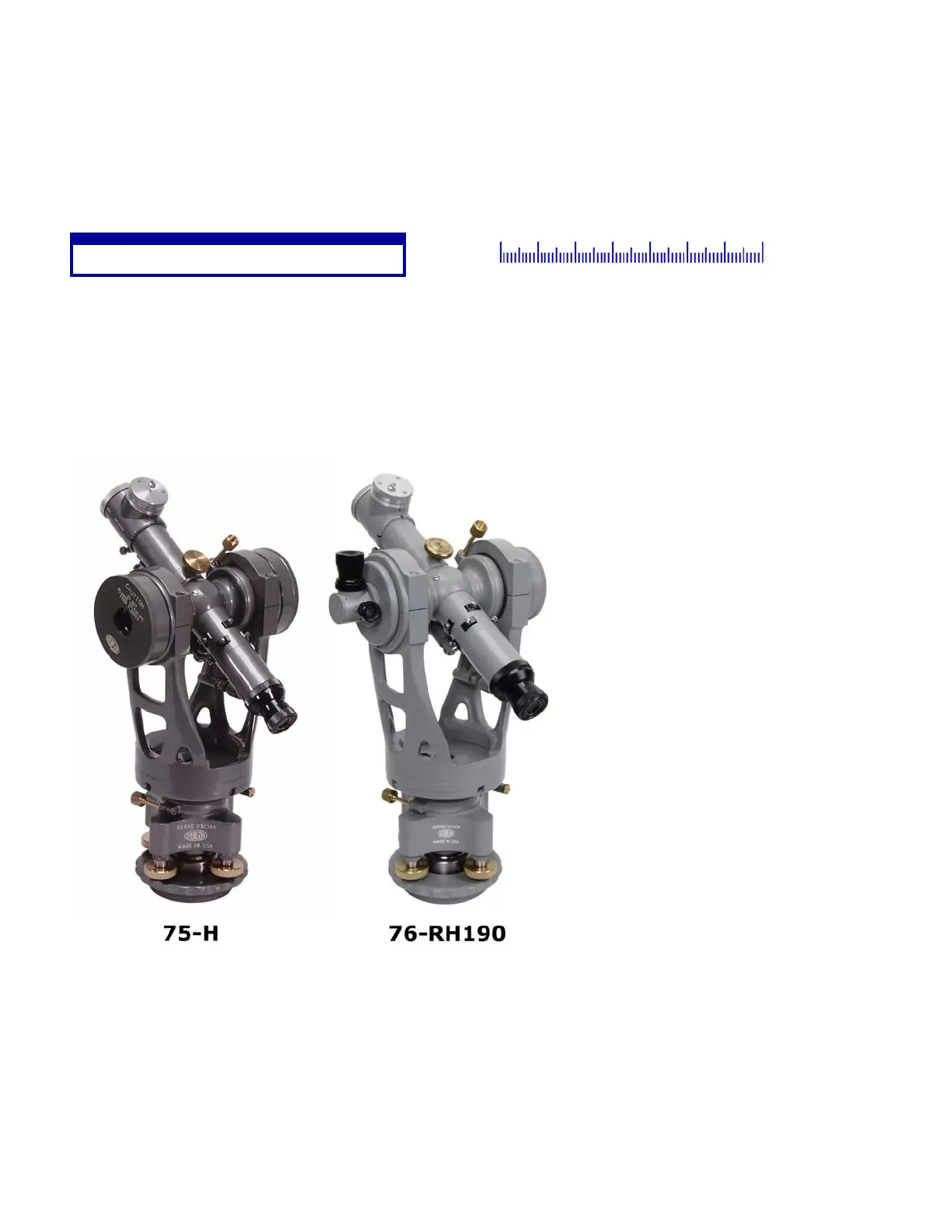
Themostbasictransitisthe771or
771‐H.Thesetransitshavenoop‐
ticsinthecrossaxis.Theyare
usedas“jig”transitstoestablish
straightlinesandplanes.How‐
ever,theyhavenocapabilityto
makeanaccuraterightangleturn.
Onestep“up”isthemodel75or
75‐H(ontheleftinFigure1.3).
Thesetransitshaveacrossaxis
whichishollowandcanbeseen
through.Ononesideofthecross‐
axisisaclearglasswindow,and
ontheothersideisapartiallyre‐
flectivemirror.The75(‐H)does
everythingthatthe771(‐H)can
do,butcanalsobeusedincon‐
junctionwithanotherinstrument
toproduceaveryaccurateright
angle.
Themostflexibletransit(andthe
onlyonecurrentlyproduced)
is
themodel76‐RH190.Thecross‐
axisofthistransitcontainsatele‐
scopethatispermanentlyfocusedatinfinityandisequippedwith
reticlelighting.Arightangleeyepieceisprovidedasstandard
equipmentonthecross‐axistelescope.The76‐RH190maybeused
toestablishstraightlines,horizontalorverticalplanes,andcreate
accuraterightangleswithrespecttoothertransits,alignmenttele‐
scopes,mirrors,orotherphysicaltargets.Whenthecrosswiresof
thetransit’scross‐axistelescopearesetonthoseofareferencetele‐
scopeormirror,themaintelescopeofthetransitwillsweepaplane
atpreciserightanglestothecross‐axisreferenceline.
The75‐Htransit
(above,left)hasbeendis‐
continuedbutmanyare
stillinuse,andmostof
theinformationcon‐
tainedinthismanual
stillapplies.
Figure1.3
Thethreedifferenttransits


 To Next Page