EasyManua.ls Logo

Bryant Evolution Control SYSTXBBUID01 - User Manual

Bryant Evolution Control SYSTXBBUID01
12 pages
Print Icon
To Next Page IconTo Next Page
Loading...
NOTE: Read the entire instruction manual before starting the
installation.
This symbol indicates a change since the last issue.
TABLE OF CONTENTS
SAFETY CONSIDERATIONS.....................................................1
INTRODUCTION..........................................................................1
INSTALLATION AND START-UP OVERVIEW......................1
INSTALLATION...........................................................................1
INITIAL POWER-UP....................................................................5
QUICK START..............................................................................6
INSTALL / SERVICE MENUS....................................................7
OPERATIONAL INFORMATION.............................................11
TROUBLESHOOTING ...............................................................12
SAFETY CONSIDERATIONS
Read and follow manufacturer instructions carefully. Follow all
local electrical codes during installation. All wiring must conform
to local and national electrical codes. Improper wiring or installa-
tion may damage Evolution Control System. Recognize safety
information. This is the safety-alert symbol
. When you see this
symbol on the equipment and in the instruction manual, be alert to
the potential for personal injury. Understand the signal words
DANGER, WARNING, and CAUTION. These words are used
with the safety-alert symbol. DANGER identifies the most serious
hazards, which will result in severe personal injury or death.
WARNING signifies a hazard, which could result in personal
injury or death. CAUTION is used to identify unsafe practices,
which would result in minor personal injury or product and
property damage. NOTE is used to highlight suggestions which
will result in enhanced installation, reliability, or operation.
INTRODUCTION
The Evolution System consists of intelligent communicating
components (User Interface, variable speed furnace or fan coil, AC
or HP), which continually communicate with each other via a
four-wire connection called the ABCD bus. Conventional 24-volt
signals on dedicated wires are not needed. Commands, operating
conditions, and other data are passed continually between the
components over the ABCD bus. The result is a new level of
comfort, versatility, and simplicity.
An Evolution System consists of a Evolution Control™ (thermo-
stat plus much more) and a variable-speed furnace or FE fan coil.
They support controlled ventilation, humidification, dehumidifica-
tion, and air quality control. Either a two-speed (communicating),
or a standard 24 vac controlled outdoor unit may be used.
When using conventional outdoor units, the variable-speed furnace
or fan coil provides the 24 volt signals needed to control them.
Also, the Evolution Network Interface Module (NIM) allows
connection of a conventional HRV or ERV without the need for a
separate wall control.
All system components are controlled through the wall mounted
Evolution Control™, which replaces the conventional thermostat
and provides the homeowner with a single wall control for all the
features of the system.
INSTALLATION AND START-UP OVERVIEW
This instruction covers installation of the Evolution Control™
only. Physical installation instructions for the indoor, outdoor
equipment and accessories are provided with each unit.
Setup, commissioning, operation, and troubleshooting of the
Evolution System is covered only in this installation instruction. It
is your guide to connecting the system components and commis-
sioning the system once all the physical components are installed.
Special screen prompts and start-up capabilities are provided in the
Evolution System to simplify and lead you through the initial
commissioning of the system. So:
Install the Evolution Control™ according to this instruction.
Install the indoor unit, outdoor unit, and accessories according
to their instructions.
Wire the complete system according to this instruction.
Setup, commission, and operate the system according to this
instruction to assure yourself a smooth and trouble free
start-up.
INSTALLATION
A. Step 1 Check Equipment and Job Site
INSPECT EQUIPMENT File claim with shipping company,
prior to installation, if shipment is damaged or incomplete.
HOLD
COOL
HEAT
OFF
Evolution Control™
SYSTXBBUID01
A03149
Installation and Start-Up Instructions
Evolution™ Control
SYSTXBBUID01
Cancels: NEW II UID01-0-1
02-04
—1—

Questions and Answers

Summary

Safety Considerations and System Introduction

Installation and Start-Up Overview

Guide for connecting system components and initial commissioning of the Evolution System.

Evolution Control Location and Wiring Guidelines

Location and Mounting Options

Best practices for control placement and instructions for recess, surface, and decorative mounting.

Wiring Considerations

Recommendations for thermostat wire gauge, color coding, and remote sensor usage.

Installing the Evolution Control

Electrical Safety Warning

Warning about potential injury or death from electrical hazards during installation.

Physical Installation Steps

Process for powering off equipment, mounting the control, and routing wires.

Evolution Control Wiring and Humidifier Setup

ABCD Connector and Wiring

Explanation of the 4-wire ABCD connector and recommended color code for system wiring.

Humidifier Connection Instructions

Procedures for connecting bypass and fan powered humidifiers to the system.

System Power Up and Outdoor Unit Configuration

Initial Power Up Sequence

Outlines the initial power-up process and system equipment identification.

Outdoor Unit Type and Size Selection

Guide for selecting outdoor unit type, size, and speed settings during setup.

Accessory Selection and System Configuration Summary

Electric Heater and Accessory Selection

Selecting electric heater size and system accessories like filters, humidifiers, and UV lights.

Equipment Summary and Saving Settings

Reviewing all selected equipment and accessory settings before saving.

Install;Service Menu Navigation and Setup

Install;Service Menu Overview

Overview of the Install/Service menus and their respective functions.

Install and Setup Menu Operations

Accessing Install (re-install) and Setup (configuration) menus for system adjustments.

Thermostat and Furnace Configuration Options

Thermostat Setup Parameters

Configuration of auto mode, deadbands, offsets, programming, and smart recovery settings.

Furnace Setup Parameters

Settings for furnace airflow, AC airflow, and dehumidification airflow adjustments.

Heat Pump, Ventilator, and System Checkout

Heat Pump;AC and Accessory Setup

Settings for heat pump/AC, filters, humidifiers, and ventilators.

System Component Checkout

Accessing diagnostic menus to test furnace, fan coil, electric heat, and other components.

Component Checkout and Service Information

Component Checkout Procedures

Exercising furnace, fan coil, humidifier, and ventilator operations for testing.

Service Information Categories

Overview of service information categories like furnace status, faults, and operating history.

Operational Information and System Timers

Operational Modes and Protection Features

Continuous fan operation, compressor timeguard, emergency heat, keypad lockout, and LED indicators.

System Timers and Advanced Features

Equipment cycle timer, staging timers, setpoints, auto changeover, smart recovery, and filter detection.

Troubleshooting Common Malfunctions

Power and Unit Communication Issues

Troubleshooting steps for no power, indoor unit not found, and outdoor unit not found errors.

Critical and System Malfunction Alerts

Explains critical malfunction and system malfunction alerts and their visual indicators.

Overview

The Bryant Evolution Control (SYSTXBBUID01) is an intelligent communicating thermostat that serves as the command center for the Evolution System. This system comprises the User Interface (the control itself), a variable-speed furnace or fan coil, and an AC or heat pump unit. These components continuously communicate via a four-wire ABCD bus, eliminating the need for conventional 24-volt signals on dedicated wires. This communication allows for the exchange of commands, operating conditions, and other data, resulting in enhanced comfort, versatility, and simplicity.

Function Description:

The Evolution Control manages various aspects of indoor climate, including controlled ventilation, humidification, dehumidification, and air quality control. It replaces conventional thermostats, providing a single wall control for all system features. When conventional outdoor units are used, the variable-speed furnace or fan coil provides the necessary 24-volt signals for control. The Evolution Network Interface Module (NIM) also enables connection of a conventional HRV or ERV without a separate wall control.

Important Technical Specifications:

  • Wiring: Uses a four-wire ABCD bus connection. Recommended wire gauge is 22 AWG or larger for normal applications, and 20 AWG or larger for continuous wire lengths over 100 ft. A consistent color code (Green=Data A, Yellow=Data B, White=24VAC Com, Red=24VAC Hot) is recommended.
  • Mounting: Two options: Recess Mount (thinnest configuration, requires a 1½" wide by 2 1/8" high hole) or Surface Mount (uses a small hole for wiring). A decorative backplate is supplied to cover marks from previous thermostats.
  • Temperature Measurement: For accurate readings, the control should be mounted approximately 5 feet (1.5 meters) from the floor, preferably on an inside partitioning wall, away from windows, outside walls, direct light/heat sources, supply registers, or areas with poor air circulation.
  • Remote Sensor Option: A remote room sensor can be connected to S1 and S2 terminals to replace the internal temperature sensor. The humidity sensor cannot be remotely located.
  • Humidifier Connection: Supports 24VAC bypass or fan-powered humidifiers. Traditional humidistats should not be used. For fan-powered humidifiers, a 24VAC N.O. Isolation Relay (DPST) MUST be used to prevent mixing internal humidifier power with the indoor equipment transformer.
  • Electric Heater Sizing: If the indoor unit is a fan coil and the electric heater is not self-identifying, the installer must select the appropriate size (5, 10, or 15 KW). The control limits available sizes based on the fan coil model.
  • Filter Types: Supports 1-4 inch media, high voltage EAC, or a combination (MEDIA + EAC).
  • UV Lights: Installer can select if UV lights are installed.
  • Temperature Offsets: Adjustable from -5 to +5 degrees for room temp and outside temp.
  • Humidity Offset: Adjustable from -10 to +10 percent.
  • Cycles Per Hour: Maximum cycles per hour can be set to 4 (default) or 6.
  • Anticipator: Adjustable from 1 to 9 (default=3).
  • Programming: On/Off (default=On), Periods Per Day (2 or 4, default=4), Programmable Fan On/Off (default=Off).
  • Smart Recovery: On/Off (default=On), starts recovery 90 minutes prior to schedule change.
  • Display Units: °F or °C (default = °F).
  • Heat/Cool Deadband: Adjustable from 0 to 6 degrees (default=2°). A minimum 2° difference is enforced.
  • Dehumidification Airflow: NORMAL (default) or HIGH. HIGH increases airflow speed to reduce duct sweating.
  • Low Heat Rise: ON or OFF (default). ON increases furnace low heat airflow for bypass humidifiers.
  • Staging: SYSTEM (default), FURNACE, LOW, or HIGH. Controls furnace staging.
  • Off Delay: Blower run time after heating shut off: 90 (default), 120, 150, or 180 seconds.
  • Lockout Temp: NONE (default) or +5 to 55 deg F. For dual fuel systems, outside temperature above which furnace will NOT run.
  • Cooling Lockout: NONE (default), 45°F, 50°F, 55°F. Outside temperature below which cooling will not be provided.
  • Defrost Interval: 30, 60, 90 (default), or 120 minutes.
  • Electric Heat Lockout: NONE (default) or +5 to 55 deg F. Outside temperature above which electric heat will not operate.
  • High Cool Latch: NONE (default) or 80-110 deg F. Outside temperature above which only high speed (of a 2-speed outdoor unit) will run when cooling.
  • Humidifier Change Pad Interval: 1 to 24 months (default=6 months).
  • Humidify with Fan: NO (default) or YES. YES runs humidifier with Continuous Fan if there is a humidify demand.
  • UV Lights Change Interval: 6 to 48 months (default=12 months).
  • System Maintenance Reminder: OFF, 6 to 24 months (default=12 months).
  • Five-Minute Compressor Timeguard: Prevents compressor from starting unless it has been off for at least 5 minutes. Can be defeated by simultaneously pressing Fan and Temp + buttons.
  • Ten-Minute Staging Timer: Prevents higher stage from turning on until preceding stage has been on for 10 minutes. Defeated if temperature error > 5°F.
  • Three-Minute Minimum On Time: When a stage turns on, it remains on for a minimum of three minutes. Defeated if set point is changed.

Usage Features:

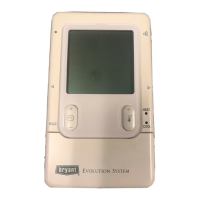
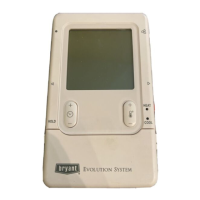
  • User Interface: Features a display screen (LCD), fan button, humidity/OAT button, left/right-side buttons, time (+/-) button, hold button, heat/cool buttons, temperature (+/-) button, scroll buttons, schedule & vacation program buttons, basic & advanced setup buttons, and a flip-down door.
  • Initial Power-Up Sequence: The User Interface automatically establishes communication with equipment, searches for indoor and outdoor units, and prompts the installer to select accessories. If a communicating outdoor unit is not found, the installer must manually select AC or HP type and Btu size.
  • Quick Start: Allows setting day, time, desired heating/cooling humidity, and overriding heating/cooling schedules. Override time can be adjusted in 15-minute increments or set indefinitely with the HOLD button.
  • Quick Program Schedule for All Days: Enables setting WAKE, DAY, EVENING, and SLEEP periods with corresponding start times and heating/cooling temperatures.
  • Continuous Fan Operation: Cycles through AUTO, LOW (approx. 50% High Speed), MED (difference between High and Low speed), and HIGH (highest of either High Heating or High Cooling CFM).
  • Emergency Heat: Activated by pressing and holding the HEAT button for 3 seconds.
  • Keypad Lockout: Activated by pressing Fan and Humidity/OAT buttons simultaneously for 3 seconds. A lock symbol appears on the screen.
  • Heat and Cool LED: Pulsates during actual equipment operation.
  • Auto Changeover: When enabled, a change from heat to cool (or vice versa) will not occur until an opposite mode demand has existed for 30 minutes. This 30-minute requirement is defeated if the set point is changed.
  • Smart Recovery: When selected, transition out of setback begins 1.5 hours before selected recovery time, gradually adjusting room temperature.

Maintenance Features:

  • Install / Service Menus: Accessed by holding the ADVANCED button for at least ten seconds. Provides vital information for installers and service personnel.
    • Equipment Summary: Shows all recognized and attached equipment (indoor unit type/model, outdoor unit type/model, filter type, accessories).
    • Install Menu: Initiates the start-up process to add, uninstall, or re-install equipment.
    • Setup Menu: Allows modification of equipment settings (e.g., thermostat settings, furnace airflow, fan coil settings, heat pump/AC settings, accessories settings, system maintenance).
    • Checkout Menu: Allows testing of equipment operation (furnace, heat pump heating/cooling, humidifier, ventilator, electric heat check). Displays runtimes, stages, airflow, RPM, and static pressure.
    • Service Menu: Displays operational and fault history.
      • Furnace Status: Shows heat stage, airflow CFM, inducer/blower RPM, static pressure.
      • Fan Coil Status: Shows electric heat status, airflow CFM, blower RPM, static pressure.
      • Heat Pump / AC Status: Shows stage (heat/cool), defrost status, airflow CFM, blower RPM, coil temp (for 2-speed communicating outdoor units), static pressure.
      • Last 10 System Faults: Records the last 10 faults with time and date. Each fault has a two-letter acronym indicating the equipment that generated it.
      • Run / Fault History: Displays resettable fault counters and cycle counters (heat/cool/power cycles).
      • Today's Date: Allows installer to enter current date for time/date stamping of system faults.
      • Model / Serial Numbers: Displays model and serial numbers of all communicating equipment.
      • Service Phone Number: Allows installer to enter a name and phone number for homeowner display during service reminders.
  • Media Filter: Performs a static pressure check whenever power is applied or system mode changes (Off to Cool/Heat).
  • TrueSense™ Dirty Filter Detection: When MEDIA or MEDIA+EAC is installed, a static pressure check is performed every 24 hours at 1:00 PM to monitor filter accumulation.
  • Critical Alert Screen: Appears for critical malfunctions (e.g., communication faults, blower motor lockout, abnormal flame proving signal), with alternating Heat and Cool LEDs.
  • System Malfunction Screen: Appears for system malfunctions (e.g., heater output sensed ON when not energized, limit circuit lockout, ignition lockout, pressure switch did not open, secondary voltage fuse open, temp sensor failed, outdoor unit communication fault, defrost error). The user can dismiss the notice, but it will reappear if the error persists for 24 hours.

Bryant Evolution Control SYSTXBBUID01 Specifications

General IconGeneral
BrandBryant
ModelEvolution Control SYSTXBBUID01
CategoryThermostat
LanguageEnglish

Related product manuals