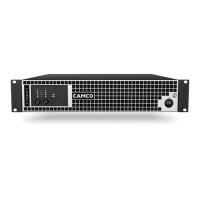
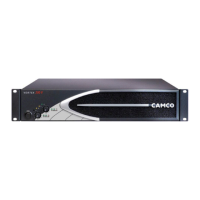
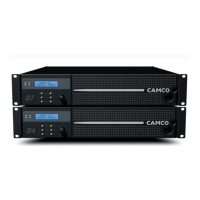
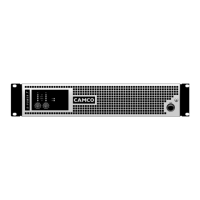
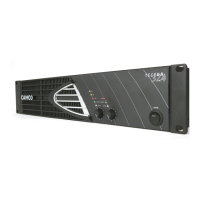
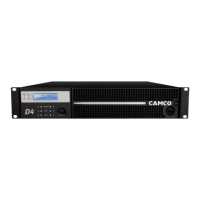
VORTEX-200V
230 V ~ 50/60 Hz 12 A 1700 W
3200 W / 4 Ohm
xxxxxxx
VORTEX-2.6
230 V ~ 50/60 Hz 7,2 A 1005 W
1500 W / 1,8 Ohm
xxxxx
VORTEX-4
230 V ~ 50/60 Hz 10 A 1450 W
2000 W / 2 Ohm
xxxxx
VORTEX-6
230 V ~ 50/60 Hz 12 A 1800 W
3000 W / 2 Ohm
xxxxx
3 INSTALLATION
USER MANUAL
VORTEX 6, 4, 2.6 and 200V
P.10
USER MANUAL
VORTEX 6, 4, 2.6 and 200V
P.11
3.1 Mains supply
When mounting or connecting the amp always disconnect it from mains.
Only connect the VORTEX amplier to an appropriate AC circuit and outlet,
according to the requirements indicated in the second line on the rating
plate.
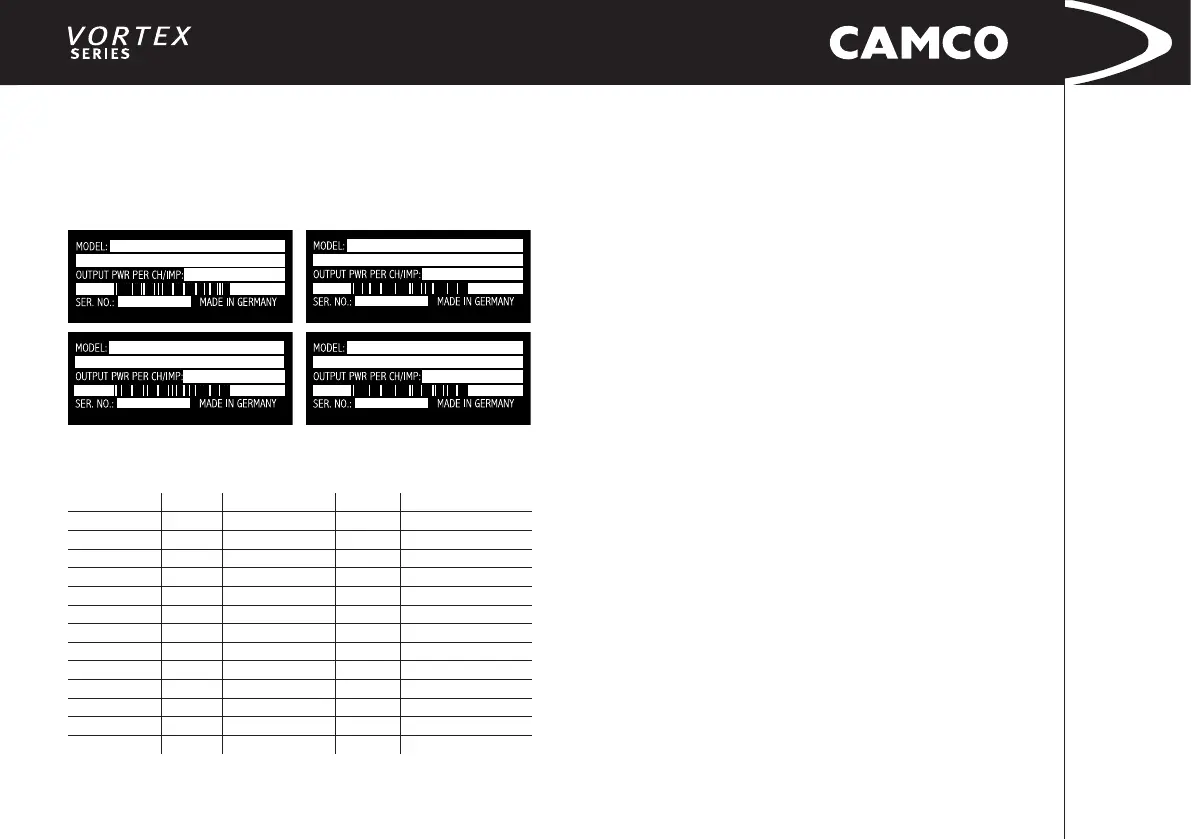
Exemplary rating plates for a mains supply of 230 V AC 50/60 Hz.
Power Supply Data:
Voltage Mains Frequency Current Power Consumption
VORTEX-200V 120 V 50/60 Hz 24 A 1700 W
VORTEX-200V 220 V 60 Hz 12 A 1700 W
VORTEX-200V 230 V 50/60 Hz 12 A 1700 W
VORTEX-6 100 V 50/60 Hz 28 A 1800 W
VORTEX-6 120 V 50/60 Hz 24 A 1800 W
VORTEX-6 220 V 60 Hz 12 A 1800 W
VORTEX-6 230 V 50/60 Hz 12 A 1800 W
VORTEX-4 120 V 50/60 Hz 20 A 1450 W
VORTEX-4 220 V 60 Hz 10 A 1450 W
VORTEX-4 230 V 50/60 Hz 10 A 1450 W
VORTEX-2.6 120 V 50/60 Hz 14,4 A 1005 W
VORTEX-2.6 220 V 60 Hz 7,2 A 1005 W
VORTEX-2.6 230 V 50/60 Hz 7,2 A 1005 W
NOTE: Even under normal conditions the mains current can reach levels
up to 60 A (230 V) and 120 A (120 V), respectively; this could cause lamps
to icker if connected to the same mains as the amp. The impedance of
the AC circuit should be less than 0,157 Ohms to avoid icker according
to EN61000-3-11 “Electromagnetic compatibility – Part 3-11: Limits
– Limitation of voltage changes, voltage uctuations and icker in the
public low-voltage supply systems – Equipment with rated current more
than 75 A and subject to conditional connection”. If in any doubt, consult
your local power provider. Never attempt to measure this impedance level
with your ohmmeter. This may damage your meter and expose you to the
risk of electric shock!
3.2 On/Off Switch
NOTE: This switch does NOT disconnect the amplier from mains.
The switch initiates start-up by activating the current limiting function. As soon
as the power amplier is connected to the mains power supply, a voltage is
supplied to both the line-lter and the fused input of the controllable rectier.
Disconnecting the amplier from the main power supply can only be achieved
by physically separating the amplier from the mains by pulling the mains plug.
The mains plug therefore has to be freely accessible. Disconnect the mains
plug from the mains during a lightning storm or when the amplier remains
unused or un-supervised for a prolonged period of time. Alternatively, you can
disconnect the amplier via an external all-pole disconnection from the mains.
If a power cut occurs while the amplier is switched on, it will restart auto-
matically once the power supply has been restored. All settings operation prior
to the loss of power will be maintained.



 To Next Page