B. Performance Adjustments
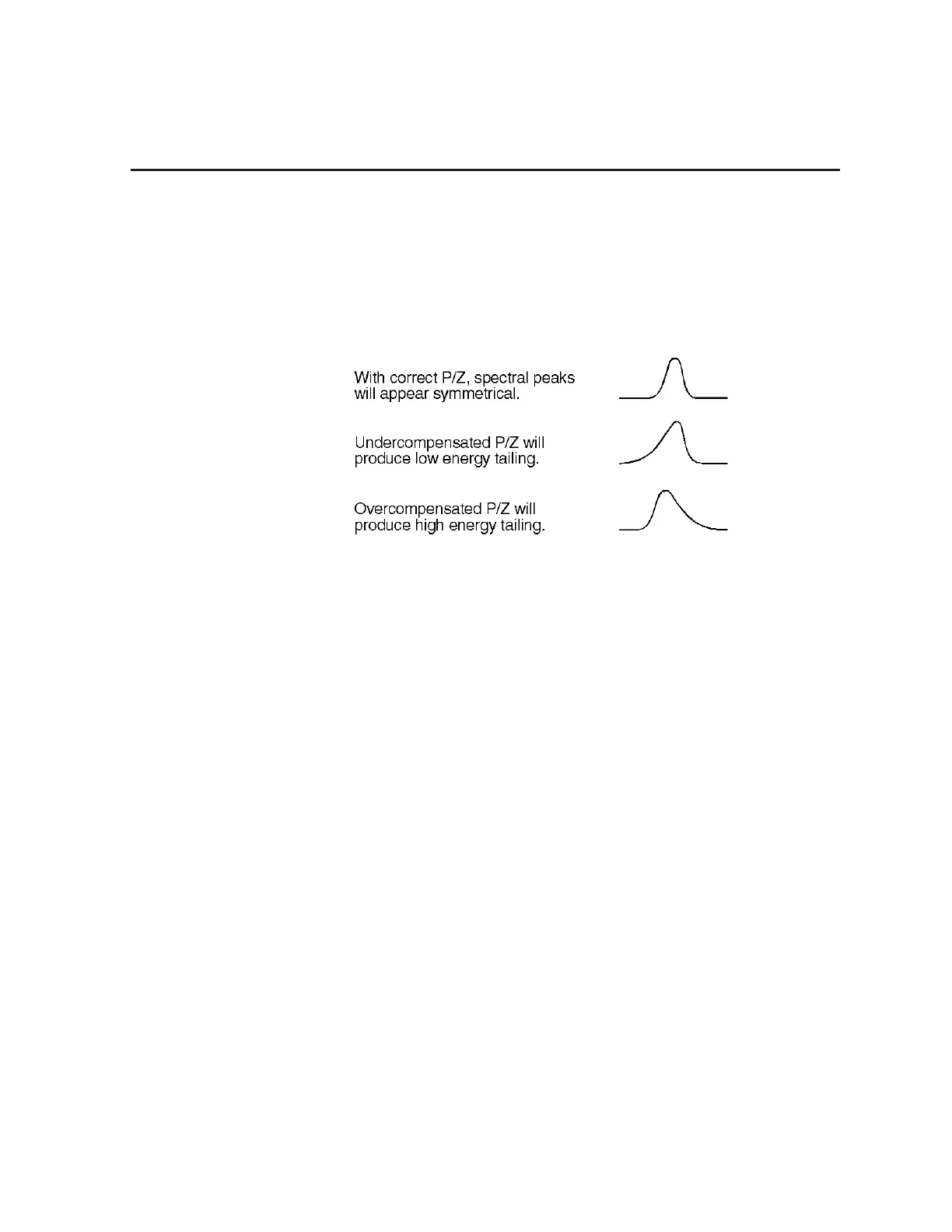
At high count rates, the pole/zero (P/Z) matching adjustment (compensation) is ex
-
tremely critical for maintaining good resolution and low peak shift. For a precise and
optimum setting of P/Z matching, a scope vertical sensitivity of 50 mV/div should be
used.
Higher scope sensitivities can also be used, but result in a less precise P/Z matching
adjustment. However, most scopes will overload for a 10 V input signal when the ver-
tical signal returns to the baseline. Thus the P/Z matching will be incorrectly adjusted
resulting in a loss of resolution at high count rates.
When performing the following manual P/Z matching adjustments, set the scope’s ver
-
tical sensitivity to 50 mV/div and use a clamp box, such as the Canberra Model
LB1502 Schottky Clamp Box, to view the unipolar signal. This will eliminate potential
scope overload, and allow precise manual P/Z matching adjustment.
Pole/Zero Matching Using an Ultra LEGe Detector and
55
Fe.
1. Set the gain for a Unipolar Output signal of 8 to 10 volts.
2. Adjust the
55
Fe source count rate to be between 2 kcps and 25 kcps.
3. Using a clamp box, such as the Canberra Model LB1502 Schottky Clamp
Box, observe the AMP OUT signal on the scope and adjust the manual P/Z
control so that the trailing edge of the unipolar pulse returns to the baseline
with no overshoots or undershoots.
37
Pole/Zero Matching Using an Ultra LEGe Detector and
55
Fe.



 To Next Page