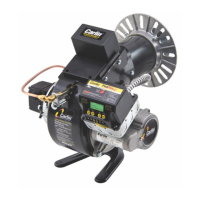
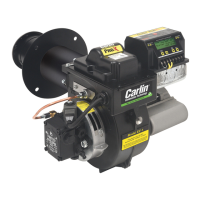
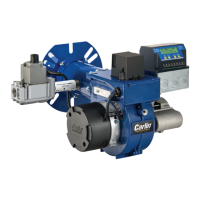
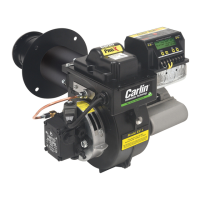
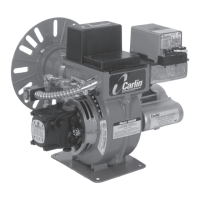
Model 201CRD & 301CRD Advanced oil burners — Instruction manual
Carlin part number MN2301 Rev. 04/12/04
– 26 –
8. Maintenance/service procedures
Turn off power to appliance when servicing burner. Failure to comply
could result in severe personal injury, death or substantial property
damage.
Cleaning blower wheel
1. The blower wheel accumulates dust and debris from normal operation. You will
need to clean the wheel blades periodically to prevent reduction in airflow.
• Inspect the blower wheel by removing the blower wheel access cover.
• To remove the cover, open the ignitor plate and loosen the blower wheel
access cover screw about three turns.
• Inspect the blower wheel to see if it needs to be cleaned. Dirt and lint on
the wheel reduce air flow, and must be removed if the burner is to operate
correctly.
2. To clean blades, remove the two bolts securing the motor to blower housing.
a. Slide the motor out and rotate to remove and access blower wheel.
b. Use a brush and vacuum to clean each blade and the blower housing
interior.
c. Install motor/wheel in blower housing and secure with the two bolts.
d. Push wire slack back into junction box.
Replacing blower motor or wheel
1. If either the blower wheel or motor must be replaced, remove the two bolts
securing the motor to housing.
2. Disconnect the motor wires in the burner junction box.
3. Loosen the Allen screw securing the blower to the motor shaft and remove the
wheel.
4. When assembling the replacement assembly, slide the wheel onto the motor
shaft and use feeler gauges to set space between the blower wheel and the
motor face. This space must be:
201CRD – 1/8” 301CRD – 1/8”
5. Install the motor/wheel assembly in the housing, wire the motor leads and
secure the motor with the two bolts.
Motor maintenance
• The Carlin PSC motor is constructed with permanently-lubricated bearings,
and requires no oiling. Should you replace the original motor with another type
of motor, occasional oiling may be required, depending on motor design and
manufacturer’s recommendations.
• Any time you replace a component or disassemble any part of the burner for
service/maintenance, perform a complete operational test after reassembly to
verify the burner operates correctly. Failure to verify operation could result in
severe personal injury, death or substantial property damage.
Checking motor windings (98630 PSC motor)
1. Allow the motor to cool to room temperature.
2. Remove power from the burner.
3. Disconnect the orange and white motor leads in the burner junction box.
4. Remove the motor capacitor cover. Disconnect the blue and white lead
wires connected to the capacitor. (The capacitor is 16 microfarads.)
5. Use the ohmmeter to check each of the following resistances by connecting
to the motor lead wires. If any of the measured resistances is outside of
the range listed, the motor winding(s) are faulty and the motor should be
replaced.
• Orange to Blue (capacitor) wire ............................ 5 to 7 ohms
• Orange to White (capacitor) wire .......................... 2 to 4 ohms
• White to Blue (capacitor) wire .............................. 8 to 11 ohms
• White motor wire to White capacitor wire ..............LESS THAN 1 ohm
6. Restore wiring and components.
Checking ignitor
Never test an ignitor by placing a screwdriver (or other metallic
object) across the high voltage clips. Check 40700 & 40900 ignitors
only by observing spark at appliance ignition electrodes, with fuel
supply OFF. Using any other method could cause ignitor damage
and severe personal injury.
1. Checking 41000 ignitors only:
• Disconnect electrical power to burner.
• Remove hold down clips or screws. Lift ignitor mounting plate to the full-
open position. Set high voltage clips to a ½” to ¾” gap.
• Carefully energize ignitor and check for spark arcing at the high voltage
terminals. If spark jumps the gap, ignitor is good.
Ceramic fiber materials
The appliance may contain ceramic fiber and/or fiberglass
materials. Ceramic fiber materials, such as chamber liners, may
contain carcinogenic particles (chrystobalites) after exposure
to heat. Airborne particles from fiberglass or ceramic fiber
components have been listed as potentially carcinogenic by
the State of California. Take the following precautions when
removing, replacing and handling these items.
Avoid breathing dust and avoid contact with skin or eyes. Wear
long-sleeved, loose-fitting clothing, gloves and eye protection.
Use a NIOSH N95 certified respirator. This respirator meets
requirements for protection from chrystobalites. Actual job
requirements or NIOSH regulations may require other or ad-
ditional protection. For information, refer to the NIOSH website,
http://www.cdc.gov/niosh/homepage.html.
Ceramic fiber removal: To prevent airborne dust, thoroughly wet
ceramic fiber with water before handling. Place ceramic fiber
materials in a plastic bag and seal to dispose.
Avoid blowing, tearing, sawing or spraying fiberglass or ceramic
fiber materials. If such operations are necessary, wear extra
protection to prevent breathing dust.
Wash work clothes separately from other laundry. Rinse clothes
washer thoroughly afterwards to prevent contamination of other
clothing.
NIOSH First aid procedures:
Eye exposure — irrigate immediately
Breathing — fresh air.


 To Next Page
 Loading...