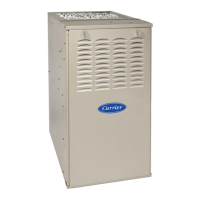
58TUA
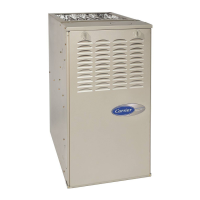
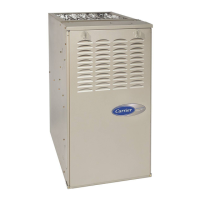
2-Speed, 2-Stage
Induced-Combustion Gas Furnace
Installation, Start-Up, and Operating Instructions
Size 040-135, Series 110 or 120
NOTE: Read the entire instruction manual before starting the
installation.
This symbol → indicates a change since the last issue.
Index Page
SAFETY CONSIDERATIONS.....................................................1
ELECTROSTATIC DISCHARGE (ESD) PRECAUTIONS
PROCEDURE...........................................................................3
Dimensional Drawing ....................................................................2
Clearances to Combustibles......................................................3
INTRODUCTION.......................................................................3-4
LOCATION....................................................................................4
General ......................................................................................4
Location Relative to Cooling Equipment ................................4
Hazardous Locations.................................................................4
AIR FOR COMBUSTION AND VENTILATION...................4-5
Unconfined Space.....................................................................5
Confined Space......................................................................5-6
AIR DUCTS ..........................................................................6-7
FILTER ARRANGEMENT...........................................................7
LEVELING LEGS (IF REQUIRED).........................................7-8
GAS PIPING...............................................................................8-9
ELECTRICAL CONNECTIONS ..................................................9
115-v Wiring.............................................................................9
24-v Wiring...............................................................................9
Accessories................................................................................9
VENTING ......................................................................................9
START-UP, ADJUSTMENT, AND
SAFETY CHECK................................................................9-21
General.................................................................................9-11
Sequence of Operation ......................................................11-15
Adaptive Heating Mode ....................................................11-12
Non-Adaptive Heating Mode .................................................12
Cooling Mode .........................................................................14
Continuous Blower Mode.......................................................14
Heat Pump Mode....................................................................14
Defrost.....................................................................................15
Start-Up Procedures................................................................15
Adjustments .......................................................................15-20
Set Gas Input Rate ............................................................15-20
Set Temperature Rise ........................................................20-21
Set Thermostat Heat Anticipator............................................21
Check Safety Controls............................................................21
Checklist..................................................................................22
SAFETY CONSIDERATIONS
Installation and servicing of heating equipment can be hazardous
due to gas and electrical components. Only trained and qualified
personnel should install, repair, or service heating equipment.
Untrained personnel can perform basic maintenance functions
such as cleaning and replacing air filters. All other operations must
be performed by trained service personnel. When working on
heating equipment, observe precautions in the literature, on tags,
and on labels attached to or shipped with the unit and other safety
precautions that may apply.
Follow all safety codes. In the United States, refer to the National
Fuel Gas Code (NFGC) NFPA No. 54-1996/ANSI Z223.1-1996.
In Canada, refer to the current edition of the National Standard of
Canada CAN/CGA- B149.1- and .2-M95 Natural Gas and Propane
Installation Codes (NSCNGPIC) and Amendment No. 1. Wear
safety glasses and work gloves. Have fire extinguisher available
during start-up and adjustment procedures and service calls.
Recognize safety information. This is the safety-alert symbol
.
When you see this symbol on the furnace and in instructions or
manuals, be alert to the potential for personal injury.
Understand the signal words DANGER, WARNING, and CAU-
TION. These words are used with the safety-alert symbol. DAN-
GER identifies the most serious hazards which will result in severe
personal injury or death. WARNING signifies a hazard which
could result in personal injury or death. CAUTION is used to
identify unsafe practices which would result in minor personal
injury or product and property damage. NOTE is used to highlight
suggestions which will result in enhanced installation, reliability,
or operation.
These instructions cover minimum requirements and conform to
existing national standards and safety codes. In some instances,
these instructions exceed certain local codes and ordinances,
especially those that may not have kept up with changing resi-
dential construction practices. We require these instructions as a
minimum for a safe installation.
®
ama
CANADIAN GAS ASSOCIATION
APPROVED
R
REGISTERED QUALITY SYSTEM
Visit www.carrier.com
Manufacturer reserves the right to discontinue, or change at any time, specifications or designs without notice and without incurring obligations.
Book 1 4
Tab 6a 8a
PC 101 Catalog No. 535-735 Printed in U.S.A. Form 58TUA-6SI Pg 1 4-99 Replaces: 58TUA-5SI
→

 Need help?

 To Next Page

 General