Celestar Manual
Fastar Lens Assembl
PixCel 237 CCD Camera
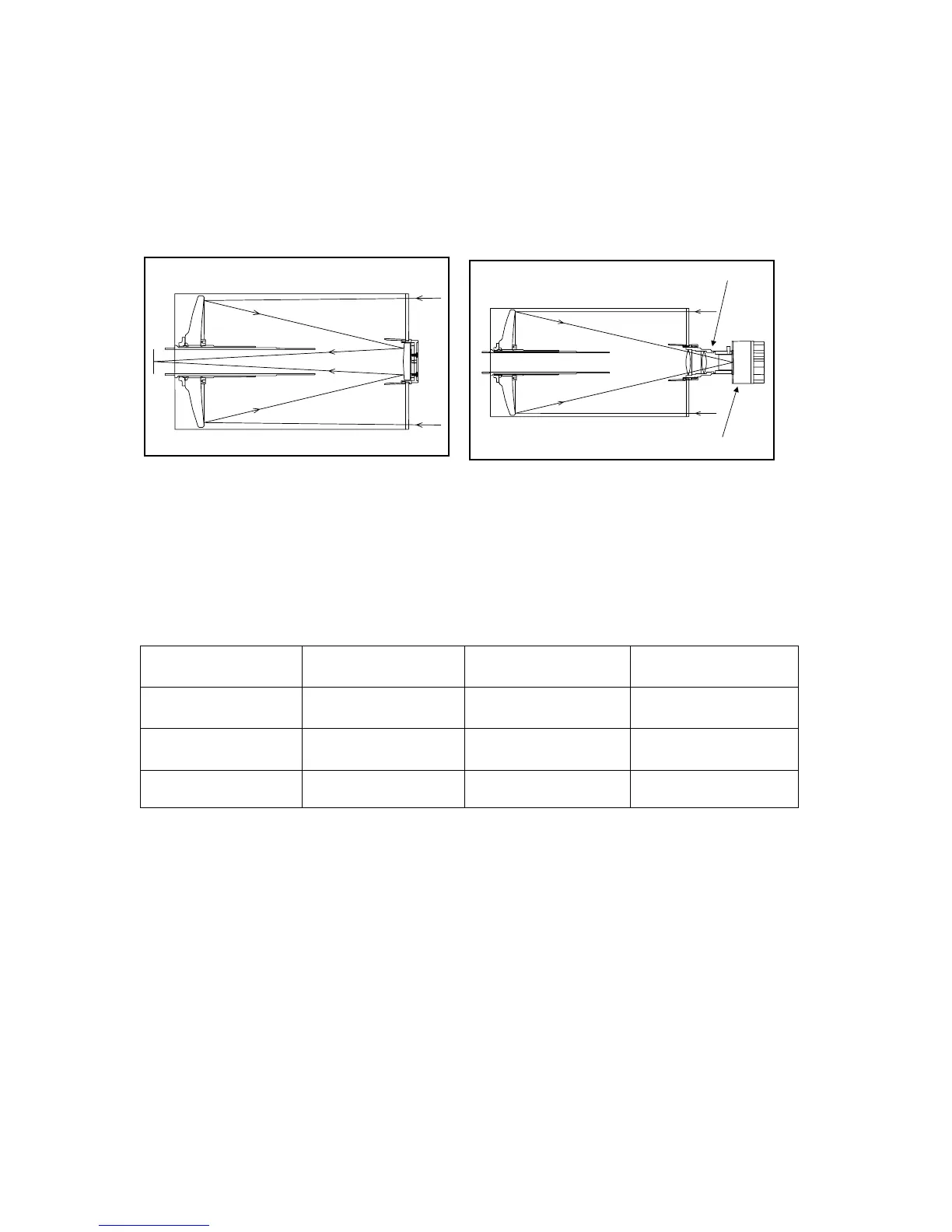
DESCRIPTION OF F-NUMBERS
The F/# stands for the ratio between the focal length and the diameter of the light gathering element. A
standard C8 has a focal length of 80 inches and a diameter of 8 inches. This makes the system an f/10,
(focal length divided by diameter). When the secondary is removed and the CCD is placed at the Fastar
position, the system becomes f/1.95, this is unique to Celestron telescopes (see figures below).
The key factors for good CCD imaging are; exposure time, field-of-view, image size, and pixel resolution.
As the F/# goes down (or gets faster), the exposure times needed decreases, the field-of-view-increases, but
the image scale of the object gets smaller. What is the difference between f/1.95 and f/10? F/1.95 has 1/5
the focal length of f/10. That makes the exposure time needed about 25 times shorter than at f/10, the field
of view 5 times larger and the object size 1/5 compared to that of f/10. (see Table below)
Standard Cassegrain With Reducer/corrector
Accessory
With Fastar lens
Accessory
Focal Length & Speed 80" (2000mm) @f/10 50" (1250mm) @f/6.3
16"(400mm) @
f/1.95
PixCel 237 F.O.V. 8.1 x 6.3 (arc min) 13 x 10 (arc min)
.69 x .53 (degrees)
41 x 31 (arc min)
PixCel Sampling
(arc sec/pixel)
.75 (arc sec) 1.2 (arc sec)
3.8 (arc sec)
Table 8-3
FASTAR CONFIGURATIONS
The following is a brief description of the advantages of imaging at each f-number configuration and the
proper equipment needed to use the telescope in any of its many settings. Refer to Figure 8-6 for a more
detailed description of the accessories offered for each configuration.
IMAGING AT F/1.95
As stated above, the exposure times are much shorter at f/1.95 then at f/6.3 or f/10. The field-of-view is
wider, so it is easier to find and center objects. Also with a wider field-of-view you can fit larger object
(such as M51, The Whirlpool Galaxy) in the frame. Typical exposure times can be 20-30 seconds for
many objects. With the Track and Accumulate function on the PixCel software (see the PixCel Operating
Manual for more details about its software features), the camera can shoot and stack several images
automatically without ever having to guide the exposure. Under dark skies you can get an excellent image
of the Dumbbell Nebula (M27) with only a few 30 second exposures (see figure 8-4 below). The spiral
arms of the Whirlpool galaxy (Figure 8-5) can be captured with a 30 second exposure and can be
•
Fig 8-3 -- Light path at Fastar f/1.95 focus
•
Fig 8-2 -- Light path at f/10 focus





 To Next Page