Celestar Manual
7
THE SCHMIDT-CASSEGRAIN OPTICAL SYSTEM
A telescope is nothing more than an instrument that collects and focuses light. The nature of the optical
design determines how the light is focused. Some telescopes, known as refractors, use lenses while others,
known as reflectors, use mirrors. The Schmidt-Cassegrain optical (or Schmidt-Cass for short) system uses
a combination of mirrors and lenses and is referred to as a compound or catadioptric telescope. This
unique design offers large diameter optics while maintaining very short tube lengths, making them
extremely portable. This makes them extremely popular among amateur astronomers. The Schmidt-
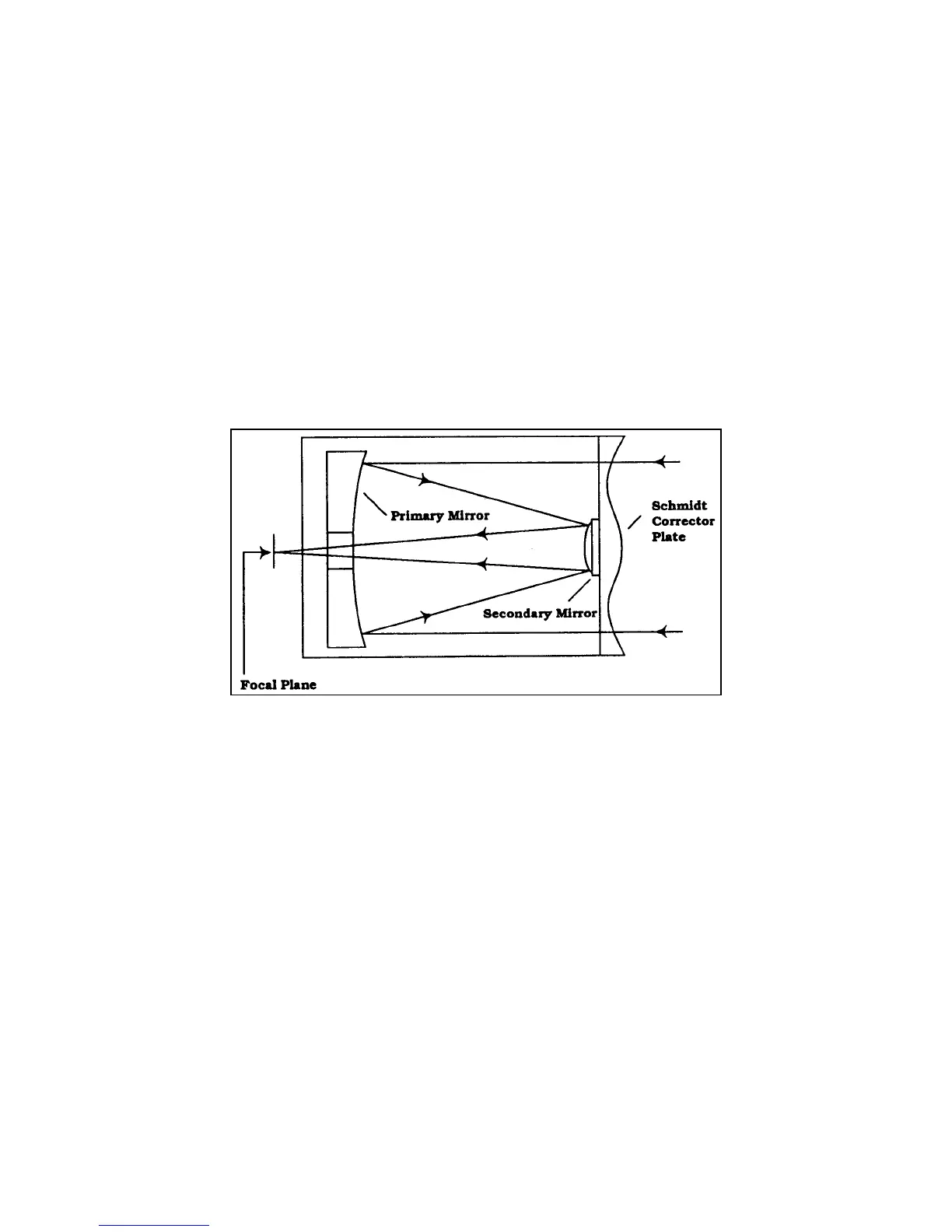
Cassegrain system consists of a zero power corrector plate, a spherical primary mirror, and a secondary
mirror. Once light rays enter the optical system, they travel the length of the optical tube three times.
Inside the optical tube you will notice a black tube (not illustrated) that extends out from the center hole in
the primary mirror. This is the primary baffle tube which prevents stray light from passing through to the
eyepiece or camera without striking the primary or secondary mirrors.
Figure 1-1.
This cross-section diagram shows the light path of the Schmidt-Cassegrain optical
system. Note that the light rays travel the length of the telescope tube three times, making this a
compact design. Note that the curve of the corrector plate is greatly exaggerated
.





 To Next Page