Need help?
Do you have a question about the CHCNAV CHC E91 and is the answer not in the manual?
Copyright information for the CHC E91 GNSS Receiver User Guide.
Mentions trademarks of products and brand names used in the manual.
General warnings regarding the use of GNSS receivers and potential hazards.
Details compliance with FCC rules for digital devices to prevent interference.
Declaration of Conformity for compliance with EU directives.
Provides essential safety guidelines for operating the GNSS receiver.
Explains the meaning of Warning and Caution alerts for user safety.
Discusses country-specific regulations for wireless modem usage.
Guidance on handling the receiver to prevent damage and ensure longevity.
Information on how to obtain technical assistance for the receiver.
States CHC's responsibility and user obligations regarding the user guide.
Invites user feedback for future revisions of the user guide.
An overview of the E91 GNSS receiver's features and capabilities.
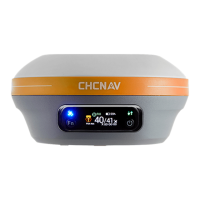
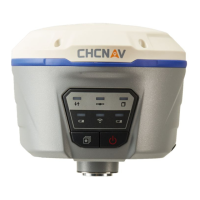
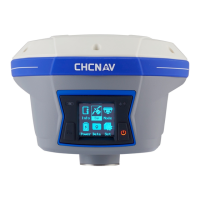
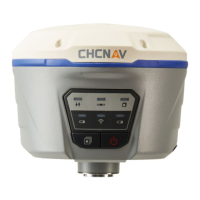
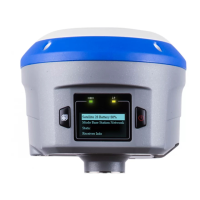
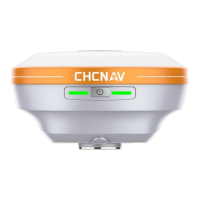
Details the physical components and layout of the E91 GNSS receiver.
Information on the receiver's internal battery and external power options.
Lists the standard accessories included in the base and rover kits.
Instructions for connecting the receiver to a computer for data transfer.
Steps to establish communication between the receiver and a controller.
Procedure for extracting recorded GNSS data from the receiver.
Recommendations for optimal placement and configuration of a base station.
Steps to set up the receiver for transmitting corrections internally.
Steps to set up the receiver for transmitting corrections externally.
Recommendations for optimal placement and configuration of a rover station.
Step-by-step guide for setting up the rover receiver.
Lists the web browsers compatible with the receiver's web interface.
Step-by-step guide to establish a web connection.
Provides a quick review of the receiver's operational status and position information.
Displays detailed position data, DOP values, and satellite tracking status.
Shows current operational status, including battery, storage, and logging status.
Allows viewing the receiver's location on a Google Map.
View satellite tracking details and enable/disable satellite constellations.
Displays detailed status of tracked satellites.
Shows satellite types and SNR for L-band carriers.
Visual representation of satellite positions in the sky.
Options to enable or disable specific satellite systems.
Options to enable or disable tracking of specific GNSS signals.
Access to various settings for receiver configuration.
Displays general receiver and reference station information.
Configure GNSS antenna settings like height and mask.
Configure settings for the receiver acting as a reference station.
Options to reboot, reset to factory defaults, or clear data.
Select the preferred language for the web interface.
Manage user accounts and passwords for the receiver interface.
Switch between USB network and storage modes.
Configure the HCPPP (High-Precision Positioning) range.
Set up and manage static GNSS data logging.
Configure parameters for data logging sessions.
Configure settings for pushing logged data to an FTP server.
View logs related to FTP push operations.
Download recorded data files from the receiver's internal storage.
Detailed configuration options for receiver I/O.
Configure settings for connecting to RTK correction services.
Configure TCP, UDP, and NTRIP client connections.
Configure the receiver to act as a TCP or NTRIP server.
Configure settings for data transmission via the serial port.
Configure settings for data transmission via Bluetooth.
Configure settings for data transmission via the internal radio.
Displays general network information of the receiver.
Configure mobile network settings like GPRS and dialing.
Set up email alerts for specific receiver events.
Configure the HTTP port for web access.
Configure the HTTPS port for secure web access.
Configure user name and password for internal FTP site.
Displays information about Wi-Fi, Bluetooth, and radio modules.
Turn Wi-Fi on/off and configure Wi-Fi settings.
Configure Bluetooth function and PIN number.
Turn radio function on/off and configure radio parameters.
View current firmware version and release time.
Check main board and core board hardware versions.
Download or update the receiver's configuration file.
Download system logs for troubleshooting.
Configure and download user-specific logs.
Load new firmware to the receiver.
Upgrade the GNSS board firmware.
Upgrade the radio module firmware.
Perform firmware upgrades directly from an online server.
Register the receiver with a provided code.
Turn cloud services on/off and configure related settings.
Details the pins and functions of the IO port.
 General
| Type | GNSS Receiver |
|---|---|
| RTK positioning accuracy (Horizontal) | 8 mm + 1 ppm |
| RTK positioning accuracy (Vertical) | 15 mm + 1 ppm |
| Static surveying accuracy (Vertical) | 5 mm + 0.5 ppm |
| Tilt sensor | Yes |
| IMU | Yes |
| eBubble | Yes |
| Waterproof/Dustproof | IP67 |
| GPS | Yes |
| Glonass | Yes |
| BeiDou | Yes |
| Galileo | Yes |
| QZSS | Yes |
| SBAS | L1 |
| Data format | CMR, CMR+ |
| Wi-Fi | 802.11 b/g/n |
| Shock resistance | 2 m drop |
| Communication Interfaces | Bluetooth, Wi-Fi, USB |
| Storage Temperature | -40°C to +70°C |

 To Next Page